spacestr

🔔 This profile hasn't been claimed yet. If this is your Nostr profile, you can claim it.

Edit
BusAndTrainUser (Unofficial)
Member since: 2026-10-16
BusAndTrainUser (Unofficial)
BusAndTrainUser (Unofficial) 59m

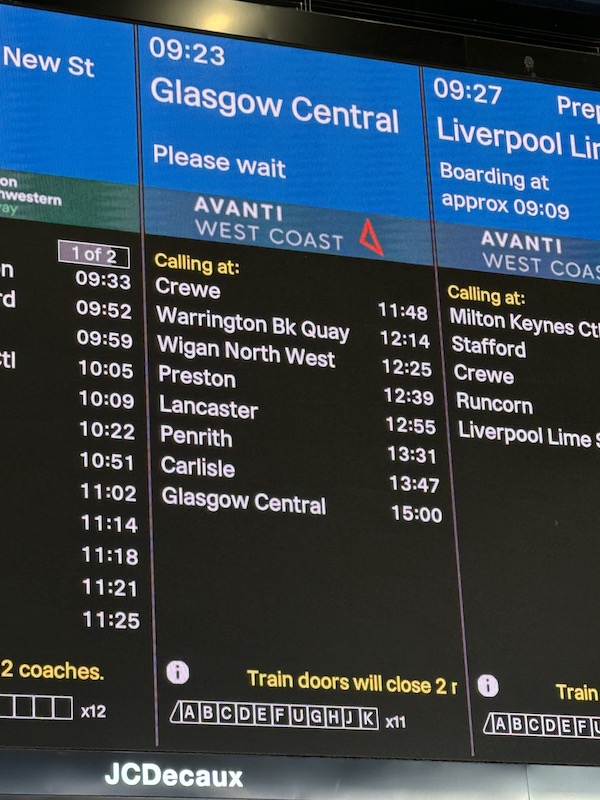
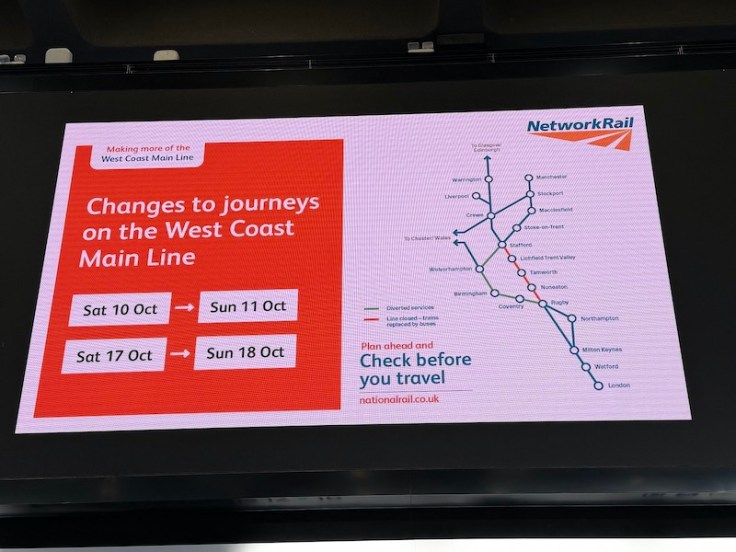
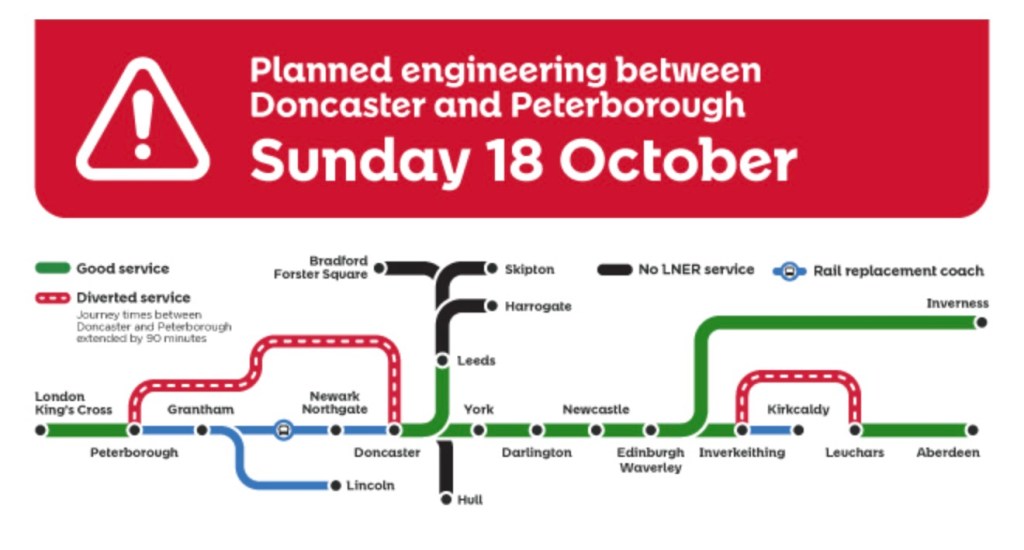
Seen Around Saturday 31st October 2026 Another potpourri of miscellany from the past month’s travels….. Slow going on the main lines You couldn’t travel anywhere on either the West Coast or East Coast Main Lines very quickly on the weekend of 17th/18th October, as I found when travelling from Euston to Warrington on the Saturday and back south from Eaglescliff to King’s Cross on the Sunday. Network Rail’s orange army was obviously hard at work as passengers enjoyed a change of scenery to avoid the closed line between Rugby and Stafford adding an hour to the journey time with trains running via Coventry and Tame Bridge Parkway as well as lines closed between Doncaster and Peterborough with an extra hour to enjoy the delights of travelling through Gainsborough and Lincoln. It all helps to avoid the hassle of rail replacement buses and coaches but it does mean less trains and those that do run being overcrowded, bearing in mind weekends are now a hotbed of leisure travellers as I recently featured in a blog about GWR. Sadly the Midland Main Line doesn’t offer much comfort (literally)as an alternative with five coach trains struggling on just an hourly service between each of Sheffield and Nottingham and St Pancras. Five hours and 37 minutes London to Glasgow Still, it could be worse. And indeed, it is ….. this weekend … when the East Coast Main Line is closed between Doncaster and Darlington with rail replacement road vehicles. I know the tracks have to be maintained and the work has to be done, but these line closures must do great damage to the otherwise booming market for weekend leisure travel by train as captured in the above photo showing passengers alighting from an inbound train at Euston on Saturday 17th October. New Information booth opens at Euston While patiently waiting on Euston’s busy concourse I noticed another improvement recently introduced in the form of a combined Avanti West Coast/London Northwestern Railway information counter has been introduced. This is much better than the previous arrangement of two separate mini-type desks each operator had in separate parts of the concourse. There are also new Information Screens available… … but, as always, I find them all a bit too OTT in what they’re trying to do… … and far better to speak to a human being. Happy 90th to the OS NWYB I was heading up to Warrington to join members of the Omnibus Society marking the 90th Anniversary of the formation of its North Western & Yorkshire Branch and it was a delight to meet everyone there as well as give a presentation in the afternoon to members who’d also enjoyed the hospitality of Ben Wakerley and his team at Warrington’s Own Buses depot in the town in the morning and later also hearing interesting presentations from OS President David Lee-Kong and Giles Fearnley. And while congratulating those celebrating anniversaries, take a bow, Reading Buses for its recent 125th Anniversary display in Broad Street, Reading and thanks to Richard Windley for sending me some photos (above and below) which he took of the event which looked to be enjoyed by many local people as well as enthusiasts. Thirdly, many congratulations to Philp Ayers and the team at Cuckmere Buses for marking its 50th Anniversary last week with a celebratory dinner in Alfriston which sadly, I was unable to make but was very grateful for the invitation. It’s a fantastic achievement to reach the Golden milestone for a community run bus company. Crawley’s new look bus station Work has begun to enhance and improve the bus station alongside Crawleys’ County Mall shopping centre. The plan is to create a central island on which passengers will wait with buses using stops on both sides ‘saw tooth’ style. Passing through recently I was able to see the impact of the recently commenced works which are due to continue until 2028. So far it’s the north side by the entrance to the shopping centre which has closed, of what had been a two-way bus station with an impenetrable barrier down the middle, with buses temporarily dispersed to adjacent roads. Passengers seem to have adapted well to these temporary arrangements and plans showing how the new layout will eventually look are available on Crawley Borough Council’s website. Looking forward to seeing the completed project in due course. Hereford’s Hub is nearly there Passing through Hereford a couple of weeks ago I was able to see the fevered activity to complete the city’s new Transport Hub alongside the railway station which will replace what has been known as the ‘County Bus Station’ located in Commercial Road. The new arrangement includes an L shaped covered waiting area for passengers with buses using drive on and drive off stands on one side and on-street stands on the other, The artists impression (above) shows how buses will be further away than both taxis and the drop off/pick up area compared to the currently located bus stop right outside the station… … which is a shame, but it looks like there’ll be plenty of trees and greenery to make for pleasant public realm, as they say,… … on what was otherwise a rather barren area. And it was the case that some buses departed from exposed bus shelters much further away from the station… …pedestrian exit/entrance. It does look like the facilities will be better than previously available both at the railway station… … and the old bus station on Commercial Road albeit the latter was closer to the city centre. Hopefully there’ll be enough space and stands for buses in the new ‘Hub” too. Bluewater’s real time bus information is due in ….. Meanwhile, over in Bluewater, the lack of information to advise passengers where to catch a bus has been commented on in previous blogs, but on my latest visit earlier this month I saw even the real time departure sign doesn’t show when the delayed provision of real time information is due. Although, to be fair, another sign is working albeit your departure must be within the next eight buses to leave otherwise you won’t know when it leaves – and sadly there’s no stand number information displayed for each entry. However, I did notice work is now well underway on reopening the hidden tunnel behind the trees in the above photo which will make a direct connection to the busway through Castle Hill saving a bit of time and bus miles for FastTrack B and C buses heading to and from Ebbsfleet. I’ve shown the above image of the disused tunnel from the area’s quarrying days in a previous blog as well as the plan (below) indicating where the new bus only road will link into the bus station. It’s now becoming a reality. Eaglescliffe transformation Something else that’s a reality is the recently completed works at Eaglescliffe station where the £14.5 million transformative project completed in July including the opening of a new footbridge (with lifts) which at 56 metres now provides for step free access and exit to the west of the station… … as well as a new building on the island platform… … containing a waiting room… … and ticket office through the gap in the wall beyond that … … which, impressively, was staffed and open when I passed through on Sunday before last… … something the old office on the now closed footbridge never was. So that’s a welcome improvement, and good to see, and I guess the old footbridge and waiting room (photographed below) will be demolished at some point. The station is managed by Northern Trains working in partnership with Grand Central which I see has not been shy at getting its name displayed in a prominent position in the waiting area. …even though its the minority operator compared to DfTO run Northern and TransPennine Express. Like Heckmondwicke’s new bus station the toilet provision is only an accessible one, although in this case it’s good to see passengers are asked to leave the door open when leaving so those without a RADAR key can enjoy access. It’s alongside a baby changing room which is RADAR key restricted – I didn’t know parents of babies needed a key for such access. Over at the new western entrance/exit there’s a car park… … and a bus shelter, although at the moment no buses call here and it’s advertised as a pick up and drop off stop. It was a shame to see one of the new lifts out of service on the day I visited. … but otherwise some lovely new facilities and I’m sure the western entrance/exit will get busier as the area to the west is developed with a 54-acre industrial and logistics development planned for the area adjacent to the Durham Lane Industrial Park as well as new housing nearby. Darlington’s unfinished staircase Meanwhile back at the £140 million transformation of Darlington’s railway station and its new eastern entrance/exit and platforms 5 and 6, I noticed how the long flight of stairs (in four sections) down to the new island platform looked decidedly unfinished when I passed through again recently… … and also how annoying that the new layout means five coach Azuma trains have to come to a stop at the very southernly point of the new platform 5 which is as far away from the lift and stairs bringing passengers down to platform level (at the northern end) as you can get. I’ve mentioned this in a previous blog about stations at Grantham and Doncaster and commentators explained it’s to do with the positioning of a signal but I would have thought a brand new platform would have been built with the facilities such that trains don’t have to go furthest away from where passengers access the platform. Customer centric? Not this. Another LNER ticket buying oddity And while on the subject of LNER, I was returning home from Peterborough earlier this month having travelled on route 26 and at 11:50 called at the ticket office to buy a Super Off-Peak Single back to Hassocks at a cost of £31.50. I was intending to catch the 12:05 LNER departure to Hassocks via King’s Cross/St Pancras. The ticket office member of staff sold me an Advance Single for £30 for the journey including a connecting Thameslink service in London (from St Pancras). As that was my intended journey anyway, I accept the saving of £1.50 and bought the ticket which came with a reservation in seat A52. Except that seat was shown as ‘Available’ when I boarded the train (not surprising to see it not updated) but my point is, why complicate things for passengers with seat reservations for such journeys? Just sell me a flexible ticket for any journey (not morning peak) and don’t bother with a seat reservation for a journey of this kind as the system doesn’t for the Thameslink part of the journey. An unnecessary complication which doesn’t work out anyway. St Pancras lifts and escalators update. Work is continuing on the programme to replace the lifts and escalators at St Pancras and I noticed recently a completely new temporary structure has been installed to take passengers to platforms 11-13 used by Southeastern High Speed trains. I guess it was a step too far to expect passengers to use the stairs or escalator with heavy luggage while the work continues, as happens to access platforms A and B for Thameslink where similar work is in hand but the distance is smaller. Something to look forward to next year has just been announced and that’s a full closure of City Thameslink station for eight months to enable all the station’s ageing escalators to be replaced. Musical chairs in Truro Bus Station I was in Truro’s busy bus station on a Saturday afternoon at the beginning of the month and obviously the waiting room was closed but peering through the door I couldn’t help smiling at the line of seats down the middle which were laid out exactly as I remember as a child playing musical chairs at friends’ parties. Delay Repay update I’m delighted to advise within hours of last month’s update highlighting GWR’s refusal to pay the refund due for the delay I encountered returning from Bath on 22nd August being published in September’s Seen Around I received an email confirming the Delay Repay had been approved and a full refund of £60.60 was on its way. The only outstanding claim I currently have, therefore, is the delay encountered on 7th September involving a Cross Country train from Birmingham to Cheltenham … but an eight week delay in dealing with delay repay is pretty average for Cross Country so I continue to patiently wait. Lewes launch for All Change! It was great to attend the Lewes History Society’s launch of the just published book “All Change! Lewes Bus Station” and meet authors Ruth and Neil Thomson who gave a great presentation to around 150 people relating how they sourced all the material for the book as well as a history of the bus station itself. It was encouraging to see so much interest in the subject. Don’t mention the price And finally for this month’s round up I spotted the above full page advert in The Guardian newspaper during the month promoting First Class travel on the famous 07:00 Manchester to Euston journey (the one the ORR was insisting should be withdrawn until it was pointed out it would have to run out of service to get the crew and train to London). It seemed a bit over the top to take out a full page advert in a national newspaper promoting just one journey. And I noticed there was no mention of the £290 (single) fare. (£193 if you slum it in Standard Class.) More miscellany at the end of November. Roger French Blogging timetable: 06:00 TThS https://busandtrainuser.com/2026/10/31/seen-around-49/ #coastmain #mainlines #eastcoast #october #line #euston #saturday #warrington #midlandmain #rail #rss #feeds #linksharing #qwibbit
#coastmain #mainlines #eastcoast #october #line
BusAndTrainUser (Unofficial)
BusAndTrainUser (Unofficial) 2d

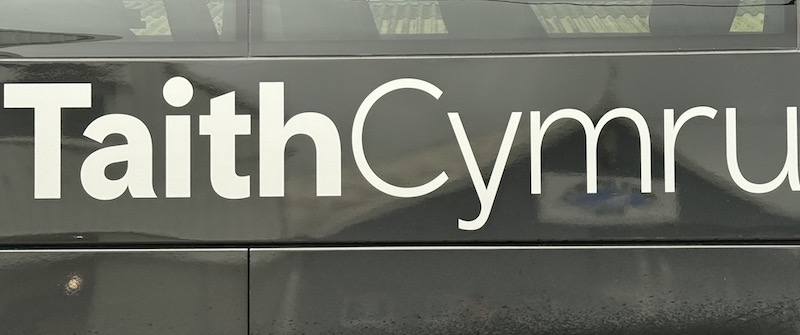
TaithCymru connects north and south Thursday 29th October 2026 After the Mayor of London finally got his pedestrianised Oxford Street ‘dream come true’ (see Tuesday’s blog) there’s been another ‘dream come true’ this week and that’s for the new ruling Plaid Cymru politicians in Wales desirous of a long held ambition for a faster public transport service linking north and south across the country. The new TaithCymru branded express coach route launched on Sunday links Bangor and Carmarthen via Caernarfon, Portmadog, Dolgellau, Machynlleth, Aberystwyth and Aberaeron. And if many of those towns sound familiar to north-south travellers, it’s because they’re all also on the long standing TrawsCymru network, in particular routes T2 (Bangor to Aberystwyth) and T1 (Aberystwyth to Carmarthen). But whereas a journey on the T2 and T1 takes just under four hours on the former (Bangor to Aberystwyth) and just under two and a half hours on the latter (Aberystwyth to Camarthen) making for a gruelling six and a half hours all told (assuming a very short break with a good connection in Aberystwyth), TaithCymru coaches are achieving a shorter five hours end to end journey time together with offering much better comfort for passengers and the all important toilet on board. As you can see from the timetable below, the service has kicked off on a two-hourly frequency with an extensive span of day across seven days a week from 05:20 to 01:07 as well as an evening journey extended to the ferry terminal at Holyhead with a return journey departing at 00:42 operating through the night with an arrival into Carmarthen at 06:20. The service is operated by Edwards Coaches and Llew Jones, (I’m assuming) each providing three of the brand new Volvo B8R MCV EvoTor coaches owned and supplied by Transport for Wales for the service. Rather than the bright red, grey and white patriotic style colours of TrawsCymru, TaithCymru coaches adorn a more funeralistic black with white lettering and a large green ‘T’ symbol. Tickets for the new service, which must be purchased at least 15 minutes in advance of travel, are booked online on a dedicated website using the same software as a number of coach companies, such as ember. The introductory single fare from Bangor to Carmarthen is £10, which I understand will increase to £14 in due course, while cheaper fares for intermediate journeys, for example, Bangor to Aberystwyth is £7 and Aberystwyth to Carmarthen, £4.50 are currently available. I gave the service a try out on Tuesday and Wednesday, breaking my journey in Aberystwyth to get as much travel in the light as possible. I caught the 15:18 from Bangor railway station. It’s one of the journeys operated by Edwards Coaches, the coach having left Carmarthen at 09:15 and arriving in Bangor at 14:15 giving the driver (who’d taken over in Aberystwyth) a break of just over an hour. The coach arrived from that journey with one passenger alighting before the driver headed off for his break. TfW had installed both a large size ‘spreadsheet style’ TaithCymru timetable in the poster frame at the bottom of the stairs from the station footbridge at Bangor… … as well as a smaller version in the bus stop panel. Sadly there doesn’t seem to be a printed timetable leaflet for passengers so in the station ticket office there was a display of TrawsCymru printed timetables (for the T2/T28, T10 and T22) but nothing for TaithCymru which seems like a wasted opportunity. The coach reappeared 50 minutes later ready for the 15:18 departure with three passengers boarding, two of whom were, like me, trying the service out of interest, travelling all the way through to Carmarthen. We departed spot on time at 15:18 for the 24 minute non-stop run to Caernarfon, the first of just seven bus stops on the 132 mile route until reaching Carmarthen five hours later. Caernarfon is a pick up only bus stop (set down only on Bangor bound journeys) presumably to ensure the coach doesn’t get crowded out with local passengers nor abstract from Arriva’s 20 minute frequency route 5C taking 37 minutes (There’s also a two-hourly TrawsCymru T2 taking 32 minutes which has no pick up/set down restrictions). Bearing in mind Caernarfon is a well known gap in the rail network (and franchising will soon take over the 5C) I’m surprised TfW hasn’t grasped the nettle and integrated TaithCymru with through ticketing and advertised connections with trains. Indeed, the T2 appears on departure listings from Bangor to Aberystwyth (and the T10 to Corwen) so why not TaithCymru? Despite slow moving traffic leaving Bangor, we arrived into Caernarfon on time at 1542 with no passengers to board so it was straight on to the next stop, 38 minutes later, in Porthmadog. But there was a treat in store as we left the bus station with the route passing the castle… … and the Welsh Highland Railway station. We arrived into Porthmadog four minutes early at 16:16 so waited until the scheduled departure of 16:20 with no passengers booked to travel. Next up was Dolgellau 44 minutes later at 17:04 where the coach stops in a car park away from the bustling town centre’s Eldon Square where TrawsCymru routes converge and provide interchange. Again, no passengers for us so after a couple of minutes pause we were on our way again to Machynlleth which we passed through a couple of minutes down at 17:42. By now the light had faded completely but before that the scenery through Snowdonia is as spectacular as ever and makes for a wonderfully scenic journey. I can’t do justice to it with a mobile phone camera pointing through a coach window travelling at speed… … but here are three photographs just to give a taste of what’s on offer. After Machynlleth it’s on to Aberystwyth passing the university (an advertised stop) on the way to the town centre.. … arriving into the bus station, conveniently located next to the railway station, seven minutes early at 18:16. There’s 13 minutes stand time scheduled at Aberystwyth and as I alighted, there was a also change of driver with the other three passengers on board since Bangor continuing their journey south. Aberystwyth is the southern terminus of the T2 from Bangor on which some journeys are now operated by Lloyds Coaches Wright StreetDeck Ultroliner double decks interworked with the T28 to/from Machynlleth as well as being the northern terminus of the T1 from Carmarthen with Yutong E12 battery electric buses. It’s also the northern terminus of the T5 from Haverfordwest… … making for quite a TrawsCymru interchange hub and an impressive display of newish vehicles. It’s a shame the poor upkeep of the bus shelters lets the whole image down… …there wasn’t even a timetable for the new TaithCymru service on display although the shelters where it departs from did have a logo. As in Bangor, train departure apps haven’t yet caught up with Taith Cymru’s introduction showing the slower (but more frequent – hourly – departures) on the T1 for Carmarthen and the slower T2 to Bangor. Google maps hasn’t yet caught up with its introduction either. I was back in the bus station yesterday (Wednesday) morning to compete the journey south to Carmarthen intending to catch the 08:36 departure which was due into the bus station at 08:23, having left Bangor at 05:20. And by a scheduling coincidence it was the same Edwards Coaches vehicle in which I’d travelled on Tuesday too, it having been down to Carmarthen after I left it on Tuesday evening and then an evening journey back to Bangor, arriving there at 02:15, before a three hour break. You can see how TfW has thrown a lot at this service in its initial phase with intensive use of the six coaches and a considerable driver resource commitment from both Edwards Coaches and Llew Jones. The Edwards Coaches’ driver who took over the coach in Aberystwyth was telling me he was based at the company’s Swansea depot and had driven up to Aberystwyth in his car that morning to take the coach down to Carmarthen and then back to Aberystwyth after which he would return to Swansea in his car. Such arrangements must be very costly. The coach arrived a little behind schedule at 08:35 displaying ‘Not in Service’ but it turned out the new driver bringing it in hadn’t yet mastered the electronic blind display and had driven in service from Bangor with one passenger on board who was travelling from Porthmadog to Carmarthen, a journey previously entailing a change in Aberystwyth and taking much longer. The relieving driver sorted out the destination blind and we left six minutes late at 08:42 with just myself and the passenger from Porthmadog on board which remained the case all the way to Carmarthen. Frustratingly, progress on the 35 minute journey to Aberaeron was slow due to a lorry doing no more than 30 mph for miles and miles. Luckily he eventually pulled over to let us, and a steam of traffic behind us, go past. However thanks to generous timings we passed through Aberaeron only five minutes down at 09:16. Although the scenery on this southern part of the journey is slightly less dramatic nevertheless there are some attractive vistas especially along the coast near Aberaeron. After that, the route’s trajectory for the final 69 miniutes of the journey is inland towards our final stop at Carmarthen. Again, as evidence of the generous journey time allowances on the service, despite a steady driving pace, we arrived into Carmarthen railway station at 10:11, nine minutes ahead of schedule. I reckon you could shave 30 minutes off the overall end-to-end journey time which, if turnaround times at each terminus were also cut down from the current hour to 30 minutes, could result in a saving of one coach with associated driver costs. Like Bangor, Carmarthen station had a display of T1/T1C timetable leaflets but nothing for TaithCymru although again it was good to see printed timetables displayed both large… … and small size. However, again, like in Aberystwyth the image is let down by poor presentation in the bus shelter… … and the TrawsCymru promotional poster on the outside could usefully be updated with something to promote TaithCymru. I’d got quite excited on boarding the coach in Aberystwyth and spotted some printed leaflets on card (thinking they might be timetables) but they were a child Activity Pack… … including puzzles, a pop out model coach to make and a joke (Q: Why did the coach stop? A: It saw a zebra crossing!). Which seemed a strange thing to print and distribute in preference to a timetable promoting the service itself. It would also be good to see some attention given to the roadside infrastructure, not least a lack of seating at the terminal points in Bangor and Carmarthen… …with bench type seats in both Carmarthen (above) and Aberystwyth’s shelters not particularly comfortable compared to improved arrangements many transport authorities have now invested in to provide quality infrastructure. TaithCymru is an ambitious and costly investment for TfW but with good promotion and proper integration with both TrawsCymru and the rail network there’s no doubt there’s a significant market for north-south travel across Wales to be tapped into with rail options non existent and buses tortuously slow. Restricting ticket sales to only advance purchase online is a bit unfortunate although companies like ember and FlixBus have successfully adopted such arrangements in their business model. It’s also noteworthy in both Bangor and Carmarthen the terminal point is the railway station rather than the bus station which would indicate the need for much better integration with rail. Arrival and departure times don’t seem particularly helpful for interchange, for example my coach was scheduled to arrive into Carmarthen at 10:20 with a Swansea and Cardiff bound TfW train departing at 10:24 making for a tight connection, albeit the coach arrived nine minutes early, as described. The next departure for Swansea is not for an hour. However it is tricky as train departures do vary from one hour to another. It’s a bit better at Bangor between trains from Chester arriving and departing TaithCymru coaches, albeit some connections are a little tight. Connection times with the night ferries at Holyhead are also very odd with the TaithCymru coach arriving at the ferry terminal at 23:00 and departing at 00:42 with ferries arriving from Dublin at 23:15 (90 minutes before the coach leaves) and 02:00 (after the coach has left) and departing at 22:15 (before the coach arrives) and 01:30 (two and a half hours after the coach arrives). I’m not sure who those extended journeys to Holyhead are aimed at, as they don’t really work for those ferry times. Concessions have been excluded from TaithCymru which is the right approach for an express service of this kind and I’m sure passengers will be prepared to pay a good value fare rather than expect a free ride for the benefit of much improved journey times. I’m not surprised numbers travelling in these first few days are very few in number but the market for north/south travel across Wales is definitely there. It will, however, need strong sustained promotion to attract it and improved waiting facilities in the towns served. Roger French Blogging timetable: 06:00 TThS https://busandtrainuser.com/2026/10/29/taithcymru-connects-north-and-south/ #aberystwyth #bangor #carmarthen #coaches #edwardscoaches #oxfordstreet #plaidcymru #south #wales #llewjones #rss #feeds #linksharing #qwibbit

#aberystwyth #bangor #carmarthen #coaches #edwardscoaches
BusAndTrainUser (Unofficial)
BusAndTrainUser (Unofficial) 4d

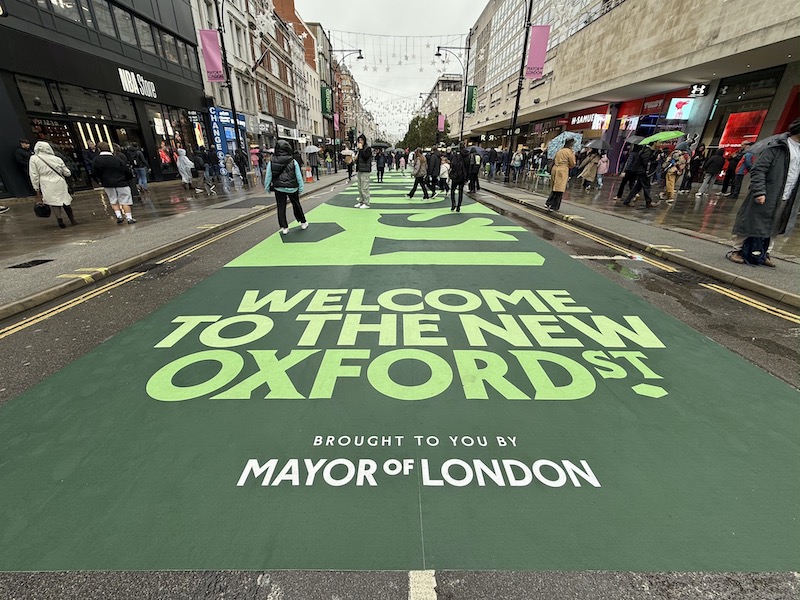
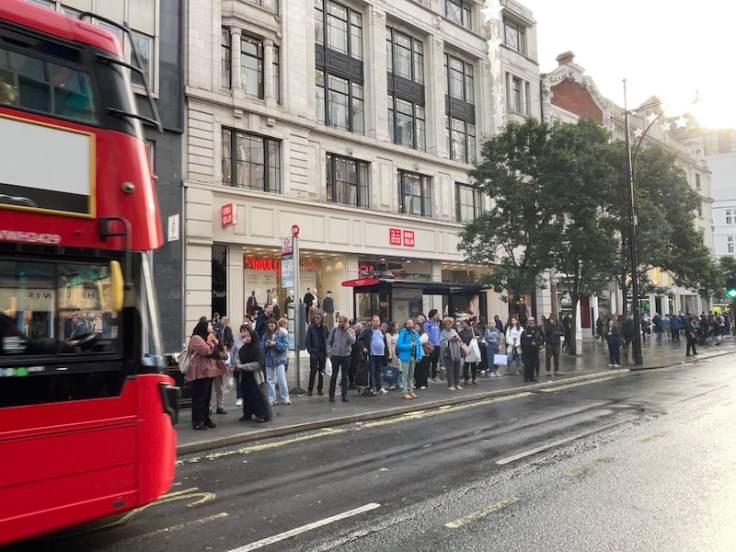
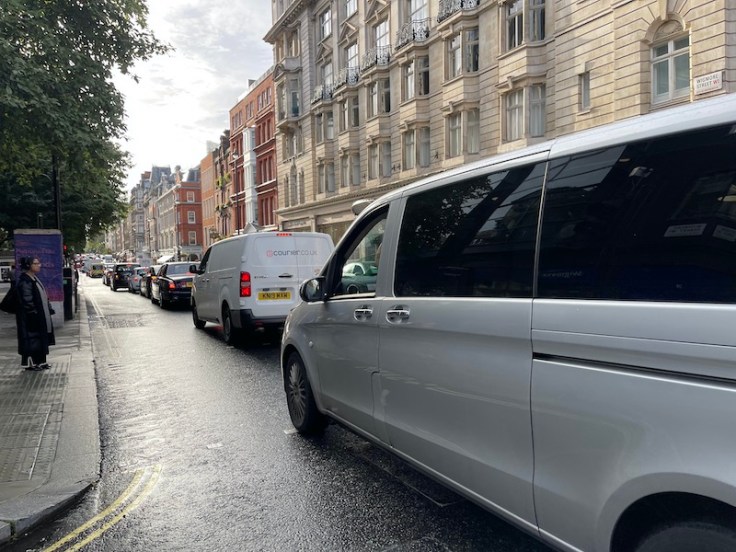
How to ruin five more central London bus routes Tuesday 27th October 2026 It’s finally happened. After years of controversy with Westminster Council and others objecting, Mayor Kahn’s vision for a traffic free Oxford Street, first launched in his 2016 manifesto, finally got under way yesterday when the 900 yard middle section, between Great Portland Street and Selfridges, of the 1.2 mile long road was pedestrianised with not even cycles allowed to use the road. I blogged about this proposal two years ago expressing concern at the impact on passengers using the busy bus stops served by the five TfL routes still using the street – routes 7, 94, 98, 139 and 390. I pointed out the proposed alternative routing via Wigmore Street, Henrietta Place and Cavendish Place is very congested… Wigmore Street in 2024 … inevitably delaying buses and increasing journey times thereby making them even less attractive than they already are in central London. TfL has mitigated that problem by simply cutting back two of the routes completely – the 7 (from East Acton) and 94 (from Acton Green), which previously ran from the Marble Arch/Selfridges end to terminate at Oxford Circus (7) or continued via Regent Street to Piccadilly Circus (94) – both now terminate at Marble Arch. As you can see from Mike Harris’s updated map below, passengers for route 7 now face a lengthy walk from/to Oxford Circus to/from the bottom of Edgware Road (the other side of Marvle Arch) making for a very unattractive proposition. Map courtesy of Mike Harris’s Greater London Bus Map which has just been updated Having ditched the 7 and 94, that just leaves routes 98 (Willesden to Holborn), 139 (Golders Green to Waterloo) and 390 (Victoria to Archway) as the only three left from a road once served in its heyday by a dozen busy bus routes (eg 60 years ago, as a bus travelling teenager, I remember you could catch a bus on routes 6, 7, 8, 12, 13, 15, 23, 60, 73, 88, 113 and 137 along the road. How the mighty have fallen. London Transport’s Central Buses map dated 1966 I took a look at the new arrangements on their first day, yesterday, to see how things were going. It wasn’t good. Approaching the eastern end of the closure by Great Portland Street where all traffic now turns right. In fact it was awful. I won’t be returning any time soon, especially if it involves travelling on routes 98, 139 or 390. The western end of the closure where all traffic turns left into Orchard Street. PR type people were taking photographs of the new ‘green carpet’ laid at the eastern end but, meanwhile, there were chaotic scenes in neighbouring roads as buses struggled to get through. The pre-pedestrianised scheduled journey time between Oxford Street/Great Portland Street (just east of Oxford Circus Underground Station) and Selfridges was an average of six to seven minutes. From yesterday that scheduled journey time has inevitably increased to an optimistic 10-11minutes. The reality yesterday morning on the three journeys I made in both directions was, ignoring an outlier, an average of 16 minutes (giving an average speed of 1.92 mph to cover what was a distance of 900 yards). The outlier took 25 minutes mainly because over five minutes was spent stationary with the road ahead blocked as a bus was having difficulty negotiating the turn into Great Portland Street at the eastern end’s closure point where all traffic turns into and from that street. It’s not an easy turn especially if traffic from Oxford Street over shoots the traffic lights and then finds the way ahead blocked which I guess is what happened. Having turned the corner into Great Portland Street, the next problem is negotiating buses now taking their stand time at one of the many bus stands which have been repositioned and are now dotted around the area adding to the restricted road widths available for passing traffic. In addition to there just being too much traffic, another big problem is the number of vans parked on double yellow lines (and even in bays marked as bus stands) doing deliveries and pick ups as well as scaffolding contractors and other impediments including roadwork compounds. Delivery vans and lorries were everywhere, even parked right bang in front of traffic lights with no thought seemingly given to their impact on passing traffic while deliveries are being made. I would have expected some high profile enforcement of parking restrictions, especially on the first morning of the Mayor’s prized scheme. on what are now key thoroughfare roads, but instead, the endemic attitude to parking anywhere was bordering on anarchy… … with buses and other traffic having to struggle through the blockages. I felt sorry for the bus drivers but I suppose they’re used to such chaotic scenes in central London and just take it in their stride. Meanwhile, in Oxford Street itself, there were no end of high viz wearing workers attending to the now defunct junctions and make them pedestrian friendly… … as well as every bus stop no longer being served along the newly pedestrianised section having the benefit of pink tabard wearing agency staff for TfL to help any bewildered passengers wondering how far (and where) they’ve got to walk to catch a bus. Bus stops (and some shelters) sported the usual TfL yellow notices in the timetable panels with a rather confusing map and lots of detail about which lettered bus stops are where. On board the buses I noticed inconsistencies with what information is available on the, now legally required, next stop announcements/displays. Some were working… … others weren’t – which is a poor show considering how long this scheme has been in the planning. What I hadn’t envisaged, but now I think about it, it’s obvious (for anti-terror attack reasons), is that each of the junctions where north/south traffic crosses the east/west pedestrianised Oxford Street, there are now elaborate temporary barriers and bollards in place… …both in the road and on the pavements – which has the effect of impeding pedestrian flow making it worse than previously. These bollards looked very much an interim arrangement and I wonder what the permanent solution will be bearing in mind the road is open during the night? Having relayed all the above negativity about the impact on bus routes I should balance this by saying, notwithstanding that, I’m sure the pedestrianisation will be a success for retailers, shoppers and tourists wanting to enjoy a more peaceful ambiance in Oxford Street itself rather than overcrowded pavements struggling to cope. There’s no doubt retailers like Selfridges and John Lewis will be pleased, especially in the run up to Christmas. Once the ‘public realm’ is enhanced it will become a very pleasant and attractive area and it won’t be long before it would be unthinkable to return to having buses, taxis, cycles and the annoying ripoff rickshaws in Oxford Street. For example, no-one would dream of proposing Reading’s Broad Street or Bromley’s High Street return to having motor traffic. But, and it’s a big BUT, it does depend on having a viable alternative arrangement for displaced buses. And in this case it doesn’t, unless there’s a serious crackdown on parking, both legitimate and illegal, on the neighbouring streets now used by buses. There again, the Mayor and TfL have long given up on its central London bus network so I guess they won’t be worried about ruining five more bus routes, as this scheme has done. Big time. Roger French Blogging timetable: 06:00 TThS https://busandtrainuser.com/2026/10/27/how-to-ruin-five-more-central-london-bus-routes/ #street #londonbus #portlandstreet #oxfordcircus #centrallondon #wigmorestreet #greatportland #busroutes #marblearch #mikeharris #rss #feeds #linksharing #qwibbit

#street #londonbus #portlandstreet #oxfordcircus #centrallondon
BusAndTrainUser (Unofficial)
BusAndTrainUser (Unofficial) 5d

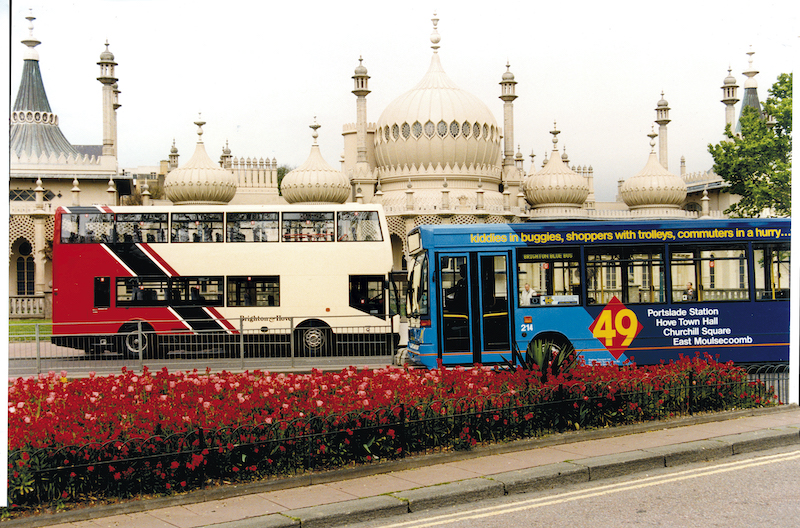
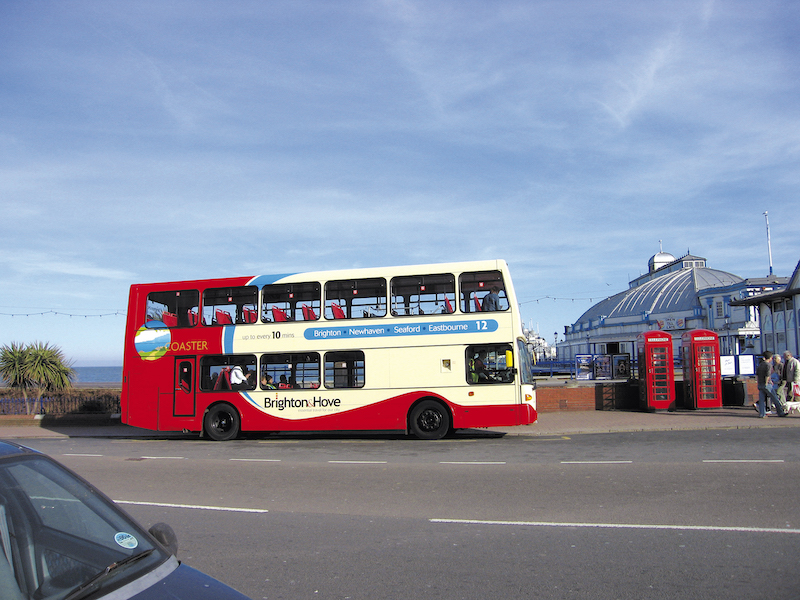
Marking 40 years of deregulated buses Sunday 25th October 2026 To mark tomorrow’s 40th Anniversary of bus deregulation here’s an article I wrote earlier this year for the Omnibus Magazine (the bi-monthly magazine of the Omnibus Society) explaining why deregulation worked so well in Brighton and Hove as well as a number of other British towns and cities. It perhaps also explains why deregulation manifestly didn’t work in other places most of which are now first in the queue for implementing the now available alternative of politically led and publicly controlled ‘franchising’, thanks to previously unheard of generous funding from Government. Bus deregulation is a bit like Brexit. It has divided opinions in a very binary way. You either believed sweeping away 50 years of regulation released pent up innovation and potential for growth or subscribe to the idea such freedoms heralded an unwelcome era of privatised ‘bus bandits’ making unjustified profits with little interest in the needs of passengers. Opinions became ever more entrenched as the decades have passed with the famous generalised comparison usually cited of consistent growth in regulated London from the early 2000s alongside year after year of mileage cuts and withdrawn services across Britain outside of the Capital. Of course, as always, the truth lies somewhere in between those two extreme characterisations and the choice between regulation and deregulation is not binary at all. As has been seen in many exemplar areas, where local authorities and motivated managers, at locally based and locally controlled bus companies, work together towards a common objective of growth, then you can achieve a virtuous circle of consistent investment in bus improvements and increasing numbers of passengers. It’s easy to forget, and indeed many involved in the industry today are too young to have had direct experience of regulation, just how stifling the pre 1986 regime was for those wanting to provide the best possible service for passengers with potential for growth. Some changes of emphasis were made in the 1980 Act but there was little incentive to improve frequencies or try out new bus routes as incumbent operators as well as British Rail and other bodies had a statutory right to object, as they usually did, and the onus was on the licence applicant to prove the desired improvement would not have a detrimental impact through any abstraction from existing services. In today’s contactless, ‘tap and cap’ digital ticketing world, complete with political inspired fare capping by the Prime Minister, it seems impossible to think that in those pre deregulated days every change to every individual fare and ticket price had to be applied for and justified in a bureaucratic Traffic Court hearing in front of a Traffic Commissioner. The loss of passengers in the 1960s and especially the 1970s and early 1980s became unsustainable. As a new fresh faced entrant into the industry in the early 1970s I recall thinking if the annual decline in passengers continued unabated during a career I hoped would span the next 40 or so years then it was touch and go whether there’d be any passengers left by the time I retired. Something had to be done. The old regulated regime may have worked in the 1930s and through to the early 1960s but growth in car ownership as well as changing retail, leisure and social habits meant it was no longer appropriate for the 1980s. Directors at the National Bus Company had recognised this with its subsidiaries embarking on the Market Analysis Project in the early 1980s to identify viable networks which local authorities could supplement with additional financial support to fund extra services. This was enacted alongside reorganisations of the companies whereby mergers of the 1970s to create larger subsidiaries to save overheads were reversed and instead new smaller units led by enthusiastic locally based managers in tune with the local market began trading. Midland Red, Western National, Bristol Omnibus, Hants & Dorset, East Kent/Maidstone & District were just some of the companies split up as well as Southdown where I’d been appointed Assistant Traffic Manager in 1982. By 1985, when we recreated an autonomous Brighton & Hove operation within Southdown, it had become obvious the Conservative Government’s intention was not only to deregulate the industry but privatise the state owned companies in small units to encourage competition, so it was decided to formally split Southdown into two operating and one engineering company, one of which was the Brighton & Hove Bus and Coach Company which I had the privilege to lead initially as General Manager. Those early years were an exciting time to be involved in the industry. Establishing a ‘new’ bus company (it was actually a resurrection of the dormant Brighton, Hove & District company which had merged into Southdown on NBC’s formation) was a tremendous opportunity to bring in a new approach to providing great customer service as well as enhance staff relations while the upcoming need to register a commercial bus network to commence on Deregulation Day on 26th October 1986 (the date is etched in my memory) enabled us to look afresh at which bus routes had the potential to grow and those which were never going to be financial winners. In the regulated world, frequencies of the former routes would be consistently cut to release resources to keep less remunerative routes afloat. The old principle of cross subsidy between routes was alive and well but it had the impact of making the best routes, with the most potential, increasingly unattractive and the routes with no potential struggled on. No wonder passenger numbers fell every year. The new approach saw us reverse this trend and improve frequencies of those routes with potential and let the local authorities take on the financial liability of the poorly used routes by inviting tenders for their continued operation. Looking back now it’s testament to the skills of my colleagues who oversaw network development, that those routes we registered as the first commercial network in 1986 are still the ones that are successfully growing forty years later with frequency uplifts and regular intakes of new buses ensuring a high profile operation to attract more and more passengers. We’d had the benefit in Brighton and Hove of working alongside the municipally owned company, Brighton Borough Transport, in a coordinated urban network under the Brighton Area Transport Services Agreement (BATS) for many years so once deregulation came along, it was no surprise that as managers who knew and trusted each other, we both tended to stick to operating the routes we knew well rather than start wasteful competition between us, which I’m sure the competition authorities would have liked to have seen. However that didn’t mean we didn’t experience competition in the area with new operators attempting to gain market share from time to time including one particular onslaught along the coast road between Newhaven and Brighton which after various iterations and ownership changes even led to competitive cross city routes for a time. But these interlopers had their work cut out simply because of the market share we’d built up with an emphasis on encouraging passengers to buy what we used to call ‘off-bus’ tickets. This became all the more pertinent when the Go-Ahead Group (which had purchased Brighton & Hove from the management buy-out team in 1993) also purchased Brighton Buses (as Brighton Borough Transport had become through its own employee buy-out) in 1997 and merged it with Brighton & Hove to form one all encompassing bus company for the conurbation. That same year East Sussex County Council was reorganised along with Brighton Borough and Hove Borough Councils to form a new Unitary Authority for Brighton & Hove which quickly established its desire to encourage residents and visitors to the area to use public transport with active restraint on car use through substantial parking charges and rigorously enforced on-street parking management and control which, when effective, can be just as good as a congestion charge. With Go-Ahead’s philosophy of backing its locally based managers and leaving them to get on with the job of developing the local market for buses we soon saw consistent growth in passenger numbers as frequencies of those same core routes improved alongside annual investment in new buses, attractive ticket deals (including in the early 2000s a simple to understand flat £1 fare in the city) with high profile and locally based marketing campaigns as the council introduced a network of bus lanes and priority measures and jointly funded, with the bus company, a real time information system, which being first in the field, revolutionised the way passengers travelled. By the early 2000s the network was 95% commercial with a consequent significant reduction in public funding compared to the early 1980s, yet passengers enjoyed a more intensive and attractive level of service including night bus routes. None of the foregoing would have been possible under the old regulated regime. The idea the so called prized regulated regime in London would consistently see reductions in passenger numbers year on year (as it has for over a decade) alongside (Covid pandemic aside) consistent growth in passengers in areas such as Brighton & Hove seems to be unthinkable to critics of deregulation. Yet that is the situation, and what a difference looking back to those worrying days when I joined the industry in the 1970s to realise that far from there being no passengers left, by the time I retired in 2013 we had successfully doubled the number of passengers since the mid 1990s giving the city the highest bus use per capita outside of London. And it’s thanks to deregulation. Roger French PS Apologies to email subscribers and online viewers earlier on Saturday morning for all the typing errors in yesterday’s blog – somehow the first draft slipped through into publication without any proofreading. My thanks to all who let me know of errors they’d spotted especially my good friend Tony who spotted 24 of the 30 typos. The favourite was Rubble Motor Services along with Midland Fred North! Hopefully today’s blog is error free after being proofread – twice. Blogging timetable: 06:00 TThS https://busandtrainuser.com/2026/10/25/marking-40-years-of-deregulated-buses/ https://2.gravatar.com/avatar/845c39a3812378e74f682217549558c25696e57e46dd85f6f1825b0340eef96a?s=96&d=identicon&r=G #omnibussociety #bus #omnibusmagazine #british #traffic #trafficcommissioner #october #anniversary #rss #feeds #linksharing #qwibbit

#omnibussociety #bus #omnibusmagazine #british #traffic
BusAndTrainUser (Unofficial)
BusAndTrainUser (Unofficial) 7d

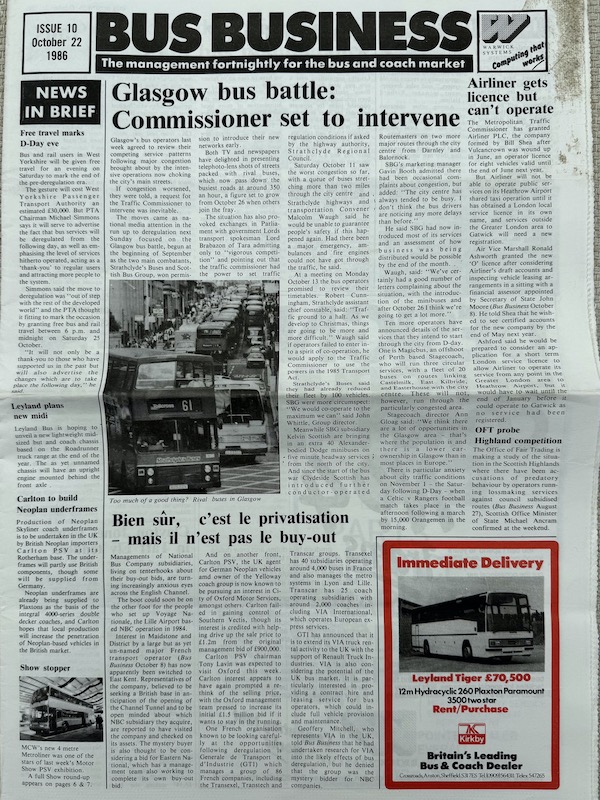
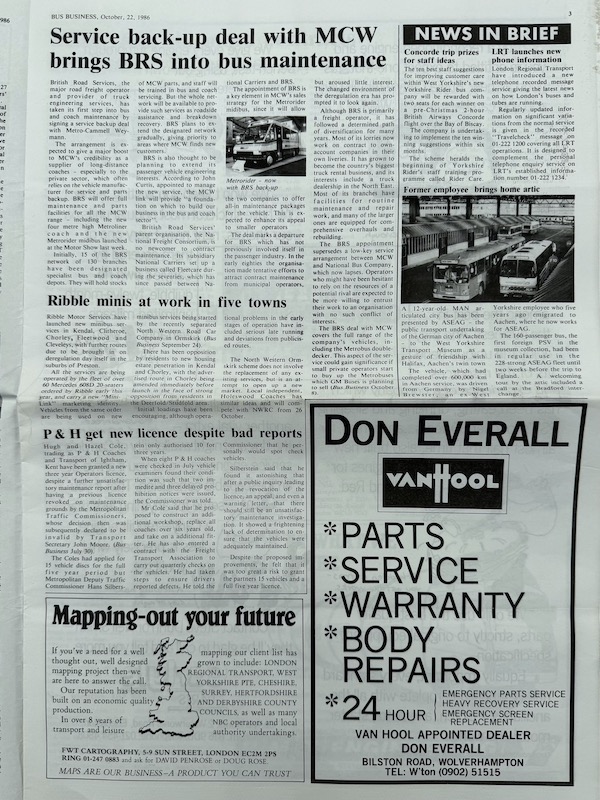
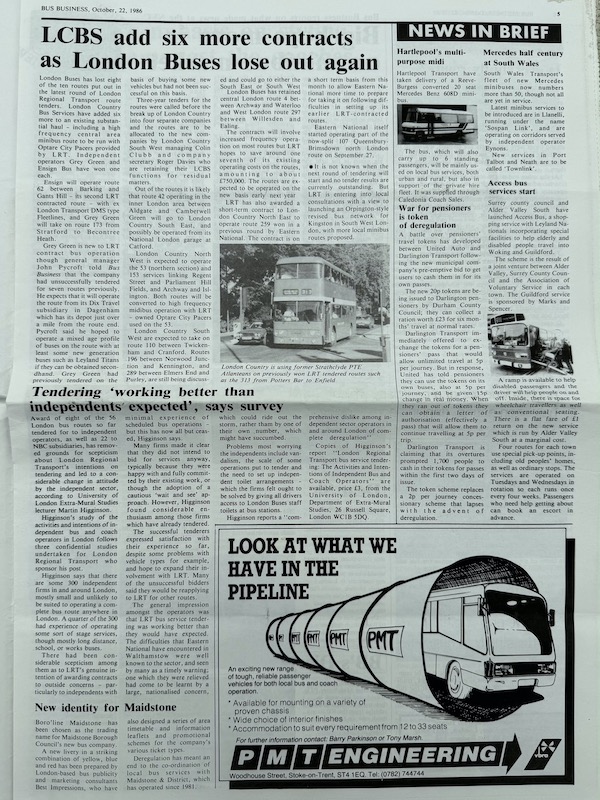
40 years of Bus Business – October 1986 Saturday 24th October 2026 Deregulation anticipation was reaching fever pitch as the 10th edition of Bus Business dated 22nd October 1986 landed on transport managers’ desks 40 years ago and, as a foretaste of what was to come, the page one headline story was all about the infamous “Glasgow Bus Battle” which was already underway. Other front page stories relaid the latest on NBC’s privatisation and news of the PTA’s free travel offer in West Yorkshire. Read on for more reminiscences straight from the pages of that issue and look out for a Deregulation 40th Anniversary Blog Extra tomorrow. Glasgow bus battle: Commissioner set to intervene Glasgow’s bus operators last week agreed to review their competing service patterns following major congestion brought about by the intensive operations now cooling the city’s main streets. If congestion worsened, they were told, a request for the Traffic Commissioner to intervene was inevitable. The moves came as national media attention in the run up to deregulation next Sunday focused on the Glasgow bus battle, begun at the beginning of September as the two main combatants, Strathclyde’s Buses and Scottish Bus Group, won permission to introduce their new networks early. Both TV and newspapers have delighted in presenting telephoto-lens shots of sweets packed with rival buses, which now pass down the busiest roads a6 around 350 an hour, a figure set to grow from October 26 when others joing the fray. The situation has also provoked exchanges in Parliament with government Lords transport spokesman Lord Brabazon of Tara admitting only to “vigorous competition” and pointing out that the traffic commissioner had the power to set traffic regulation conditions if asked by the highway authority, Strathclyde Regional Council. Saturday October 11 saw the worst congestion so far, with a queue of buses stretching more than two miles through the city centre and Strathclyde highways and transportation Convenor Malcolm Waugh said he would be unable to guarantee people’s safety if this happened again. Had there been a major emergency, ambulances and fire engines could not have got through the traffic, he said. Strathclyde’s Buses said they had already reduced their fleet by 100 vehicles. SBG were more circumspect: “We would co-operate to the maximum we can” aid John Whittle, Group director. SBG marketing manager Gavin Booth admitted there had been occasional complaints about congestion, but added: “The city centre has always tended to be busy, I don’t think the bus drivers are noticing any more delays than before”. He said SBG had now introduced most of its services and an assessment of how business was being distributed would be possible by the end of then month. Ten more operators have announced details of the services that they intend to start through the city from D-day. One is Magicbus, an offshoot of Perth based Stagecoach, who will run three circular services, with a fleet of 20 buses on routes linking Castelmilk, East Kilbride, and Easterhouse with the city centre. There is particular anxiety about city traffic conditions o November 1 – the Saturday following D-Day – when a Celtic v Rangers football match takes place in the afternoon following a march of 15,000 Orangemen in the morning. Bien sûr, chest le privatisation – main il nest pas le buy-out Managements of National Bus Company subsidiaries, living on tenterhooks about their buy-out bids, are turning increasingly anxious eyes across the English Channel. The boot could soon be on the other foot for the people who set up Voyage National, the Lille Airport based NBC operation in 1984. Interest in Maidstone & District by a large but was yet un-named major French transport operator has now apparently switched to East Kent. Representatives of the company believed to be seeking a British base in anticipation of the opening of the Channel Tunnel and to be open minded about which NBC subsidiary they acquire, are reported to be considering a bid for Eastern National, which has a management team also working to complete its own buy-out bid. And on another front, Carlton PSV, the UK agent for German Neoplan vehicles and owner of the Yelloway coach group is now known to be pursuing an interest in City of Oxford Motor Services, amongst others. Carlton failed in gaining control of Southern Vectis, though its interest is credited with helping drive up the sale price to £1.2m from the original management bid of £900,000. Free travel marks D-Day eve Bus and rail users in West Yorkshire will be given free travel for an evening on Saturday to mark the end of the pre-deregulation era. The gesture will cost West Yorkshire Passenger Transport Authority an estimated £30,000. But PTA Chairman Michael Simmons says it will serve to advertise the fact that bus services will be deregulated from the following day, as well as emphasising the level of services hitherto operated, adding as a ‘thank you’ to regulate users and attracting more people to the system. LCBS add six more contracts as London Buses lose out again London Buses has lost eight of the ten routes put out in the latest round of London Regional Transport route tenders. London Country Bus Services have added six more to an existing substantial haul – including a high frequency central area minibus route to be run with Optare City Pacers provided by LRT. Independent operators Grey Green and Ensignbus have won one each. Ensign will operate route 62 between Barking and Gants Hill – its second LRT contracted route – with ex London Transport DMS type Fleetlines, and Grey Green will take on route 173 from Stratford to Becontree Heath. Three-year tenders for the routes were called before the break up of London Country into four separate companies and the routes are to be allocated to the new companies by London Country South West managing director Colin Clubb and company secretary Roger Davies who are retaining their LCBS functions for residual matters. Out now the routes it is likely that route 42 operating in the inner London area between Aldgate and Camberwell Green will fo to London Country South East, and possibly be operated from its National London garage at Catford. London Country North West is expected ton operate the 53 (northern section) and 153 services linking Regent Street and Parliament Hill Fields, and Archway and Islington. Both routes will be converted to high frequency minibus operation with LRT-owned Operate City Pacers used on the 53. London Country South West are expected to take on route 100 between Twickenham and Cranford. Routes 196 between Norwood Junction and Kennington, and 289 between Elmers End and Purley, are still being discussed and could do to either the South East or South West. London Buses has retained central London route 4 between Archway and Waterloo and West London route 297 between Willesden and Ealing. Ribble minis at work in five towns Rubble Motor Services have launched new minibus services in Kendal, Clitheroe, Chorley, Fleetwood and Cleveleys, with further routes due to be brought in on deregulation day itself in the suburbs of Preston. All the services are being operated by the fleet of over 60 Mercedes 608D 20-seaters ordered by Ribble early this year, and carry a new “Mini-Link” marketing identity. Vehicles from the same order are being used on new minibus services being started by the recently separated North Western Road Car Company in Omskirk. Separate division will run West Yorks minis A separate “Micro Rider: division of the new Yorkshire Rider bus company is being established too run the company’s minibus services in West Yorkshire. Yorkshire Rider, formed to take over West Yorkshire PTE’s bus operations, has announced the appointment of a minibus manager and the settinng up of the new Micro Rider division following the recent purchase of 100 minibuses, the majority of which will enter service in Leeds on 26 October. London Buses’ pay deal ‘fails to cut costs enough’ Lengthy negotiations over a new pay deal for London Buses’ platform staff have been concluded after fiercely opposed plans for separate pay rates for inner and outer areas were withdrawn by LBL management. The compromise deal includes a 5 per cent increase in basic pay and a £16-a week payment to all grades in place of the traditional London lighting allowance and receipts bonus system. But LBL fear that the deal will not go far enough to help get its operating costs down sufficiently to staunch the rapid loss of business to rivals under the London Regional Transport tendering process. John Ingleton, LBL personal director said: “We have made it clear to the union that although this deal will go some way to containing our costs it is not likely to stand us in good stead when we have to face up ti future tenders. It could mean therefore, that we have to consider the introduction of more local subsidiaries such as the ones at Orpington and Stanwell”. The two subsidiaries have been used to establish new local pay scales to enable lower buds to be made for tendered routes. New identity for Maidstone Boro’line Maidstone has been chose as the trading name for Maidstone Borough Council’s new bus company. A new livery in a striking combination of yellow, blue and red has been prepared by London-based publicity and marketing consultants Best Impressions, who have also designed a series of area timetable and information leaflets and promotional; schemes for the company’s carious ticket types. Deregulation has meant an end to the co-ordination of local bus services with Maidstone & District, which has operated since 1981. Access bus services start Surrey county council and Alder Valley South have launched Access Bus, a shopping service with Leyland Nationals incorporating special facilities to help elderly and disabled people travel into Woking and Guildford. The scheme is the result of a joint venture between Alder Valley, Surrey County Council and the Association of Voluntary service in each town. The Guildford service is sponsored by Marks and Spencer. A amount us available to help disabled passengers and the driver will help people on and of. Inside, there is space for wheelchair travellers as well as conventional seating. There is a flat fare of £1 return on the new service with is run by Alder Valley South at a marginal cost. M25 Motorway nearly there The five miles of M25 motorway between junctions 19 and 21A (Micklefield Green to the A405 at Bricket Wood in Hertfordshire) opened to traffic last Friday. The remaining eight miles of the M25 London Orbital motorway from the A405 (junction 21A) to the A1 at South Mimms (junction 23) are due to open on Wednesday 29 October to complete the ring. The dual three lane stretch opened last week will provide a link between the M1 and the M25 to and from the west, relieve the overburdened A405 and A414 and completes the 114 miles of the orbital route. Bus Business Moves Cohen Heads London Bus operations Norman Cohen has been appointed operations director of London Buses Limited in succession to Marcus Smith and will take up his new post on November 17. Cohen, 46, has been operations manager since 1973. He began his career as an operational research analyst with the National Coal Board and joined LT in 1971 in a similar capacity with responsibility for the assessment of bus control and communications systems. Anthony Depledge Anthony Depledge has been appointed managing director of Blackpool Transport Services Limited, which took over the running of Blackpool Transport from October 20. Depledge was previously deputy general manager. Derek Hyde, who is present transport general manager, remains with Blackpool Borough Council to look after a range of residual functions resulting from the formation of the new company to run bus and tram services. Depledge gas been with Blackpool Borough Council Transport Department since 1977 and was formerly with South Yorkshire PTE and Midland Red. Tom Young Tom Young is now commercial manager of South Yorkshire’s Transport, the PTE’s new bus company. Young left his position as marketing manager of NBC subsidiary Midland Fred North earlier in the year. Appointments District Manager, Castleford £10,512-£11,808 The Company operates 82 vehicles at Castleford covering local bus, contract and coach operations. The successful application will be directly responsible to the Traffic Manager for the efficient and profitable operation of the Company’s activities in the Castleford District. He/she mush have a strong interest with proven man-management skills. Castleford will operate competitively tendered operations, as well as commercially registered local bus services. Additional benefits for this position include membership of a contributory pension scheme and use of a company car. The Company will also provide assistance with relocation expenses. Applications, consisting of a typed CV and a handwritten letter explaining how the candidate’s experience and qualifications fit this position should be sent to: Mr M J Hunter, Traffic Manager, West Riding Automobile Co Ltd, 24 Barnsley Road, Wakefield WF1 5JX Fleet Engineer £14,000 plus car and private health insurance We are seeking a highly motivated manager to assume responsibility for the maintenance of a fleet of 35 coaches, 15 service buses and associated equipment based in West London. The successful candidate will have practical experience as well as sound administrative and management skills. He or she will be part of a small management tram and should be able to develop with the company as it seizes the new opportunities now occurring within the bus and coach industry. Our fleet engineer controls a tam of around eight fitters and cleaners and has to be able o adapt to the varying demands of operations ranging from local bus services to extended tours throughout both West and East Europe. Please apply in writing with full CV to: Mr L J Wright, Managing Director, Len Wright Travel Ltd, 3 Fleming Way, Isleworth TW7 6EU. And finally for this round up of Bus Business news from exactly 40 years ago I had to include this snippet… All operators covered by new travel shop NBC Subsidiary Brighton & Hove have opened a new travel shop at their prime site in Old Steine, Brighton providing timetable and route information on over 20 different bus and coach companies. The shop, called 1 Stop Travel, and a former National Travelworld outlet, handles inquiries about all local and long distance bus travel, coach excursions and holidays, air travel, rail travel and sea travel. But Brighton & Hove have relinquished the precious National Travelworld Franchise and their ABTA agency. Perhaps I could end by making the observation….. well, that certainly stood the test of time …. and if only everyone had done that in October 1986 and kept it going for the ensuing 40 years! Which sums up my thoughts on deregulation in a sentence (and a few more sentences in tomorrow’s blog extra) More nostalgia from Bus Business next month including the fall out from D-Day. Watch out for a BusAndTrainUser Bus Deregulation Ruby Anniversary Blog Special to be uploaded at 06:00 tomorrow. Roger French Blogging timetable: 06:00 TThS with a special Su blog extra landing tomorrow. https://busandtrainuser.com/2026/10/24/40-years-of-bus-business-october-1986/ #busbusiness #glasgowbus #october #busbattle #busgroup #trafficcommissioner #scottishbus #strathclyde #saturdayoctober #deregulation #rss #feeds #linksharing #qwibbit

#busbusiness #glasgowbus #october #busbattle #busgroup
BusAndTrainUser (Unofficial)
BusAndTrainUser (Unofficial) 9d

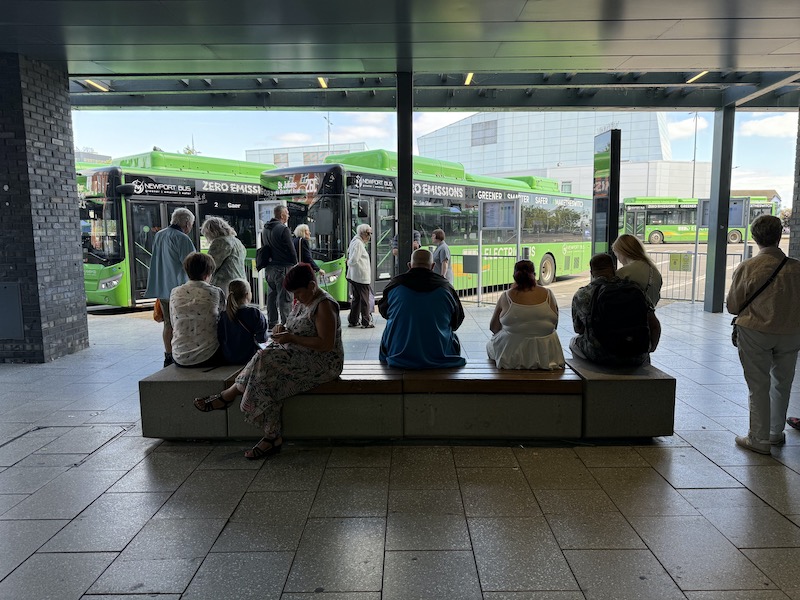
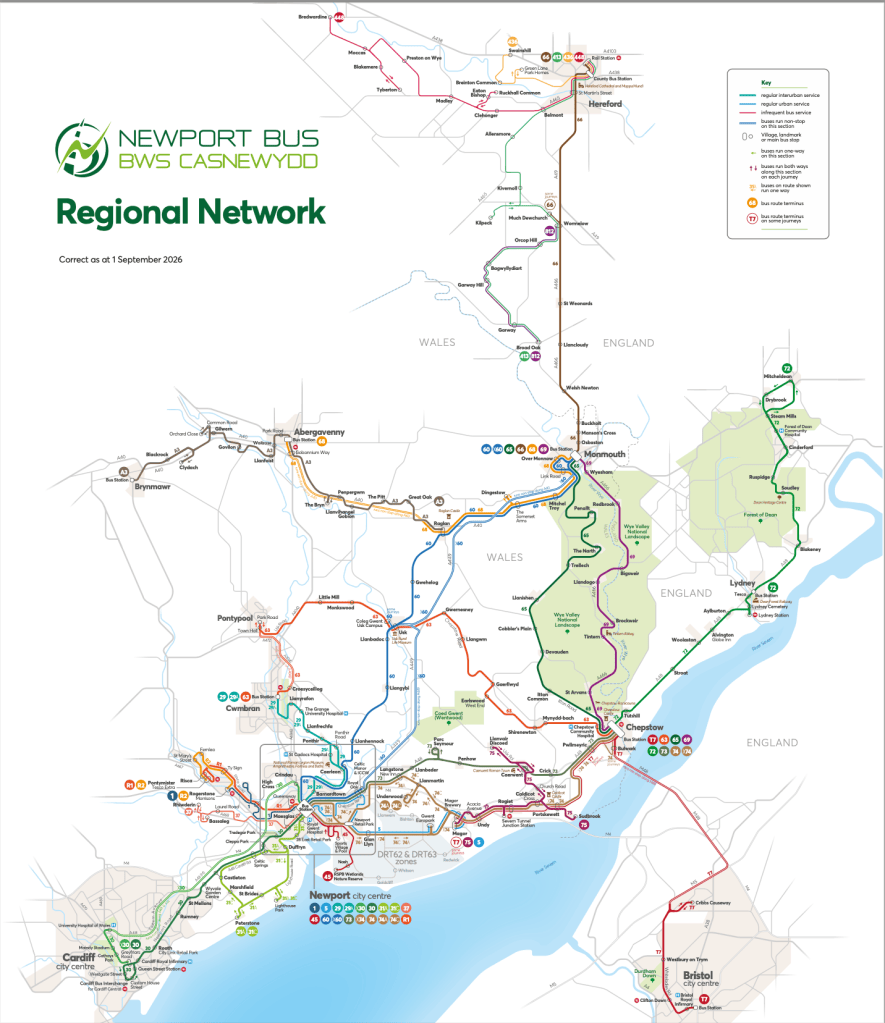
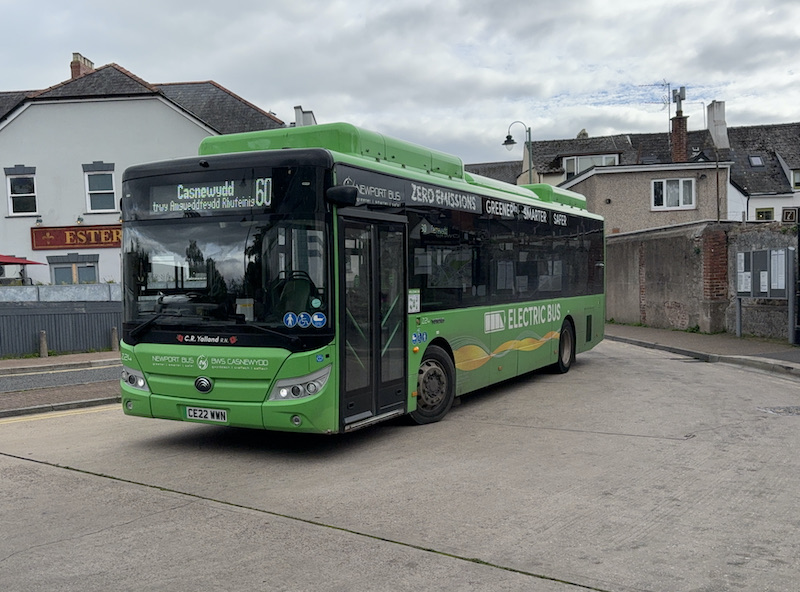
Newport Bus’s expansion Thursday 22nd October 2026 Following Tuesday’s blog highlighting Kent Country’s expansion, this time I’m taking a look at how Newport Bus has expanded over the years to become a significant player in Monmouthshire and, more recently Herefordshire, many miles from its city based heartland in Newport. The company operates what it calls a Regional Network with its website helpfully displaying a route map showing how coverage now stretches from Hereford, Monmouth, Abergavenny and Pontypool north of Newport, and over to Chepstow, Bristol and the Forest of Dean in the east. Monmouth’s bus scene is now dominated by Newport Bus with a host of inter-urban routes serving Hereford, Abergavenny and Chepstow (via two different routes) as well as Newport. I’ve recently explored all five of these routes and recommend them as great ways to enjoy the spectacular scenery Monmouthshire has to offer. Longest standing of these routes is the 60 between Monmouth and Newport. It was back in 2011 when Newport Bus first tried its hand at linking the two towns with a competing limited stop/express bus numbered X11. Nowadays its council funded route 60 provides an hourly timetable via Raglan and Usk and when I travelled on the route on a Saturday, a few weeks ago, the 13:00 departure from Newport carried 11 passengers boarding in the bus station and another nine along the journey with 14 boarding in Monmouth to return on the 14:06 with two more boarding as we headed back south. It’s a fast paced route on an unclassified road (which I guess used to be the A449 until the was upgraded on a more eastern alignment)… … with some great views especially once into Monmouthshire. On another day I travelled on route 68 from Abergavenny via Raglan to Monmouth. I caught the 13:09 from Abergavenny – one of seven journeys a day. This was a quieter journey than the 60 with just four boarding in Abergavenny’s bus station of whom two soon alighted and the other two travelling all the way to Monmouth. The bus spends the first 15 minutes of the 40 minute journey running non-stop along the A40 so no opportunities for passengers to board and alight until Raglan where the bus doubled back to avoid an awkward right turn on to the A40 (which the bus on route 60 managed to do).. … after which it follows a similar route into Monmouth as the 60 except every other journey diverts for a four minute double run to serve Dingestow village. We only picked up two other passengers, one on the main road by the road to Dingestow and the other in Mitchel Troy, so a quiet journey. On arrival in Monmouth I’d planned to head down to Chepstow on the scenic route 69 departing at 14:10 which uses the winding A466 following the path of the River Wye. Unfortunately a bad accident that morning had closed the road leading to buses on the route having to undertaken a massive diversionary alternative, effectively following the route taken by route 65 which also connects the two towns. The bus due an hour earlier had still not arrived into Monmouth, and when it did, it headed straight off out of service, so with no information about the other bus (and official news from Newport Bus who I’d rung being “the service has been suspended”) there was no alternative but with other disappointed route 69 passengers we all caught the next route 65 instead. What a shame the large electronic sign by the bus stop can’t show an update along the lines of “service suspended due to an accident”. Route 65 takes a more circuitous route via a number of villages taking 55 minutes to reach Chepstow rather than the quicker 46 minute journey time on the 69. The 65 only runs two-hourly (Mondays to Saturdays) with no Sunday service while the 69 has an hourly timetable (two-hourly Saturdays and four journeys on Sundays) and luckily there wasn’t too long to wait until the 65 departed at 14:25. Not surprisingly 23 passengers boarded (including students), with 20 travelling all the way to Chepstow and the other three alighting in Pentwyn, The Narth and Trelleck (three of the lovely villages served) and just two more boarded as we headed south (in Treleck Common and Devauden). It was a lovely route to travel along and I see there’s even a community group called Friends of the 65 bus with a website including the timetable, details of fares and a leaflet promoting travel by bus in the Wye Valley (on the 65 as well as the 69).This also gives the background to the formation of the group which was in 2018 when Monmouthshire Council was going to withdraw the route leading to a very successful campaign to save the route and introduce initiatives to raise its profile and promote it to the community and visitors. The website explains “we have a named contact in each of the villages along the route who takes responsibility for promoting the 65 Bus in their communities and looking after the bus stops in their village.” It sounds like a fantastic community run arrangement and shows what can be done. What a pity it took the threat of withdrawal of the route to get it established and if only such enthusiasm could be shown in other villages all over Britain for their local bus route. I returned to Monmouthshire for a third time last week to finish off the exploration of these routes including reuniting myself with that missing route 69. This time I boarded it in Chepstow to head north to Monmouth catching the 12:06 departure from the bus station with three other passengers all of whom alighted within the first few minutes of the journey leaving just myself on board until we reached Tintern at 12:23 where two boarded with another three boarding as we continued what is a fantastic journey north along one of the country’s most winding roads following the Wye Valley. As always it’s hard to capture the delights of such a scenic journey with a mobile phone camera on a moving single deck bus but here’s a couple to give readers a flavour… … including the ruins of Tintern Abbey… … which the Google camera car captured better than I managed. We arrived into Monmouth bus station as scheduled at 12:54 in good time to connect with my fifth route of this quintet, the 13:06 route 66 which continues the northerly trajectory from Chepstow to Monmouth along the A466 to Hereford. Well, that’s what I’d expected the departure time to be having consulted the timetable on the Newport Bus website as well as bustimes.org. Confusingly the large electronic departure sign in the bus station was showing the departure as 13:25… … and rather unhelpfully there was no printed timetable on display among some of the others to confirm either way. Even more confusing, when I looked online again, although the home page for route 66 on Newport Bus’s website was indeed showing 13:06, clicking on the option for downloading the pdf version, showed it departing at 13:25. In the event a double deck bus arrived at 13:06 screened up for route 66 with a couple of passenger alighting. The driver explained he was running late and needed a toilet stop before departing but invited the four of us waiting to sit on board until he returned, which he soon did with another passenger arriving (who possibly thought it was due away at 13:25) and we left at 13:13. It’s another great journey taking 54 minutes along the next section north of the winding A466, although the River Wye has now veered to the east but the road is still quite challenging in parts and indeed is signed as a route to Hereford for “Light Traffic Only”. I soon saw why. Although the road did improve as we headed further north… … and later joined the A49. It’s another great route for scenery, all the better for being on a double deck. One of the five passengers on board alighted in St Weonards, 22 minutes into the journey, and that was it with no other boarders and the four on board alighting when we arrived in Hereford’s congested town centre, before continuing to the railway station with half a dozen passengers boarding for the journey back to Monmouth, and where work is underway constructing a new ‘transport hub’. I very much enjoyed my travels around Monmouthshire and recommend the area especially if combined with a visit to the nearby Forest of Dean. It’s good to see Newport Bus expanding beyond its traditional city based operations but I hope it’s got all its finances on track when bidding for these council supported routes. There have been ominous signs reported in the media recently about the company failing to submit its annual accounts on time. This even included a strike-off action and threat of dissolution from Companies House after missing the statutory deadline to file the accounts for year ending March 2025 by June 2026. This striking off notice was suspended last month as an objection was received by the Registrar, but at the time of writing the accounts have still not been filed. It’s also a shame the Transport Hub travel office in Newport bus station alongside the Friars Walk shopping centre has never reopened after Covid. Let’s hope its poignantly empty contents are not an omen. Roger French Blogging timetable: 06:00 TThS https://busandtrainuser.com/2026/10/22/newport-buss-expansion/ #newportbus #monmouth #abergavenny #chepstow #kentcountry #expansion #raglan #regionalnetwork #hereford #rss #feeds #linksharing #qwibbit

#newportbus #monmouth #abergavenny #chepstow #kentcountry
BusAndTrainUser (Unofficial)
BusAndTrainUser (Unofficial) 11d

Kent Country’s expansion Tuesday 20th October 2026 Go-Ahead Group’s presence in Kent has been steadily increasing during 2026 so I recently made a couple of visits to catch up on developments. The Group’s ‘Kent Country’ branded operations are part of Go-Ahead London and began a couple of years ago in November 2024, following the company’s success at winning the tender to run the Fastrack network (formerly run by Arriva) including the introduction of a new fleet of Irizar ie tram type battery-electric buses. After a challenging start awaiting deliveries of the new buses, these unusual shaped vehicles now dominate the bus scene in the Dartford, Bluewater and Ebbsfleet area as well as on to Gravesend. Further changes to the Fastrack network were introduced at the beginning of August including a short extension in Dartford of Fastrack A (to Acacia Hall), an amended route between Bluewater and Ebbsfleet for Fastrack B (using the busway and Castle Hill instead of the B255 and A2) and a new route C to replace routes E and F (which were both withdrawn) making for a through service between Ingress Park, Bluewater (old route F), Ebbsfleet and Gravesend (old route E) via the busway and Castle Hill. The beginning of August also saw Kent Country win further tenders from Kent County Council – for routes 414 (previously operated by Arriva) and Dart1, Dart2, and Dart3 (previously operated by 1st Bus Stop) while at the end of June it gained the tender for routes 306/308 and 416/417 (previously operated by Redroute Buses). These gains, in addition to route 477, which was taken over when Arriva deregistered it in October 2025, now give Kent Country a sizeable presence in this part of Kent. Route 308 between Gravesend and Sevenoaks is the longest of these newly won tendered routes, becoming even longer when Kent Country took it over in June with an extension of four journeys beyond Gravesend to terminate at Bluewater making for an end to end journey time of an hour and 41 minutes. Saturday journeys only operate as far south as Vigo Village, north of the M20. I took a ride on the 11:50 from Bluewater on a Tuesday lunch time earlier this month. It was in the hands of a 2025 plate, plain white, ADL Enviro200 MMC which first entered service last year with Carousel and Oxford Bus. This presented a nice modern contrast with the other dozen or so buses in the fleet which, aside from the 30 ie trams, are mainly former London dual door Enviro200s which now wear the new green Kent Country livery. I noticed the bus was parked up in Bluewater when I arrived soon after 11:00 and guessed it had been there since arriving at 10:51 from Sevenoaks so was a bit perturbed when a driver appeared at the departure time of 11:50 but the bus didn’t move. Once it got past 12:00, and thinking there was probably a problem with the bus, I gave Kent Country’s advertised contact number a ring and was very impressed the phone was almost immediately answered by a member of staff (hooray, no automated push button menus to put you on hold) who said she’d check with ‘control’ and was soon back explaining there’d been a delay on the driver’s previous journey so he needed to take his break before continuing and the bus would be leaving imminently. Which it duly did, pulling forward at 12:03 with a very friendly driver greeting me, but sadly no other passengers, to board. The journey over to Gravesend goes via part of the former ‘quick’ route (previously used by Fastrack route B, before its recent diversion through Castle Hill) utilising the A2 and then via Perry Street rather than Ebbsfleet and Northfleet making for a journey time to Gravesend of just 20 minutes (compared to 25 minutes on the B) and we picked up six passengers on the way into Gravesend through Perry Street who’d otherwise catch Arriva’s half hourly route 483 (or odd journeys on the 481/489). These six all alighted in Gravesend’s Barrack Row bus station where there was quite a crowd (14) waiting to board with their shopping to go home as we pulled in at 12:25, still 15 minutes down. Four passengers soon alighted and two more boarded after which the route south includes a short double run to serve a large Morrisons and Lidl just before the A2 where three more alighted. Then there’s a wander around the residential area of Istead Rise where we lost three and gained one… …before reaching Meopham and Meopham Green where the seven passengers still on board all alighted, just over half way through the journey. It was then just myself on board for the next 10 minutes as we drove through Culverston Green before the scenic tour around the lovely Vigo Village… … where we picked up a passenger who travelled through Wrotham… … to Borough Green railway station leaving myself travelling solo again for the final 28 minutes to Sevenoaks save for one passenger boarding on the route’s wiggle as we entered the urban area to serve the town’s railway station. Sevenoaks bus station was reached at 13:38… … only seven minutes down, with the driver having done a sterling job of making up a bit of the time and then leaving almost straight away at the scheduled time of 13:40 back to Gravesend with five passengers on board. I came away thinking it’s no surprise the Saturday service only reaches as far south as Vigo. A week later I was back in the area to take a ride on route 414, the route gained at the beginning of August, having previously been operated by Arriva. It connects the communities of Horton Kirby, Southdowns, South Darenth and Sutton at Hone (all located south east of the M25) with Dartford on an hourly frequency, save for school day variations. By coincidence it was the same white liveried Enviro200 I’d travelled on the previous week to Sevenoaks. The bus arrived into Dartford having done a journey on both the local circular Dart2 and Dart1 routes (the three routes interwork) and after a driver changeover the very friendly driver got all eight, complete with shopping trolleys and walking frames, on board with a further 13 boarding at the next stop on Dartford’s town centre one-way system, giving an impressive 21 on board. One soon alighted and two more boarded as we headed south out of Dartford with eight alighting in Sutton at Hone, seven in South Darenth, four in Southdowns and three in Horton Kirby. The route includes some challenging conditions for drivers with not only some incredibly narrow sections of roads… … but also inconsiderate parking by motorists including this gap between a white van and white car… … which was probably no more than a couple of inches more than the bus’s eight feet, one inch width. The driver literally took it inch by inch and slowly, slowly, negotiated the gap to everyone on board’s amazement and recognition with clapping and cheering once he made it. The driver deserves a medal and needs to be immediately installed as Driver of the Year as his task was harder than any set in Blackpool for the annual competition. I let Kent Country know of this driver’s undoubted manoeuvring skills. Another interesting part of the journey was serving Southdowns Retirement Village. This small community, otherwise isolated, must be very appreciative of having this bus service which entails a reverse to turn round. The main bus stop in Gorringe Avenue, by the reversing point, is nothing extraordinary… … but the bus stop by the church at the entrance to the community must include the cutest bus shelter anywhere, albeit your legs would get a bit wet in the rain. The seat looks to be a fairly recent addition, as it wasn’t there when the Google camera car last passed by. Once the bus returned to Dartford, the driver set off for a circuit on route Dart2 at 12:43 followed by Dart1. These two routes were introduced back in 2014 with Go-Coach (as it then was called) being the first operator before they passed to 1st Bus Stop on re-tender. They provide an off-peak hourly circuit linking Dartford’s town centre with the Home Gardens area to the west (Dart1) and Temple Hill to the north east (Dart2). As mentioned earlier, Kent Country also now operates routes 416 (from Meopham) and 417 (from Cliffe) to Gravesend and Bluewater albeit with only one journey to Bluewater on the former and two on the latter as well as the aforementioned route 477 between Dartford, Swanley and Orpington which, as covered in a previous blog is also served by go-bus on the northern half of the route with the two operators now having nicely spaced journeys to give passengers two buses each hour. Kent Country also publishes printed timetable leaflets for each service… … although I wasn’t able to acquire a full set, and it was a bit of a challenge to work out which ones were available from the bus dispenser, but it’s good to see these available and I am sure are appreciated by many of the passengers using these services. These also contain details of tickets as well as bus times, and I see i a nod to the old days, the company makes available a Green Rover for £5.50 a day or £25 for a week although I’m not sure how many passengers would ride around on the “477, 414 and Dart services as much as you want”. All in all, it’s a tidy and impressive operation for Go-Ahead in this part of Kent, and no doubt there’ll be further expansion opportunities in the coming months. Roger French Blogging timetable: 06:00 TThS https://busandtrainuser.com/2026/10/20/kent-countrys-expansion/ #kentcountry #bluewater #castlehill #bus #gravesend #route #arriva #group #october #acaciahall #rss #feeds #linksharing #qwibbit
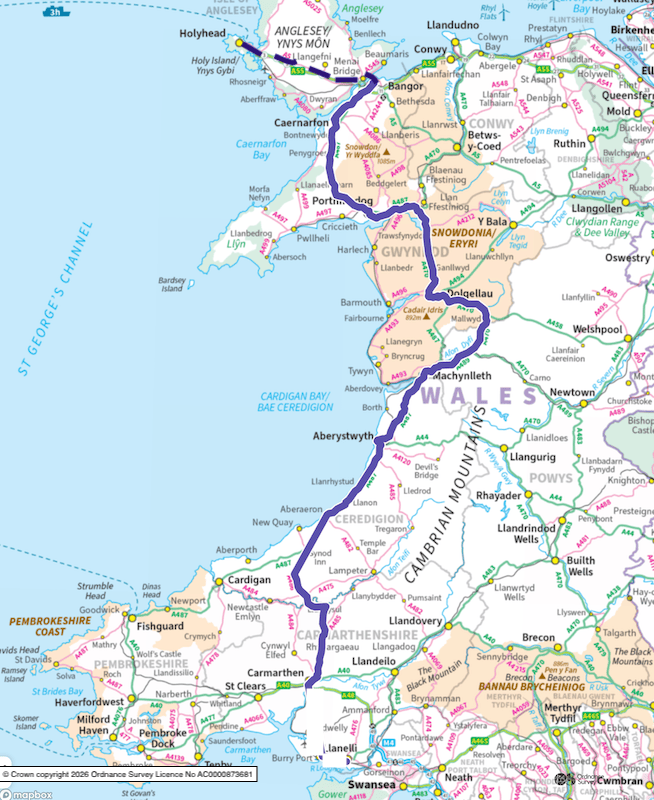
#kentcountry #bluewater #castlehill #bus #gravesend
BusAndTrainUser (Unofficial)
BusAndTrainUser (Unofficial) 14d

Every bus route 99. 23 of 25. Saturday 17th October 2026 And so to the most northerly bus route numbered 99 in England. My journey from the South East, South West and South Wales through East Anglia, West Midlands and the Potteries as well as South Yorkshire, Greater Manchester and Merseyside before heading back over to East Yorkshire arrived in the North East for last time’s adventure in County Durham and with the second of two route 99s to ride in this region being in Tyne & Wear running between Grangetown and Hylton Castle. It’s another route (the ninth) to be operated by an SME company, in this case L&G Coaches based in Chester-le-Street. But, this company only took on the route over having won a new tender from Nexus in July. Prior to that it was operated by Go North East in whose hands it was when I travelled on the route back in June. As you can see from the map below, the route lies in Sunderland but the Royal Sunderland Hospital is the closest it gets to the city centre. Blog reader Alex kindly commented on another route 99 blog recently that this 99 “has its roots in the free buses to Asda which started in the 1980s and I am not sure whether journeys to the store itself are still free. It provides a useful link across the river via Barnes Park and the Royal Hospital so has utility beyond the Asda store. At Barnes Park northbound it is only service which serves a brand new shelter only used by the 99”. The route begins at its northern end by doing a clockwise circuit of the large Hylton Castle Estate which is located adjacent to Hylton Castle. After that it heads eastwards along Hylton Park Road where there are retail warehouse type outlets and car dealerships before heading south and crossing the River Wear over the Queen Alexandra Bridge, then back westwards again for a short distance along Pallion New Road then south through Pallion Road and Kayll Road where the hospital is located and eventually terminating outside a large Asda store in Leechmere Road. The route’s timetable didn’t change when the new tender began in July and continues to consist of just five/six off peak journeys on Mondays to Saturdays with no Sunday service. As you can see from the timetable above the service starts just after 09:00 and is all done by 14:23 making it an ideal candidate to slot in between peak hour school commitments and I suspect that’s why L&G Coaches proved successful in gaining the work from Go North East. The day I travelled back in June there were few passengers travelling making the double deck capacity redundant but was almost certainly there for its peak hour work before and after. It’s a tight timetable for the one bus with just three minutes layover at the Asda end of the route and a one minute pause in Hylton Castle on the circuit around the residential area. I aimed to catch the 11:55 from outside Asda and the bus didn’t appear from its previous journey until 11:57, turning round at a roundabout for the entrance to the store on Leechmere Road after which we immediately set off slightly behind schedule. No passengers alighted and no-one boarded other than myself. The interior of the bus offered various activities on the upper deck (Snakes and Ladders and Blackjack. albeit there’s no dice, cards or counters so it’s really just a gimmick), but this was rather academic as no passengers came upstairs for the whole journey. First up we passed the Tunstall Hills Nature Reserve and then Barnes Park… …is where we picked up three passengers at two stops before another two at the Royal Sunderland Hospital followed by a district retail area along Pallion Road and St Lukes Terrace where four of our five passengers alighted and two boarded. The next exciting part of the route is the Queen Alexandra Bridge which looms up on the left hand side as we approach from the west. This structure was built in 1909 as a double deck bridge with the road on the lower level and railway tracks above. The railway carried coal from the County Durham coalfields to Sunderland Docks but fell into disuse in 1921. It wasn’t until as recently as 1985 that the tracks were dismantled and the structure from either end of the bridge altered so that there’s no trace of the former line except on the northern side of the River you can still see where the tracks came in from the west. It was then past the aforementioned retail sheds… … where three passengers alighted and one boarded and we were soon approaching the Hylton Castle residential area with just one passenger on board. After a brief pause at the ‘terminus’ bus stop on the circuit we continued round passing the Castle… … and picking up four passengers for the journey back to Grangetown. I left the bus here and caught a bus on route 8 with its direct routing into the city centre. It’s a low key route performing a useful off-peak travel facility linking various parts of the Sunderland area together which would otherwise necessitate a change of bus, and numbers travelling will always reflect that. I’m sure L&G Coaches will do it proud. Roger French Did you catch the previous 22 blogs in this series? 1 Eastbourne-Hastings, 2 Petworth-Chichester, 3 Woolwich-Bexleyheath, 4 Tilbury Town-Tilbury Ferry Terminal, 5 Chippenham-Swindon, 6 Ubley-Chew Valley, 7 Exmouth-Brixington-Exmouth, 8 Taunton-Chard, 9 Pontypridd town circular, 10 Cheltenham-Gloucester, 11 Leigh-on-Sea-Shoeburyness East Beach, 12 Malton-Chelmsford, 13 Lowestoft-Southwold-Halesworth, 14 Solihull-Kingshurst, 15 Telford-Shawbirch circular, 16 Newcastle-under-Lyme-Chell Heath, 17 Doncaster-Retford, 18 Barnsley-Denby Dale, 19 Manchester-Prestwich, 20 Whiston-Prescot, 21 Scarborough Beachcomber, 22 Spennymoor-Shildon. Blogging timetable: 06:00 TThS https://busandtrainuser.com/2026/10/17/every-bus-route-99-23-of-25/ #hyltoncastle #northeast #route #south #busroute #asda #road #barnespark #eastyorkshire #eastanglia #rss #feeds #linksharing #qwibbit
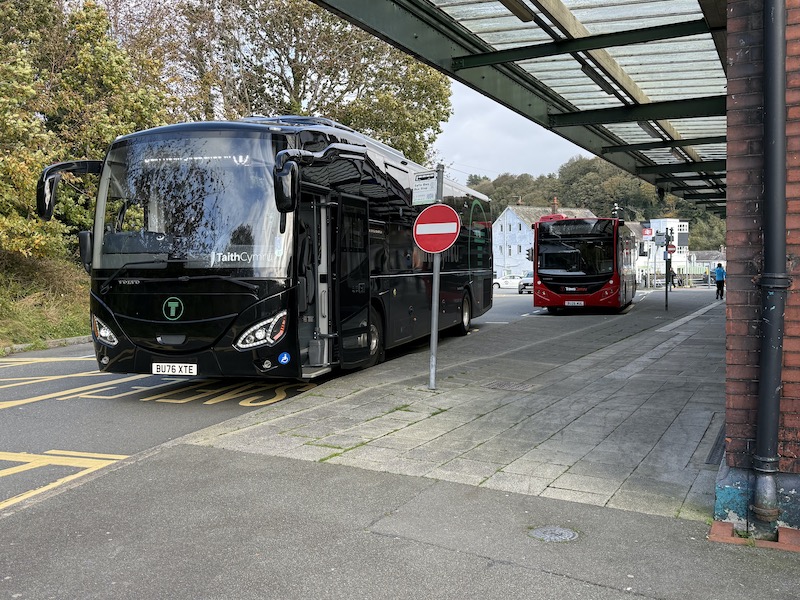
#hyltoncastle #northeast #route #south #busroute
BusAndTrainUser (Unofficial)
BusAndTrainUser (Unofficial) 15d

BusAndTrainUser Verify Saturday 10th October 2026 It’s been a while since I’ve done a blog fact checking one of those headline grabbing negative stories about public transport that appear from time to time in the media. I’m putting that right today, thanks to blog readers Harry and Lorenzo who drew my attention to a news item from Crawley which the BBC covered on Tuesday with a video clip (presumably for its Regional News programme) and online. The story was about residents, having moved into a relatively new (and still expanding) residential area west of Crawley called Kilnwood Vale, complaining buses are “disturbing the quality of life”. It does happen from time to time – whereas the media often feature passengers complaining about the lack of, or cuts to buses. there are also sometimes reports of a NIMBY attitude from others who don’t want any buses past their front door. In my time it often happened wirh the siting of bus stops. “No bus stop to be sited outside my house, thank you very much”; as if householders owned the road outside their property. What gave Tuesday’s story added interest was complaints from two residents who couldn’t sleep at night due to the noise and disturbance caused by buses passing by 24/7. One resident, Stuart Ralph reckons Calvert Link, which he calls a “fast highway” (it’s in a 20mph zone), has “400 buses going from Crawley to Horsham past my front door, which is less than five metres away”. Another resident, Andy Marits described the situation as a “nightmare” and said his wife, who has moved to their spare room, is now “sleeping with earplugs in and a pillow over her head”. Terence Nadin said he has had to add some “secondary glazing” on his bedroom window to improve his sleep quality while Andrea Gaielli claims the frequency, particularly of the number 10, was “disturbing the quality of life”. The report also stated “residents who are against the frequency of service said it exceeds the level promised in the section 106 planning agreement struck when the estate, which remains unadopted, was built.” But, Crest Nicholson, the developer pointed out “Crest Nicholson does not determine or control the frequency of bus services operating through Kilnwood Vale. We have met all of our obligations in relation to bus services at the development.” And Matt Ashton, managing director of Metrobus rightly observed “the Section 106 agreement sets minimum service requirements rather than a maximum level of provision, enabling services to respond to passenger demand.” Adding “we recognise the concerns raised by some residents and have engaged with them through meetings, calls and correspondence. Services are planned in conjunction with a range of stakeholders, including Crest Nicholson, the lead developer.” I took a ride out to Kilnwood Vale on Thursday afternoon to see what all the fuss is about. The area lies just north of the A264 Crawley to Horsham road on the western side of Crawley and by the look of the area on Google Map’s aerial view (above image) only around half the planned 2,750 houses have so far been built (Phases 1 and 2 shown in red on the map below) in a project that began with initial planning permission awarded in 2011. Three Metrobus routes serve the area, using the aforementioned Calvert Link road to run through what eventually will be the middle spine road of the estate. There’s the half hourly longer distance route 23/23X between Crawley, Horsham and Worthing; the half hourly route 200 between Gatwick Airport, Manor Royal, Gossops Green, Bewbush and Horsham and thirdly the frequent route 10 from Gatwick Airport, Manor Royal, Crawley town centre, Broadfield and Bewbush which terminates at Kilnwood Vale. Frequency of the 10 is eight buses an hour for most of the day with hourly departures from as early as 03:00 to 23:30. All told, that equates to the quoted 400 buses a day in the news item, with 200 heading along Calvert Link westbound and 200 eastbound (give or take one or two). However, just a small correction it’s not “400 buses between Crawley and Horsham” as quoted, only routes 23 and 200 comprising 144 a day (72 in each direction) continue west to Horsham; it’s the Fastway route 10 that makes up the remaining (approximately) 250 journeys a day and is the main player and hence, no doubt, why that route has been singled out as “disturbing the quality of life”. In the early days of construction at Kilnwood Vale buses on routes 23 and 200 between Bewbush and Horsham would divert off the A264 in both directions to do a short dog leg to serve the western end of the development area as no through road was available. It wasn’t until February 2024, when Calvert Link was completed, that both routes could be diverted away from the A264 to instead pass through the new estate and at the same time the 200’s timetable became a 24 hour offer (with support from Gatwick Airport) to “connect Kilnwood Vale residents directly to Crawley, Horsham, and Gatwick Airport”, as Metrobus stated at the time. A year later, in February 2025, save for some journeys between 23:30 and 03:00, Fastway route 10 was extended from its long standing western terminus at Bewbush over to Kilnwood Vale, again as part of the company’s “ongoing collaboration with Gatwick Airport” and a further enhancement, from May 2025 saw route 23’s “timetable boosted with extra journeys and expanded evening/Sunday services funded by the West Sussex Bus Service Improvement Plan”. There’s no doubt Kilnwood Vale is very well served by Metrobus, particularly for its current size. But, as we all know, key to serving new residential developments is getting the bus service established before the bulk of residents move in so how refreshing it is to see this being an exemplar of that. Kilnwood Vale has already got a similar level of service to the much more populated parts of neighbouring Bewbush and is still only around a third of its size. But it will grow. Walking around the area on Thursday it struck me just how much land was still available for Crest Nicholson with Taylor Wimpey to build the many more houses their Marketing Suite is ready to sell. It also struck me, how nicely laid out the area is with lots of trees, hedges and green spaces in between the clusters of houses and flats already built. It looked like a very pleasant place to live and what would particularly attract me to live there is the incredible bus service especially if I worked at Gatwick Airport entailing very early starts and late finishes. It would also be easy to travel into Crawley town centre (16 minutes on the 23/23X and 20 minutes on the 10) or over to Horsham as well as having a day by the sea in Worthing. Residents are really spoilt for choice. However, one thing that did strike me was how close some of the houses have been built to the Calvert Link road. Many have tiny front gardens and although there are small hedges between the pavement and the road along some parts of the road… … in other parts, at the eastern (perhaps cheaper?) end of the estate in Somerset Road, houses are much closer to the road although I noticed that hasn’t prevented one from just being sold and where the average price of a two bedroom end of terrace house is £345,000. Somerset Road is the eastern extension of Calvert Link providing a connection to neighbouring Bewbush and it’s good to see this is protected as a ‘cut through’ for general traffic by a bus only section of road. I’m sure this is effective in diverting traffic from parts of Bewbush bound for Horsham, for example, down on to the A264 rather than use Somerset Road and Calvert Link as a cut through. However, what it does do is make buses more visible and prominent as they drive along the road alongside what are otherwise only residents and delivery vehicles making up the other traffic in what effectively is a ‘no through road’. Perhaps that’s why those who aren’t bothered about using buses notice their presence on such a regular basis. Furthermore, Metrobus’s problems with its hydrogen powered single deck fleet – still all off the road since last December – has meant the company has had to use a fleet of much older vehicles than it normally would, including many borrowed from other bus companies. Due to their age, they do tend to rattle more than an otherwise almost silent recently built hydrogen bus would. Let’s hope the hydrogen buses can return to service very soon as this would be a great help in reassuring those residents making their voices heard that good bus provision is what living in a lovely green centric area is all about. One small suggestion to the Metrobus team. In the current situation, it might make sense to limit the number of times, if at all, driver training buses use Calvert Link which only adds to the 400 buses a day and I note was duly observed by a resident I saw while walking around! A final positive note about this story: it was good to see the BBC report how other residents are bowled over by the fantastic bus service they enjoy. Elizabeth Allen described the number 10 bus service as a “blessing”. She said: “It gives me safe travel at almost any time I want. If I go into London, for example, and come back as a single person, travelling at 11 at night, I know I’m perfectly safe. So we have to balance that convenience and safety against perhaps a little bit of inconvenience from time to time.” Another resident, Anne Baker, also sees the frequency of service as a positive. She argued that the development “has been sold as somewhere that is close to Gatwick, so the whole thing is geared towards people being able to get there”. The story quotes Metrobus saying “Kilnwood Vale is ‘a growing community’ and the services provide ‘important connections to Crawley, Manor Royal and Gatwick’ which give residents an alternative to car travel.” Good for them and very well done on an excellent service not only in Kilnwood Vale but throughout Crawley. Roger French Blogging timetable: 06:00 TThS https://busandtrainuser.com/2026/10/10/busandtrainuser-verify-17/

BusAndTrainUser (Unofficial)
BusAndTrainUser (Unofficial) 15d

Wightrider + Beer & Steam boost Island’s newest bus route Tuesday 13th October 2026 I popped over to the Isle of Wight on Saturday to sample yet another new bus route – this one introduced on 27th September by Southern Vectis thanks to the Isle of Wight Council’s Bus Service Improvement Plan. Route 33 runs between Newport and Ryde bringing a bus service back to the village of Havenstreet after an absence of 11 years and, as a bonus, visitors to the Isle of Wight Steam Railway’s main station at the southern end of the village is also now reconnected back to the Island’s bus network. This was all the more pertinent at the weekend as the Isle of Wight Bus Museum was holding its weekend Wightrider event involving a fleet of heritage buses providing free-to-travel shuttles between Ryde railway station and the Museum as well as circular tours of the north east corner of the Island, while the Steam Railway was running a Beer & Steam event attracting many extra visitors. Not surprisingly therefore, fledgling route 33 being run by a 25 seat Optare Solo due to the narrow road through Havenstreet was doing a roaring trade on the five journey-a-day timetable carrying visitors to and from the railway. For the past 11 years visitors to the railway, if not travelling by car, have either had to use those journeys on route 9 which serve the western end of the line at Wootton or the Island Line railway which serves Smallbrook Junction at the eastern end. Havenstreet where all the action can be found including the booking office, shop, restaurant, cafe and museum has been off limits to public transport. Both journeys I travelled on – the 11:45 from Ryde and 13:15 from Newport – were packed with a standing load. The latter journey took 23 passengers to the railway and picked up the same number on arrival for travel over to Ryde. In addition, on both journeys another half a dozen passengers travelled along the route including one boarding in Havenstreet itself. At the Ryde end of the route the bus uses roads also served by local route 37 while at the Newport the route parallels journeys on route 9 via Wootton so it’s really only the village of Havenstreet that benefits from the 33. Whereas the weekend and weekday school holiday timetable comprises five return journeys, on Monday to Friday schooldays this reduces to just three with the last two afternoon return trips cut to allow the bus to fulfill its school journey commitment. The additional cost of laying on this service is therefore marginal with it being fitted around school journeys, which is just as well as numbers travelling in the week and on more ‘normal’ weekends are likely to be small in number. However I’m sure it will be appreciated by villagers in Havenstreet, in particular, as well as visitors to the railway. While waiting for the bus in Ryde I was able to enjoy a dose of nostalgia watching some of the buses coming and going on the Wightrider trips, as well as some of the buses laying over near the Hoverport. It looked like everyone was having a great time and I’ll leave you with some of the photos of those buses in action, but before that, as always with a visit to the Island, I always come away impressed by the quality of service provision. The company consistently ticks all the boxes of ‘how to provide a good service for passengers’ including travel shops in both Ryde (next to the railway station ticket office)… … and in the bus station in the centre of Newport. Inside there’s always a display of the company’s bus timetable book… … which is also an exemplar of how to promote a bus network with many pages of easy to follow maps, timetables (including Christmas Day services) and details of the best tickets to buy. The Island has recently seen significant investment in new buses… … with a fleet of 31 Wrightbus Gen 2 Electroliner battery-electric double-decker buses entering service on routes 1, 4, 5, 9, 37 and 38 in the Spring… … with 23 more new buses on order (including 20 double-deckers and 3 open-top electric double-deckers for the Needles Breezer) for delivery next year. They’re a joy to travel on and no wonder a Saturday lunch time in October saw Newport’s bus station busy with passengers… … and where you’ll find excellent information on display, including the full colour network map… … as well as over at Ryde bus station, where it’s always attracting prospective passengers to take a look. This is how you encourage more passengers to travel by bus. And now, time for another dose of nostalgia… Well done to all those involved in the organisation of the Wightrider weekend. Roger French Blogging timetable: 06:00 TThS https://busandtrainuser.com/2026/10/13/wightrider-beer-steam-boost-islands-newest-bus-route/

Welcome to BusAndTrainUser (Unofficial) spacestr profile!

About Me

Unofficial automated RSS/Atom links to BusAndTrainUser's work on UK bus routes, transit journeys, and local transport reporting. Original work is credited at the source; follow the source links. Zaps support the independent feed operator, not the author.

Interests

  • No interests listed.

Videos

Music

My store is coming soon!

Friends