Some Thoughts on Steven Spielberg’s 2005 War of the Worlds
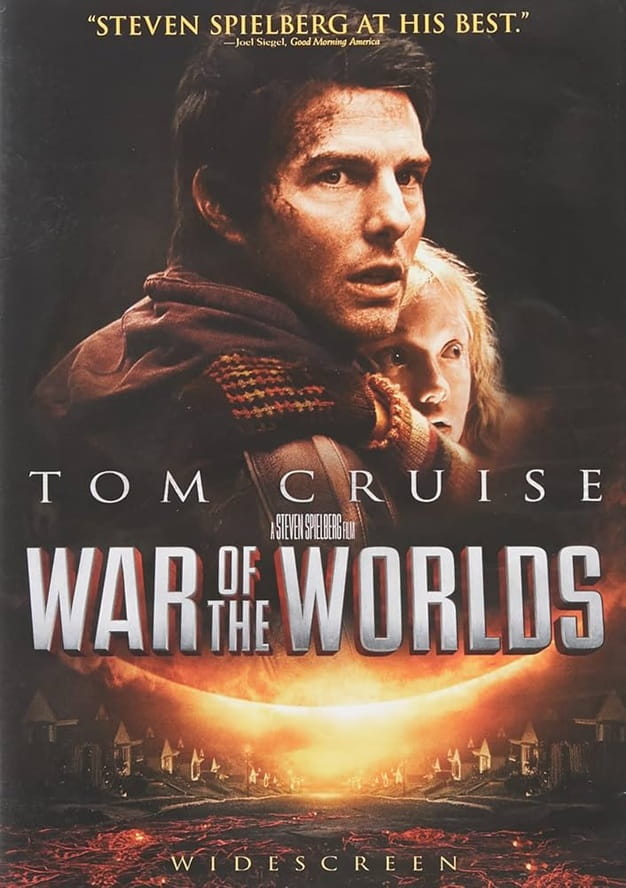
Steven Spielberg’s War of the Worlds (Paramount Pictures, June 29, 2005)
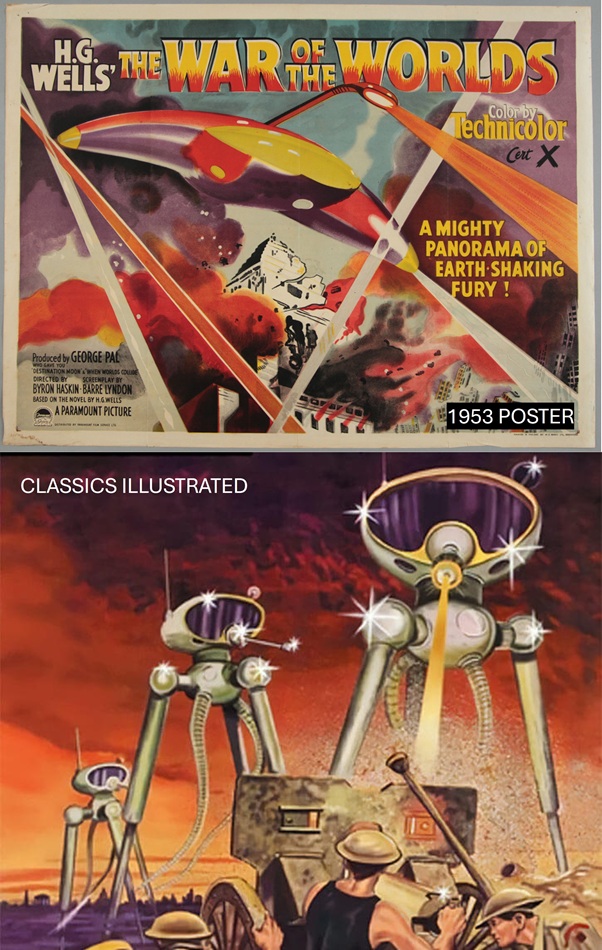
H. G. Wells’ War of the Worlds has always been a favorite of mine, since reading the excellent Classics Illustrated version, then Wells’ novel, and finally seeing the wonderful 1953 George Pale/Byron Haskins film version on television. I first encountered Wells in grade school, in an anthology of short stories, where I first read his “The Truth About Pyecraft”. That’s where I also first encountered Ray Bradbury and his “There Will Come Soft Rains,” and Poe’s The Raven, my favorite poem. Among a number of other authors in that collection were stories by Jack London, Saki, and Robert Louis Stevenson. Later I read Wells’ The Time Machine, When the Sleeper Wakes, The Island of Dr. Moreau, In the Days of the Comet, and The Shape of Things to Come, to name a few.
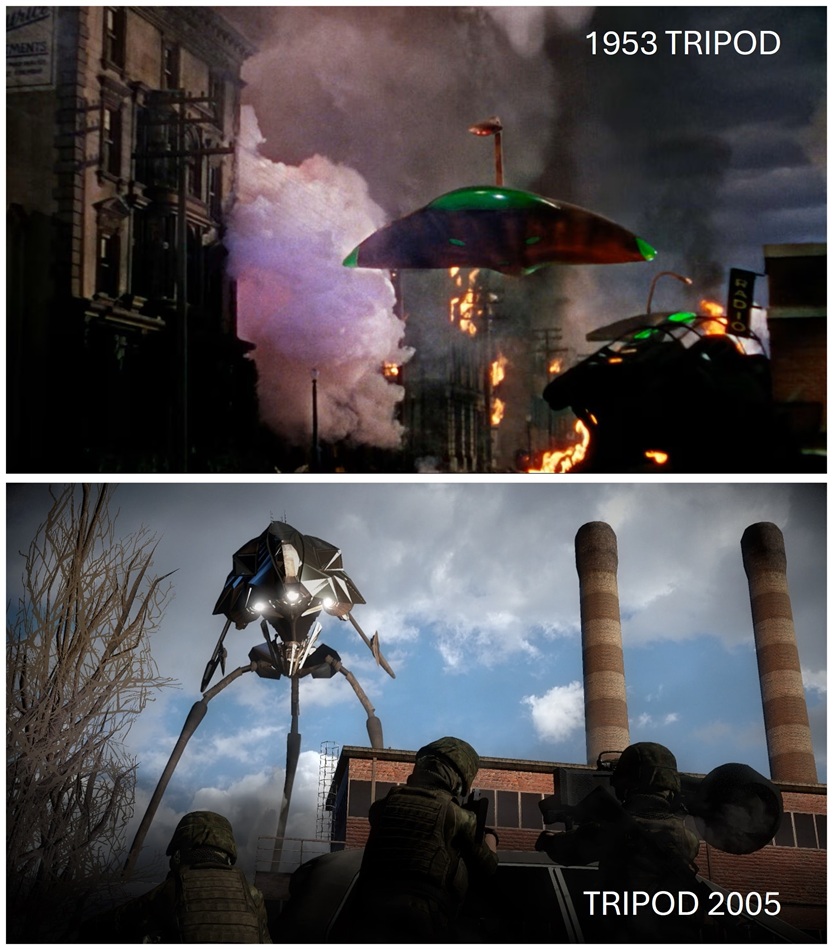
The 1953 film version of War of the Worlds is a classic, for sure, and to me it’s the perfect example of what makes for a great science fiction film. Magical special effects that still hold up today, with solid performances by the cast, and lush cinematography that really pops on Blu-Ray. Enough has been written about that film, so today I want to share some thoughts on Steven Spielberg’s 2005 version, without comparing the two films in any way. I don’t consider it a true remake, because both films are based on Wells’ novel. They’re just two different visions.
The poster for the 1953 film War of the Worlds, and the Classics Illustrated comics edition
In spite of the dislike many people I know have for this remake, Steven Spielberg’s 2005 War of the Worlds was a financial hit. I like this film. After a short first act of family dynamics, the pace never lets up. Sure, it this film has some flaws. Mars is never mentioned in the film, although the prolog, narrated by Morgan Freeman, is taken from Wells’ own opening from his 1898 novel (“Across the vastness of space” etc.), and we are shown an image of Mars.
No one would have believed in the early years of the 21st century, that our world was being watched by intelligences greater than our own. That as men busied themselves about their various concerns, they observed and studied, the way a man with a microscope might observe the creatures that swarm and multiply in a drop of water. With infinite complacency, men went to and fro about the globe, confident of our empire over this world. Yet across the gulf of space, intellects vast and cool and unsympathetic regarded our planet with envious eyes, and slowly, and surely, drew their plans against us.
— Morgan Freeman’s Intro on Youtube
On the DVD commentary, Spielberg says the aliens came from inside the Earth, not from space, or words to that affect, which is somewhat true. But one of special FX people says the “tripod” Martian war machines had been buried in the Earth long ago, which is also mentioned in the film.
But how long ago were the machines buried? Probably before the Earth cooled, surely before humans dominated the planet, before the rise of civilization. He also says, and in the film, it’s later shown, that the Martians themselves came down in small vessels inside the many “lightning strikes,” to retrieve and use their machines.
So why did the Martians wait so long to invade? Planning for the future? Maybe because they needed enough human blood for their terraforming of Earth?
I like the usage of the red kudzu or the Red Weed, as Wells called it. When the war machines rise up from the earth, they emit an electro-magnetic pulse (EMP) that knocks out electricity and batteries in the vicinity. So why was that video camera still operational? Was it outside the “vicinity?”
Red Weed – Stan Winston School of Character Arts
I like that the film uses Well’s ferry boat attack; it’s a powerful scene. The scene in the basement, with Tim Robbins, is also taken from Wells’ novel; it’s revised, of course, but uses some of Ogilvy’s (Robbins) dialog from the novel.
The film, naturally, uses the same death of the Martians as it is in the book; Freeman also has the last word, using the same narration that closes the 1953 film.
I like that this is an intimate version, a family drama. Dakota Fanning, as Tom Cruise’s daughter, is wonderful: she is the heart of this film, and surely her character will need years of therapy. Her scenes with Cruise pack a punch. Cruise has a nice story arc, too, going from a callous, narcissistic and irresponsible parent to a brave, loving and heroic father. His scenes with his son (Justin Chatwin) also run the gamut from a somewhat strained relationship, to one of pride and tenderness; witness the look on Cruise’s face aboard the ferry when his son risks his life to save people, and then again later, when he realizes that his son is not a kid anymore.
The film is filled with excellent performances by the cast. Chatwin’s sibling relationship with Fanning is sweet and loving, and they protect each other.
Now, I’m not always fond of cameos in films, like Stan Lee’s in so many Marvel films. So, I’m not sure how I feel about the cameo in the final scenes, when Gene Barry and Ann Robinson, from the 1953 version, show up as the parents of Cruise’s ex-wife, played by Miranda Otto. They have nothing to do and no dialog whatsoever. (Robinson played her same 1953 character of Dr. Sylvia Van Buren in the 1988-1990 television sequel series.)
There are plenty of intense, dramatic scenes, and the special effects, especially the Martian war machines, are superb. This IS a Spielberg film, after all.
Joe Bonadonna
Joe Bonadonna is the author of the Heroic Fantasies Mad Shadows—Book One: The Weird Tales of Dorgo the Dowser (winner of the 2017 Golden Book Readers’ Choice Award for Fantasy); Mad Shadows—Book Two: The Order of the Serpent; Mad Shadows—Book Three: The Heroes of Echo Gate; Mad Shadows—Book Four: All the Colors of Darkness; the Space Opera Three Against The Stars and its sequel, the Sword & Planet space adventure, The MechMen of Canis-9. In collaboration with author David C. Smith, he’s written the Sword & Sorcery pirate adventure, Waters of Darkness. With author and artist Erika M. Szabo, Joe penned Three Ghosts in a Black Pumpkin (winner of the 2017 Golden Books Judge’s Choice Award for Children’s Fantasy), and its sequel, The Power of the Sapphire Wand. With author Shebat Legion he wrote Undertaker’s Holiday, for “Poets in Hell,” as well as Samuel Meant Well and the Little Black Cloud of the Apocalypse for the shared-world of “Sha’Daa: Toys.” With author Seth Lindberg he wrote The Tarnished Horde, for “Monsters in Hell.”
He also has solo stories appearing in: Azieran: Artifacts and Relics; Savage Realms Monthly (March 2022); Griots 2: Sisters of the Spear; Heroika I: Dragon Eaters; Poets in Hell; Doctors in Hell; Pirates in Hell; Lovers in Hell; Mystics in Hell; Liars in Hell; Monsters in Hell; Sinbad: The New Voyages, Volume 4; Unbreakable Ink; Stand Together—A Collection of Poems and Short Stories for Ukraine; and the anthology, Legion House. In addition to his fiction, Joe has written numerous articles, book reviews and author interviews for Black Gate online magazine.
Amazon Author Page for Joe Bonadonna / Bonadonna’s Bookshelf on Facebook
https://www.blackgate.com/2026/09/24/some-thoughts-on-steven-spielbergs-2005-war-of-the-worlds/
#stevenspielberg #war #classicsillustrated #paramountpictures #morganfreeman #georgepale #byronhaskins #comesoft
#rss #feeds #linksharing #qwibbit
Forgotten Authors: Charles W. Diffin
Astounding, February 1930, Cover by H.H. Wesso
Charles Willard Diffin was born on March 25, 1884 in Meadville, Pennsylvania to Charles A. Diffin and Julia (nee Benedict). He attended the University of Buffalo, where he graduated with a degree in analytical chemistry.
In 1903, Diffin married Pearl Burnside. Their daughter, Beatrice, was born in 1905. Son Charles followed in 1910 and Douglas in 1915. Charles predeceased his parents, dying in 1938 and Pearl died in 1951.
He began publishing science fiction in the February 1930 issue of Astounding with “Spawn of the Stars,” which was reprinted in Conklin’s The Best of Science Fiction in 1946. His “The Power and the Glory” in the July 1039 issue of Astounding explored the use of nuclear power, questioning whether it would be used to benefit or harm mankind.
From 1931 to 1932, he published four stories in his Harkness Bullard series. The series includes an initial trilogy beginning with “Dark Moon,” continuing with “Brood of the Dark Moon,” (serialized over four issues) and concluding with “The Finding of Haldgren,” all published in Astounding. He followed them with the serialized novel Two Thousand Miles Below, which was set in the same universe, although several years earlier.
Diffin’s other serialized novels included The Pirate Planet in 1930. Land of the Lost in 1933/4 and Blue Magic in 1935. All of them appeared Astounding. Although many of his stories did appear in Astounding, Diffin also published stories in Strange Tales, Top-Notch, and various western pulps.
Damon Knight credits Diffin, along with E.E. “Doc” Smith with introducing “the jodhpured and booted [Anglo-Saxon] hero,” in In Search of Wonder, but surely those staples of the pulps predated the creation of science fiction with the adventure stories of the Victorians.
By the mid-thirties, Diffin turned his back on writing for the pulps to focus on his primary occupation was working as an engineer and building contractor. At times, he also worked as an airplane salesman. In addition to his genre writing, he also wrote several volumes in the San Diego City Schools Project on the history of transportation.
Diffin died on May 15, 1966 in Bonita, California and is buried in Greenwood Memorial Park in San Diego.
Steven H Silver is a twenty-two-time Hugo Award nominee and was the publisher of the Hugo-nominated fanzine Argentus as well as the editor and publisher of ISFiC Press for eight years. He has also edited books for DAW, NESFA Press, and ZNB. His most recent anthology is Alternate Peace and his novel After Hastings was published in 2020. Steven has chaired the first Midwest Construction, Windycon three times, and the SFWA Nebula Conference numerous times. He was programming chair for Chicon 2000 and Vice Chair of Chicon 7.
https://www.blackgate.com/2026/10/30/forgotten-authors-charles-w-diffin/
#charles #diffin #astounding #wessocharles #darkmoon #willarddiffin #sciencefiction #pearlburnside #chicon #press
#rss #feeds #linksharing #qwibbit
Dark Muse News: Sword & Sorcery Chain Story (#29-#32)
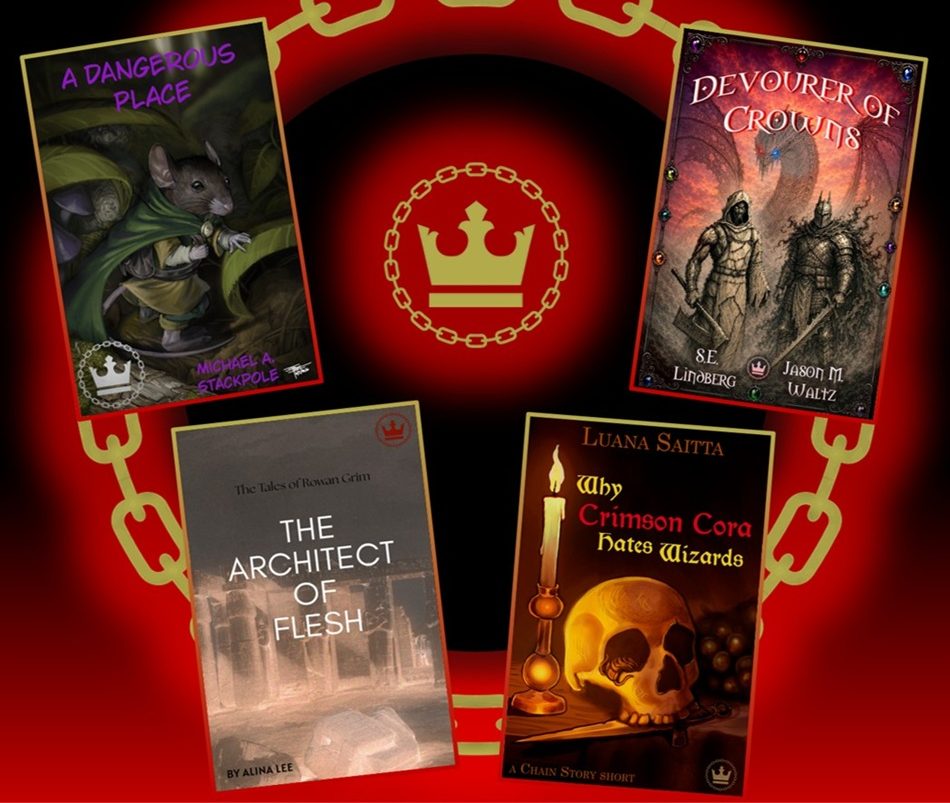
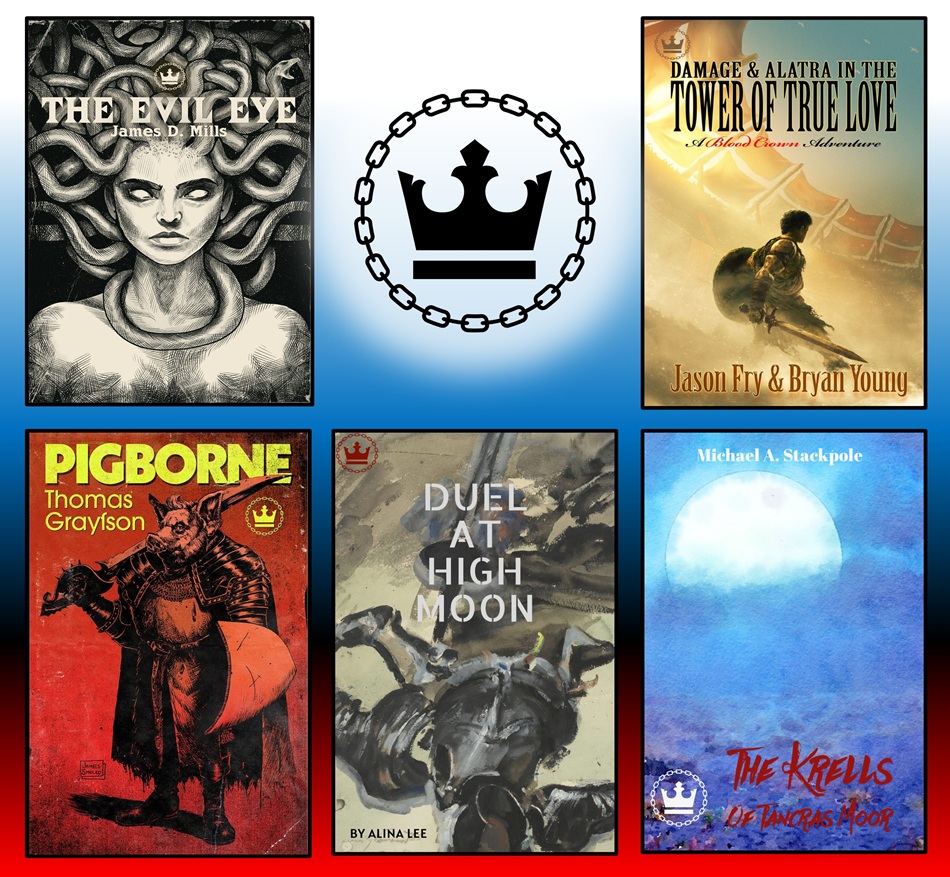
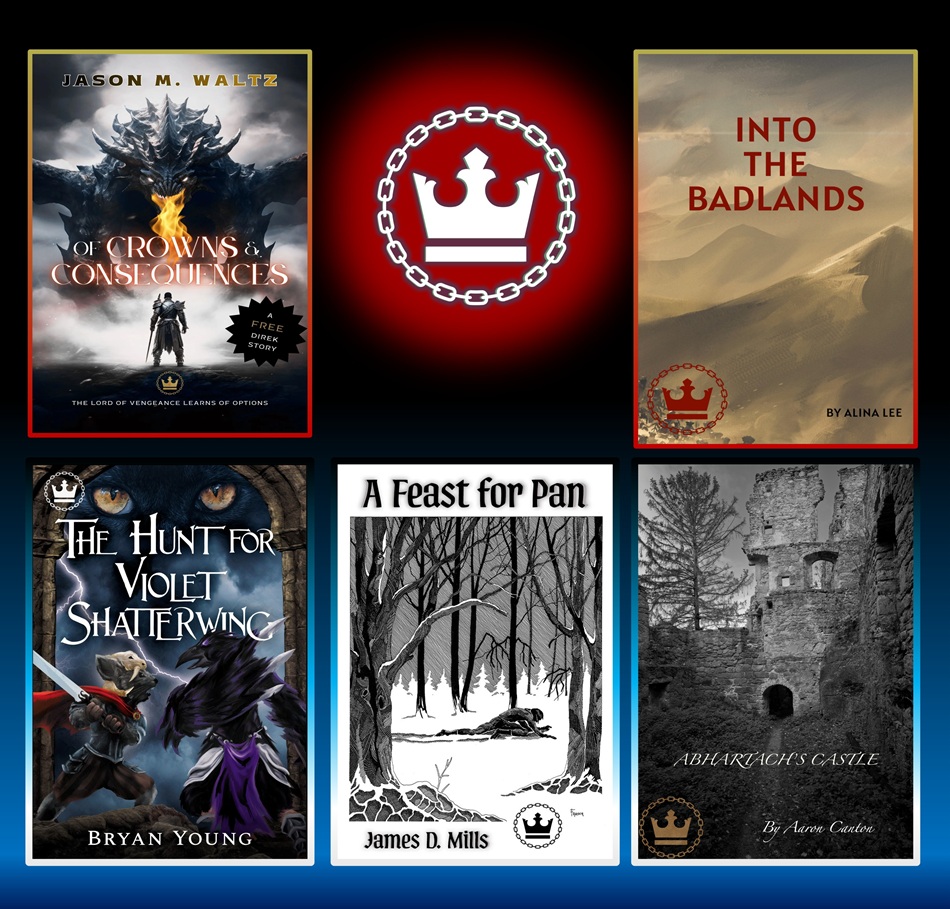
In August 2025, we hailed the emergence of a second Chain Story project championed by Michael A. Stackpole. This is a Sword & Sorcery-focused, contagious set of connected (“chained”) stories.
Each is:
A standalone tale
Readable in any order
Free to read! (for at least three months from its posting date)
Interconnected via a theme involving a Crown
We round up groups every several weeks, but check the Chain Story website for the latest. Here we highlight the latest set of five, Episodes 29-32.
#32. “Devourer of Crowns” by Jason M. Waltz and S.E. Lindberg
Lord Direk struggles to contain the shadow cursing his body when the meddling of unknown entities brings him into contact with the suspicious Doktor Grave. Their shared fascination with the jewels of Tarru-syn may offer Direk deliverance—or be his damnation. Can these strangers from different worlds dare to rely on each other long enough to defeat their common enemy? Will alchemy and will-power be enough to save them from being devoured by the treasures they seek?”
#31. “Why Crimson Cora Hates Wizards” by Luana Saitta
The Ionaian Basin is atwitter with the capture of its scourge, Crimson Cora! Is this the final hour for the dreaded pirate queen? Brought low by the ruthless commander Pallidus, she is left to die upon the shores of a desolate island. Now the tide is rising and demons from the depths hunger for flesh! How will she get outta this pickle, before she becomes a seaside lunch?
#30. “The Architect of Flesh” by Alina Lee
There are terrible things waiting in the Badlands.Rowan Grim returns. In this tale, she finds herself tracking down a workshop of an old enemy of her lost people, the demon known as the Architect of Flesh. What she finds there is more than she expected, and answers to questions she’d not thought to ask. There is more to what she has become than she assumes.
#29. “A Dangerous Place” by Michael Stackpole
Myrk is a mouse who spends most of his time trying not to be seen. However, a mission he sees as urgent causes him to leave The Academy and plunge headlong into a forest which, as all mice know, is a dangerous place for a mouse. And dangerous indeed it proves, as an act of kindness reveals him to one of the deadliest enemies a mouse could ever meet.
Previous Black Gate posts have chronicled groups of the growing chain:
The Chain Story 2 – Sword and Sorcery – Episodes 1 – 3 (Aug 2025)
The Chain Story 2 – Sword and Sorcery – Episodes 4 – 8 (Oct 2025)
The Chain Story 2 – Sword and Sorcery – Episodes 9 – 13 (Nov 2025)
The Chain Story 2 — Sword and Sorcery – Episodes 14 – 18 (Feb 2026)
The Chain Story 2 — Sword and Sorcery — Episodes 19-23 (May 2026)
The Chain Story 2 — Sword and Sorcery — Episodes 24-28 (May 2026)
Entry
Chain_Post_Date
Story
(Link to Free version)
Author(s)
Abstract
32
August 19, 2026
Devourer of Crowns
Jason M. Waltz and S.E. Lindberg
Lord Direk struggles to contain the shadow cursing his body when the meddling of unknown entities brings him into contact with the suspicious Doktor Grave. Their shared fascination with the jewels of Tarru-syn may offer Direk deliverance—or be his damnation. Can these strangers from different worlds dare to rely on each other long enough to defeat their common enemy? Will alchemy and will-power be enough to save them from being devoured by the treasures they seek?
31
August 5, 2026
Why Crimson Cora Hates Wizards
Luana Saitta
The Ionaian Basin is atwitter with the capture of its scourge, Crimson Cora! Is this the final hour for the dreaded pirate queen? Brought low by the ruthless commander Pallidus, she is left to die upon the shores of a desolate island. Now the tide is rising and demons from the depths hunger for flesh! How will she get outta this pickle, before she becomes a seaside lunch?
30
July 22, 2026
The Architect of Flesh
Alina Lee
There are terrible things waiting in the Badlands.Rowan Grim returns. In this tale, she finds herself tracking down a workshop of an old enemy of her lost people, the demon known as the Architect of Flesh. What she finds there is more than she expected, and answers to questions she’d not thought to ask. There is more to what she has become than she assumes.
29
July 8, 2026
A Dangerous Place
Michael Stackpole
Myrk is a mouse who spends most of his time trying not to be seen. However, a mission he sees as urgent causes him to leave The Academy and plunge headlong into a forest which, as all mice know, is a dangerous place for a mouse.
And dangerous indeed it proves, as an act of kindness reveals him to one of the deadliest enemies a mouse could ever meet.
28
June 24th, 2026
Damage And Alatra In The Tower of True Love
Bryan Young,
Jason Fry,
Luke Chmilenko
Damage and Alatra are opposites in every way. thrown together as a gladiator pair and bound by the interaction of their talents so that they can’t be more than four paces apart. Together, they must navigate the perils of the Blood Crown and a dangerous world marked by brutality and sorcery. In the The Tower of True Love, they get a break from the gladiator pits and have been loaned out to protect a traveling caravan. In their travels, they stumble across a mysterious tower that could prove a vulnerability to their employ and are forced to investigate. They get far more than they bargained for when they discover the tower is cursed and they must complete a series of mystical tests to survive.
27
June 10, 2026
The Krells of Tancras Moor
Michael Stackpole
Enemies destroyed Black Morgan of Aldare’s life through deception and guile. They tricked him into shattering everything, everyone, he loved.
Their only failure was in letting him live. And now he is stalking them, intent on putting an end to their evil.
26
May 27, 2026
The Evil Eye
James D. Mills
Gora Younger, the First Son of the Chieftain is exiled from his village in the Great Cave after vainly pursuing his betrothed, who left him to live beneath the sky. After years sealed away in the dark, Gora is summoned home to investigate a demonic presence that has taken the tribe’s best warriors and afflicted the Chieftain with a strange malady, slowly turning his flesh to stone. Diving into uncharted depths alongside a healer from a strange city, Gora must dispel a curse that has long shackled his people… and his soul.
25
May 27, 2026
PIGBORNE
Thomas Grayfson
Captain Malion is one of the last defenders of Genlina, an animal kingdom reduced to feral instinct by the sapphire of Tarru-Syn. As his mission into the Nexus Dimension unravels and his comrades are irrevocably transformed, he must decide what he is willing to sacrifice to reclaim his world.
A grimdark animal fantasy in the spirit of Redwall, Pigborne is a brutal tale of loyalty and ruin.
24
May 13, 2026
Chain Story Project: Duel at High Moon
Alina Lee
Rowan Grim’s fearful hunger is sated, at least for a bit, so her only desire is for a hot meal, a warm bath, deep sleep and perhaps a dream. Galant’s Gultch looks like the town that can provide all that and even a little whiskey.
But there are forces in the town which see her as something more than a weary traveler. They think she will sate a hunger they have. And, under the Scarlet Moon, the truth of the matter will be revealed.
23
March 25, 2026
A Feast For Pan
James D. Mills
IN THE WASTES, ALL ARE FODDER FOR PAN. In a return to the world of SOIL and Ashen Rider, Hromgir and Arvid of Clan Sparrow are on the run after a raid gone wrong. Braving the frozen wastes of the northern coast, they must reach the mountain pass to escape the Wystran riders close on their heels. Hiding from the riders, they take shelter in the depths of a strange cave, unearthing otherworldly horrors better left buried….
22
March 11, 2026
Abhartach’s Castle
Aaron Canton
A trio of student witches head off on a dangerous adventure to obtain a powerful artifact—aiming to retrieve it and keep it out of the hands of sinister forces.
Unexpectedly they meet opposition in the form of a classmate they’d once all considered a friend, but who has become a most dangerous foe.
21
February 25, 2026
Into The Badlands
Alina Lee
Rowan Grim’s world is one which is long on places you don’t want to travel to, and few people return from. But what is out there draws her, and she willingly embraces the challenges which have devoured so many others.
20
February 9, 2026
The Hunt For Violet Shatterwing
Bryan Young
Now returned to Nightfall Forest, and in the company of the fox bard Ashley, Pip finds the hamlet of Riveroak ablaze. The mouse knight, his war cat, and companion race to quench the fires and hunt the leader of the crow cult, intent on putting an end to her evil.
19
January 28, 2026
Of Crowns & Consequences
Jason M. Waltz
Direk, wielder of the magickal sword Retribution, has been dispatched to destroy an old enemy at the behest of his King. In his pursuit he encounters a newly awakened power which challenges his knowledge of the world, and threatens to up end all he knows to be true.
18
January 19, 2026
The Sapphire and the Sorceress
Bryan Young
As with all good heroes, Pip does not shrink from danger and adventure. Still, there are times when it would be good to relax at home. But Pip is far from home, and is searching for a powerful sorceress who can help him on his way.
17
January 14, 2026
Terror Above Icehenge
Malcolm T. North
To reach her, however, he’ll have to venture through the Chaos Realm and, as every true hero knows if you undertake that journey lightly, it will end quickly. But Pip has no choice, and therein our adventure begins.
16
December 31, 2025
Demonfire: A Tale of Shintaro Oba
C. L. Werner
A forbidden ritual conducted in secret, bathed in blood and death enables a demon to grasp unimaginable power—the power to destroy all enemies and raise himself above all others.
15
December 24, 2025
In The Land of the Giants,
Bryan Young
A Samurai, whose duty calls for him to hunt down such a creature. A destiny he must pursue even as the world burns around him.
14
December 10, 2025
Blight
Katherine Monasterio
Forest Ranger Hazel Boncliff is a Green Speaker, a person with the magical ability to commune with plants. When the king summons Hazel and her assistant to the capital to heal the strange blight affecting his hunting grounds, she’s reluctant to help—least of all because he’s insisting his inexperienced secretary go along for the journey. But with a reward she can’t refuse and the blight’s effects more harrowing by the moment, she’ll take all the help she can get.
13
November 26, 2025
Ice Hawk’s Aerie,
Bryan Young
A chance meeting in the dark forest. A tale of woe and injustice.
Pip Strongpaw, the last of the fabled Great Catriders, must once again wield the runed-sword Feathersbane, to end the chilling menace threatening to destroy the hamlet of Riveroak. A menace of sorcerous origins against which even the bravest of heroes may not prevail.
12
November 12, 2025
Blood for the River
Michael Stackpole
Chased into a swamp by homicidal cultists, Kellach and Serinna encounter a fire mage who saves their lives, and then leads them on an adventure that is sure to get them killed.
11
October 14, 2025
Of Nightmares & Jewels
Robert Greenberger
Something drew the mage onward, always toward the northwest, through restless evenings and dark dreams of ill portent. Yet when Jareth’s traveling companion, the swordswoman Talin, asks him why, he has no idea.
And then they reached a tiny town at the edge of nowhere, wherein lurked an evil with roots sunk deep in times beyond remembering; an evil that has chosen their visit as a time to awaken.
10
October 14, 2025
The Cursed Cuff
Aaron Rosenberg
She came to them spinning a tale of woe. An army of undead lay siege to the Manor she called home. She had barely escaped and sough adventurers brave enough to free her people.
But to do that Birr Blackjaw and his companions would have to wrest an ancient artifact from the hands of a cult leader who had his own army, and a hellish pet none could hope to defeat.
9
October 1, 2025
The Monastery Plot
Bryan Young
Shield Maiden and legendary sleuth Sister Agatha, accompanied by her faithful initiate, Brother Dominguez, sought to enjoy peace and quiet at the Monastery of St. Maryam.Despite their desires, they soon find themselves investigating twin murders. Murders which become all that much more bizarre when the name Tarru-Syn turns up, and their search leads them into the very bowels of the earth, to face a foe from beyond their reality.
8
September 24, 2025
On Memories
Michael Stackpole
Dancillius Hrekt is fairly new to the world of Monster Fighting. All he wants to do is to make a good impression with his peers. And all they want is for him and his best friend to die.
7
September 10, 2025
The Village of Morvoss
Thomas Grayfson
In this new Kavion adventure, our tormented knight clings to the last threads of family and sanity as he navigates the mysterious Village of Morvoss. Haunted by fractured memories, he must confront the darkness around him—and within.
6
August 27, 2025
Fragment of a Sorcerous Crown
Joan Marie Verba
In this tale from the Chronicles of the Library of Sorcery, the sorcerers investigate a dangerous magical artifact of mysterious origin. Can the sorcerers uncover the truth?Sorcerer Serena is called to investigate an enormous, carnivorous plant. She finds that a mysterious magical artifact is behind the phenomenon. To find out where the artifact came from and what its properties might be, she consults the Library of Sorcery, where she uncovers the answers, but not on the Library shelves. Can the artifact be banished from the sorcerous regions before it becomes a more deathly threat?
5
August 13, 2025
Grave’s Brood
S.E. Lindberg
Doktor Grave sends Brood to recover a crown from the Red Orchard, only for Brood to find it is the source of a bloody plague caused by Grave’s experiments. Facing vampiric plants and their loyal clan, Brood must confront his past and question whether he can trust Grave or escape the nightmare himself.
4
July 28, 2025
Shard of Song
Rigel Ailur
Two wizards search desperately for a way to stave off a vicious magical-musical attack before the dragons succumb. A powerful relic ancient beyond memory calls to them, but do they dare use it?
3
July 16, 2025
Forest of the Fallen Colossus
Bryan Young
A dying robber hands Laila and Zaki a mysterious artifact in the middle of a fae-haunted wood. “Danger,” the robber manages before dying. Suddenly sister and brother find themselves safeguarding an unwanted gift—on the run for their lives in the Forest of the Fallen Colossus.
2
July 3, 2025
Death Grip
Michael Stackpole
The man hadn’t died easily.A smoking hole sat where his heart should have been. Terror twisted his features, and he clutched an emerald reeking of magick as if would somehow save him. Neryon and Magistrate-Martial Logan find themselves in a race to find the killer before he has a chance to harvest more victims. But, with the amount of power used on his first target, there was a big gulf between finding and stopping; and no guarantee he wouldn’t kill them, too.
1
July 3, 2025
Blade of the Storm Witch
Robert E. Vardeman
Her vengeance became elemental! The Conqueror-King’s minion murdered her pirate husband. The Lady Rennata was condemned to follow him into a watery grave—until wind and wave swept her to a magical blade that commands all of Nature.
S.E. Lindberg is a Managing Editor at Blackgate.com, regularly reviewing books, interviewing authors on ‘Beauty & Art in Weird-Fantasy Fiction’, and running Dark Muse News. He has taken lead roles organizing the Gen Con Writers’ Symposium (2021-2023) and the Goodreads Sword & Sorcery Group; he even interned for Tales from the Magician’s Skull magazine and is an Assistant Editor for Battleborn magazine. As for crafting stories, he has contributed eight entries across Perseid Press’s Heroes in Hell and Heroika series, and has an entry in Weirdbook Annual #3: Zombies. He independently publishes novels under the banner Dyscrasia Fiction®; short stories of these have appeared in Whetstone and Swords & Sorcery online magazine, Rogues In the House Podcast’s A Book of Blades (Vol. I and Vol. II), DMR’s Terra Incognita, Tales From the Magician’s Skull, Savage Realms M
https://www.blackgate.com/2026/10/29/dark-muse-news-sword-sorcery-chain-story-29-32/
#rss #feeds #linksharing #qwibbit
#29
#32
#31
#30
#3
Black Gate (Unofficial)2d
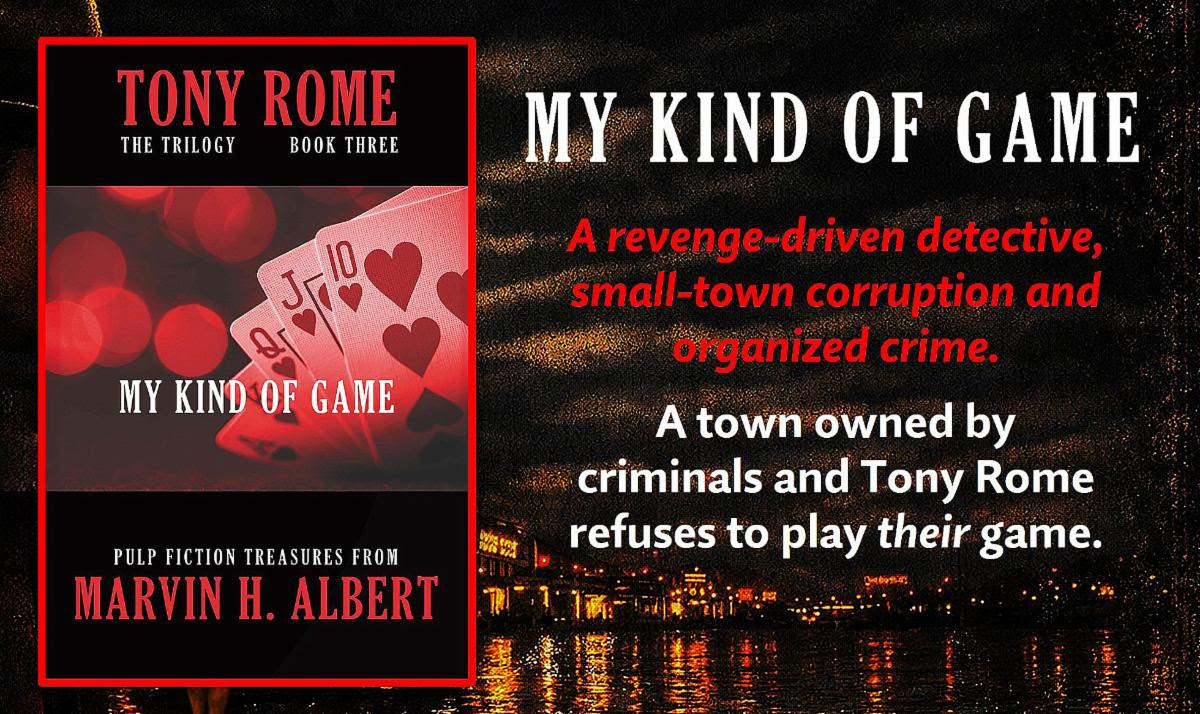
Pulp Treasures Rediscovered: Tony Rome, Private Eye by Marvin H. Albert
Twelve years ago, I wrote a piece for Black Gate about Marvin H. Albert’s unsung hardboiled private eye, Tony Rome. The post concluded with my suggestion, some might claim it was a plea, that an enterprising publisher would give these long out-of-print treasures a new lease on life. Here we are a dozen years later and that is exactly what has happened.
The paperback original (PBO to collectors) was the immediate successor to the pulp magazine as the home of pulp fiction. Marvin Albert was one of the bright lights of the paperback original market for detective fiction.
Albert’s work is revered in France, where he is considered a master of the hardboiled form, but he is largely forgotten stateside since his work lacks the literary polish of Dashiell Hammett or Raymond Chandler and was never shocking like Mickey Spillane. Albert may not have broken new ground, but he did excel at crafting hardboiled private eye stories in the classic tradition from the 1950s through the 1980s.
Much like Max Allan Collins or Michael Avallone, he also supplemented his income by adapting screenplays as movie tie-in novels for the paperback original market. Oddly enough, Albert specialized in bedroom farces for his movie tie-in assignments, in sharp contrast to his tough guy crime novels and westerns.
Albert utilized a number of pseudonyms during his career (although many of these titles were reprinted under his real name towards the end of his life). He published three hardboiled mysteries featuring a tough private eye called Tony Rome in the early 1960s. The books were originally published under the byline of Anthony Rome, as if to suggest the tales being told were real cases.
Tony Rome is best remembered today thanks to a pair of campy Frank Sinatra vehicles in the mid-1960s which portray the character as a middle-aged playboy drooling after bikini-clad lovelies half his age. The fact that the private eye operated out of a houseboat called “The Straight Pass” seems to have inspired John D. MacDonald’s Travis McGee private eye series, which launched later in the decade. The sad thing is such vivid recollections of the character do a terrible disservice to the books.
Tony Rome, on the printed page, is a private eye who carries a great deal of emotional baggage. He quit the Miami Police Department after his father (a police captain) committed suicide following public exposure by a political rival that he had once accepted a bribe early in his career. Tony quit the force and largely retreated from the world aboard his houseboat. He is most at home snorkeling in the beautiful and peaceful Atlantic Ocean. Crime routinely brings him ashore and Rome sees justice is done before retreating out to sea once more.
While no longer a young man, Tony has no interest in settling down or even seriously dating anyone. He feels the occasional attraction and pangs of loneliness, but in the end, he remains the loner who knows he is too damaged to be of use to anyone else. He is also surprisingly self-conscious of his gambling addiction and realizes he would make a poor husband and father with his various issues.
Lest one think the character wallows in clinical depression, it is worth noting that Tony’s troubled past has afforded him an understanding of life’s other outsiders. Tony views the strippers and junkies and lesbians, that are treated as objects of lust or ridicule ripe for exploitation by the lowlife users that populate Miami, as real people deserving of compassion. In that respect, Sinatra’s interpretation of the character is a stinging betrayal of the humanity of the literary original.
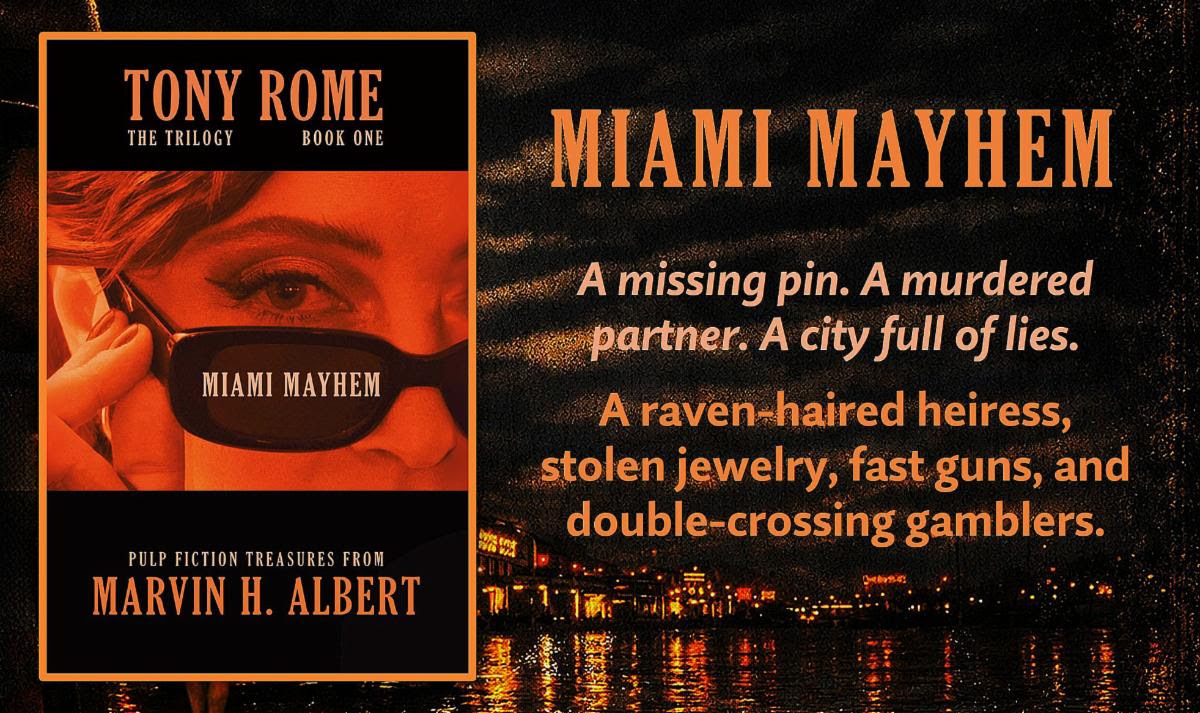
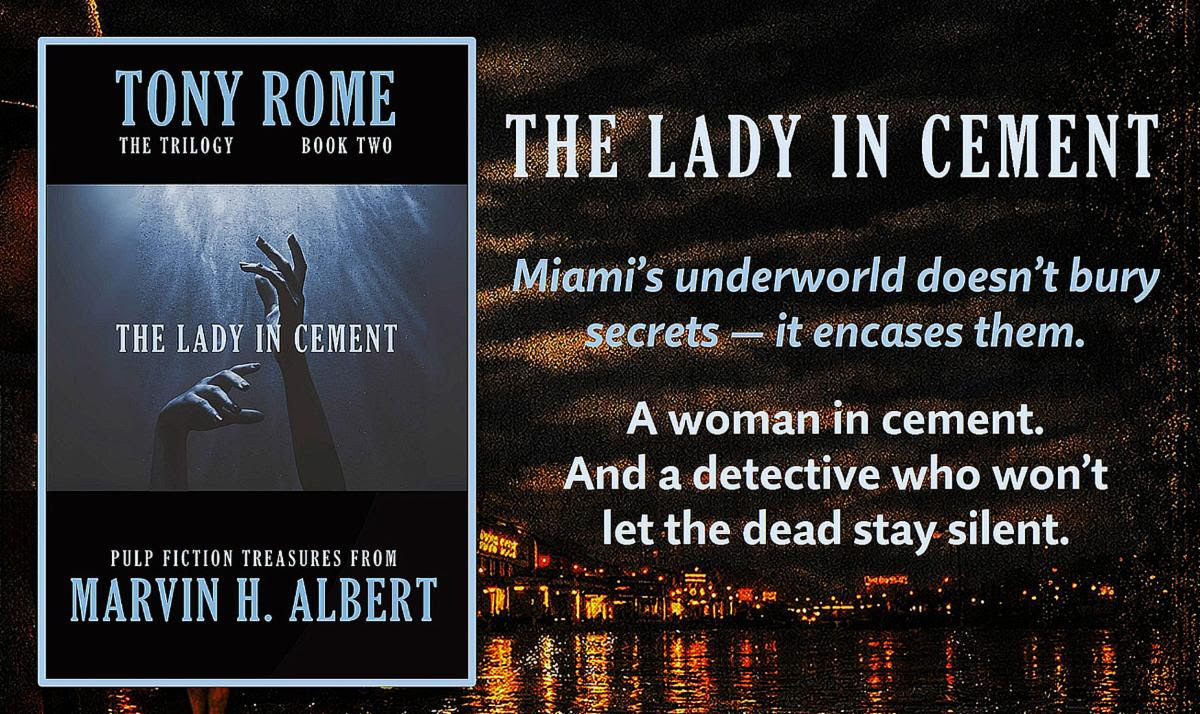
The Tony Rome trilogy from Compass Rose Publishing, 2025-2036 editions
The first book in the series, Miami Mayhem (1960), plays like an update of Chandler’s The Big Sleep (1939), with its exposure of the dirty secrets wealthy families can afford to hide most of the time. The second title, Lady in Cement (1961), sees Tony stumble into the middle of a sordid mob connection after discovering the corpse of a nude woman in a block of cement while snorkeling in the deep blue sea. The third and final book, My Kind of Game (1962), sees Tony on a mission of vengeance when the surrogate father figure who mentored him in the private eye business is worked over while investigating big crime in a small town.
All three books have strong echoes of Chandler and the last has echoes of Hammett’s Red Harvest (1929). Every time I settled into thinking the story was purely a routine gumshoe caper, Albert would toss in an original wrinkle that would keep me off guard and hold my interest. All of the traditional hallmarks of the genre are present from the cop friend with a prickly relationship with the private eye to the detective as knight errant setting the world to rights by staving off the forces of chaos that threaten to overturn a surprisingly fragile society.
Tony Rome’s adventures are worth discovering, as are the talents of the criminally ignored Marvin Albert. For all those hardboiled purists who balk at continuation writers trying to resuscitate Philip Marlowe, discovering a Marlowe-inspired hero like Tony Rome should prove a more than acceptable alternative.
All three titles are back in print courtesy of Compass Rose Publishing; an independent publisher focused on brick-and-mortar bookstores rather than POD selling principally through Amazon. The brainchild of former Congressman turned author/filmmaker Robert Mrazek, a man who already built a lasting legacy in film preservation, land preservation, historical preservation, and protecting the rights of children.
Compass Rose Publishing steadfastly refuses to follow the modern publishing model by believing in promoting new talent, rediscovering lost classics, and helping brick-and-mortar bookstores survive. Like Charley Varrick, they are the Last of the Independents and a fitting home for authors new and old who don’t fit the modern mold.
William Patrick Maynard was authorized to continue Sax Rohmer’s Fu Manchu thrillers beginning with The Terror of Fu Manchu (2009) and The Destiny of Fu Manchu (2012). Both titles were recently reprinted by Cancelled Books. Maynard’s never-bef0re-published third novel in the series; The Triumph of Fu Manchu is scheduled for publication this Fall from Cancelled Books.
https://www.blackgate.com/2026/10/28/pulp-treasures-rediscovered-tony-rome-private-eye-by-marvin-h-albert/
#tonyrome #privateeye #albert #marvinalbert #pulp #blackgate #mickeyspillane #dashiellhammett #raymondchandler #michaelavallone
#rss #feeds #linksharing #qwibbit
#tonyrome
#privateeye
#albert
#marvinalbert
#pulp
Black Gate (Unofficial)4d
Nine Years Later – Revisiting Castlevania and Tragic Villains and Heroes
Goodafterevenmorn, Readers!
Being chronically online has revealed some pretty awesome things (as well as absolute nonsense (covered previously)). For example, I discovered an entirely new to me Transformers show – Transformers Prime, which is a lot of fun. Also, fully available on YouTube, if you’re interested. Perhaps one day I’ll go through the show and point out its very funny rebuke of the Bayverse Optimus Prime. It’s probably very basic of me, but Optimus was always my favourite Cybertronian. But we’re not here to talk about that.
What I wanted to talk about was Castlevania. Let’s dive in!
The YouTube algorithm has been popping off with new reactions to Castlevania in my feed — a now nearly ten-year old Netflix original animation adapted from a series of video games bearing the same name. It is far and away the single best video game adaptation, I think, or at least on par with The Last of Us (which I also loved). So of course, I’ve had to rewatch it. Nothing has changed from the first time I watched it. Castlevania is phenomenal; a masterclass in writing and voice acting, as well as stylish animation.
But what struck me most was how it is a beautiful example of writing tragedy. In fact, Vlad Dracula Tepes in this series is one of the best sympathetic villains I’ve seen in pretty much any media. His son is one of the best tragic heroes. I’ve written about Vlad specifically before on this very site, I realise (as a search for images to use revealed my own damned article… that’s a weird experience), so I’m going to focus a little more on Alucard this time… Though I remain absolutely fascinated with Vlad as a character in this show. I’m also limiting it to the first two seasons, because there is a lot that this poor boy goes through, and I’d be writing forever if I went through it all.
The first two seasons make for a nice contained story within themselves, though the rest of the series is well worth the watch.
If you’ve not seen the series, stop reading right now, go watch it (four short seasons; very binge-able), and come back and tell me your heart didn’t break for both Vlad and Adrian (Alucard). Also, do it now, because this will be full of (probably mild) spoilers.
Right, so, from my last article, we know that Vlad’s quest for genocide was the direct result of his human wife being murdered — accused of witchcraft and burnt at the stake for the crime of effectively practicing medicine. We all know that women in possession of medical knowledge must have acquired it from association with the devil (that was sarcasm, in case that needed explaining). Which… in this story, is not really all that far from the truth. Lisa did make her way to Vlad’s castle and demand he teach her the sciences necessary to help her become a physician and help the people of Wallachia. So, I mean, she did learn it from a creature we might consider the embodiment of evil, I guess. There’s that.
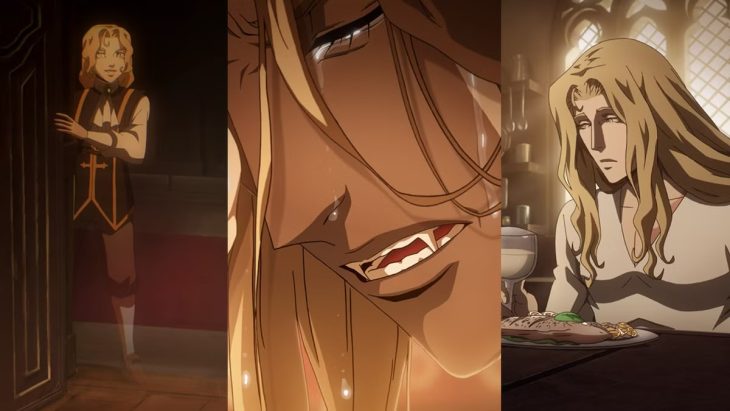
In the first episode, we’re introduced to a mysterious blond man who tells Vlad that he also grieves Lisa’s death, and those responsible should be punished, but that he would not let Vlad commit genocide. Enraged, Vlad slashes this mysterious blond man. In that scene we don’t really see what this stranger looks like, save that he is blonde. If you are watching without the captions, you don’t even know it’s Alucard.
Not Alucard, but his father. Still one of the greatest sympathetic villains I’ve seen.
I’m not going to recap everything here. What you really need to know is that while Dracula was intent on making the world suffer for murdering his wife, Adrian was intent on saving the innocent from his father’s wrath. Both of them were, in their ways, acting out of love. Lisa would not want genocide in her name. Indeed, she even attempted to appeal to her husband as she died. Not that he could hear. He was off travelling.
So we have love for the same woman as the central fulcrum balancing two opposing ends. Vlad would kill his son to see his vision of a human-free world. Adrian would kill his father to prevent that. In his own words, he chooses to honour his mother by killing his father. What a terrible choice to have to make. But in Alcuard’s mind, his father cannot be stopped otherwise. Indeed, the man who was his father had died with his mother, and only a madman remained, lashing out in “the world’s longest suicide.”
Alucard had failed to stop his father before (right at the beginning of season one). We watch his journey as he teams up with a Belmont, the hilariously sardonic last son of House Belmont, and a speaker magician. So this time, when he confronts his father again at the end of season two, he has friends. Together, the three of them fight Dracula. And here we have the terrifying power of Vlad Dracula Tepes on display. He hasn’t been feeding. He is in a weakened state, and still, the three of them cannot overcome him.
The only reason Alucard is able to land the final blow that kills his father is because Vlad ultimately lets him. Their ferocious battle through Dracula’s castle ends in Adrian’s childhood bedroom. It is there that Vlad realises that it is his son he’s very nearly killed. And he mourns it. He mourns nearly obliterating the gift his wife had given him. Only in that grief, only when his lovingly reaches for his son, does Alucard find the opening he needs to drive an improvised stake through his father’s heart, killing him.
That scene is as beautiful as it is brutal. The looks of grief and horror on Alucard’s face as he watches his father crumble to dust before his eyes is beautifully done. This isn’t a triumph. Sure, the genocidal maniac is killed. The heroes achieved their goal. But that victory is costly, and it is heartbreaking. At least for one of the heroes.
This heaviness is not lifted in the final episode of the second season. The aftermath. We see the other two heroes, Trevor and Sypha, head off together, clearly in love and happy. They won the day. Dracula is dead. The genocide is averted. Yay! They experience what many heroes written get to experience. Alucard is left alone in a guarding a ruined house, in a ruined castle full of mostly happy memories. There isn’t some grand celebration for Alucard. He isn’t satisfied or happy.
In fact the very last shot of the season is this:
If the last episode broke hearts, this one shattered them. I have never wanted to hug a fictional character more. Poor baby.
It is also the perfect way to end the first two seasons. It’s also one of the best representations of the cost of heroism I think I’ve seen in visual media.
We are inundated with stories of heroes doing the deed and then being celebrated. It’s rare that we see heroes being affected by the things they’ve had to do to save the world in this way. It’s not usual for us to see heroes struggle after victory, to feel guilt or grief over the lives they’ve had to take. Personal cost for far too many heroes in media stops at physical harm. Not this series.
Like Frodo in The Lord of the Rings, the quest to save the world cost far more than a few scars or broken bones.
I adore the writers of this series for this. Creating this tragic character that is a hero, who achieves his goal, and who grieves because of it was a most excellent choice.
Because here’s the truth about heroism. It’s hard. Doing the right thing, the good thing is really, ridiculously hard. So hard, in fact, that few people do. The cost is judged too high for most people to do the right thing, even about much, much, much smaller evils than Dracula (or Sauron). Showing the deep, personal cost of Alucard’s act of heroism, of him protecting humanity, making himself an orphan in doing so, was brilliant. I would love to see more stories like this.
Of course, the writing throughout the first two seasons (and the entire series, to be honest), made this ending so damned emotional (at least for me. I sobbed — sobbed — the first time I saw this). And I really do also enjoy the more campy representations of heroes and heroism, when they win the day and are perfectly fine with all the things they had to do to get there. But there is a special place in my dark little heart for the tragic hero.
Anyway, I’ve already said it here, but I’ll say it again, Castlevania is masterful, and I’m so glad that the algorithm has put it back into my feed. I think this will become a yearly Hallowe’en-time watch for me. I love it.
When S.M. Carrière isn’t brutally killing your favorite characters, she spends her time teaching martial arts, live streaming video games, and sometimes painting. In other words, she spends her time teaching others to kill, streaming her digital kills… and sometimes relaxing. Her most recent titles include Skylark, Human and The Timbercreek Incident.
https://www.blackgate.com/2026/10/27/nine-years-later-revisiting-castlevania-and-tragic-villains-and-heroes/
#vlad #castlevania #transformersprime #optimusprime #bayverseoptimus #which #vladdracula
#rss #feeds #linksharing #qwibbit
Nero Wolfe’s Brownstone: What If? – The Unchronicled Cases
Two Nero Wolfe posts in one month? What flummery is this? Like most avid readers know, there’s just not enough time to read (and write about) all our interest areas.
I finished a Terry Pratchett novella (last week’s post), while continuing on with a Savage Sword of Conan Omnibus, and starting a first read of Tolkien’s Sir Gawain and the Green Knight (I’m never gonna be a poetry fan), AND grabbing an Isaac Bell detective book from the Clive Cussler shelves.
While still working on a couple of Nero Wolfe projects ‘in my other spare time.’ I started this one a year or two ago and finally dialed in to finish it. And man, it was fun. Using every original or alternate title, I came up with a different plot, title, or both. With a minimum of two per.
Some are ridiculous, but some others would make good stories. Regardless, this was a very enjoyable dive into The Corpus. I think it’s satisfactory, though Wolfe would probably go with flummery.
FER DE LANCE
Fair de Lance – A murder occurs during a joust at a Ren Faire which Archie and Wolfe are attending.
Press My Pants – Wolfe’s favorite launderer is murdered.
THE LEAGUE OF FRIGHTENED MEN
The League of Frightened Men – Fritz burns dinner; Theodore lets a prized orchid die; Archie forgets to pay the beer supplier.
The League of Frightened Hens – Wolfe is forced to solve a crime at a chicken farm.
THE RUBBER BAND
The Rubber Band – Archie accidentally hits Wolfe in the face with a rubber band. Alternate title – You’ll Poke Your Eye Out.
The Robber Hand – A card shark hustles Archie; who is the lead suspect when he’s found dead.
THE RED BOX
The Red Sox – Wolfe is hired by the Yankees to get the dirt on Boston’s star pitcher.
The Red Fox – Archie finds murder and mayhem when Lily drags him to a fox hunt on a country estate.
TOO MANY COOKS
Too Many Books – Marie Kondo writes an article, criticizing Wolfe’s book habits.
Too Many Looks – Lily finally has enough of Archie noticing other women.
Too Many Crooks – A valuable diamond necklace is stolen at a mob gathering. The capo hires Wolfe.
SOME BURIED CAESAR
Some Harried Caesar – Somebody is trying to ruin Sid Caesar, who comes to Wolfe for help.
Don’t Carry Visa – Wolfe is hired over a major credit card fraud.
OVER MY DEAD BODY
Over My Dead Body – When Archie says this to a thug with a gun in hand, he says ‘Works for me’ and shoots Archie.
Over Thy Dead Body – A priest is found dead, clutching a rare Gutenberg Bible.
WHERE THERE’S A WILL
Where There’s a Will – Archie gives up milk for Lent.
Where There’s a Grill – Circumstances force Fritz into an Iron Chef-type competition, on barbecue grills.
BLACK ORCHIDS
Black Orchids – A fire breaks out in the rooftop garden.
Black Beans – Due to a world-wide bean pandemic, Wolfe can only have black beans to eat for the winter.
CORDIALLY INVITED TO MEET DEATH
Cordially Invited to Meet Death – Wolfe investigates a major NYC funeral home racket.
Cordially Invited to Meet Seth – Seth Green wants protection from a stalker on the set of an Austin Powers film.
INVITATION TO MURDER
Invitation to Murder – Archie is invited to a murder mystery dinner where the victim is a Wolfe copy.
Invitation to Nurture – A murder occurs at a baby birthing class.
NOT QUITE DEAD ENOUGH
Not Quite Dead Enough – It seems that someone Wolfe sent to the electric chair has come back to get revenge.
Not Quite Red Enough – Wolfe’s envious disbelief that someone has grown a pure red Vanda in NY enmeshes him in a murder.
THE BOOBY TRAP
The Booby Trap – Archie hunts a killer in a bra factory.
The Scooby Doobie Trap – Archie is after Shaggie for pot dealing.
THE SILENT SPEAKER
The Silent Speaker – Wolfe investigates a killing at a mime convention.
The Silent Speaker – Harpo Marx visits the Brownstone.
The Silent Beaker – Wolfe investigates murder in a lab.
TOO MANY WOMEN
Too Many Women – Archie is the lead suspect when a murder occurs at a beauty pageant he’s judging. Wolfe has to go on-site to clear him.
Too Many Women – Archie is the lead suspect when a murder occurs at a charity bachelor auction he is up for bid at.
Choose Any Lemon – Wolfe buys a new car but finds the dealer has been conned into selling lemons.
Too Many Vermin – The Brownstone has a rat infestation.
AND BE A VILLAIN
Aunt Bee the Villain – Archie’s Aunt Bee visits from Ohio and finds herself in trouble with the law.
Four Deaths in One – Four corpses fall out of a closet. (More Deaths Than One is British Title of And Be a Villain)
THE SECOND CONFESSION
The Second Confession – Stebbins thinks he has to cover up for Cramer. Who then covers up for him. Wolfe finds the real culprit.
The Second Confession – Rowcliffe thinks he’d finally got Archie when the latter confesses to a murder, and it fits perfectly. Then Saul confesses, and it fits just as well.
The Second Regression – Regression analysis plays a part in the solution.
TROUBLE IN TRIPLICATE
Trouble in Triplicate – The IRS audits Wolfe. (I know it’s a collection: I just like the plot)
BEFORE I DIE
Before I Die – A dying man gives Archie clues to a case he and Wolfe failed to solve years ago.
On The Floor I Lie – Archie wakes up from a major bender – next to a dead woman.
HELP WANTED, MALE
Help Wanted, Mail – Theodore quits and becomes a postal worker. Wolfe is too much without Theodore in the plant rooms and Archie has to lure Theodore back.
Help Wanted, Bail – A judge orders that Wolfe’s annoying client must stay at the Brownstone as part of his bail.
INSTEAD OF EVIDENCE
Bed of Evidence – The key to solving a murder is a bed of flowers at a country house. Wolfe constantly grumbles about non-orchid flowers.
Dread of Evidence – Archie finds a clue that makes it clear Wolfe’s client is guilty.
IN THE BEST OF FAMILIES
In the Best of Families – Wolfe investigates a murder in the Rockefeller social circle.
In the Rest of the Homilies – Wolfe has to find a key clue in homilies given by murdered priests.
THREE DOORS TO DEATH
Three Doors to Meth – Wolfe is drawn into Cramer’s case, looking for meth labs being operated out of townhouses in the city.
MAN ALIVE
Man Alive – This used to be Saul’s go-to phrase. We see the case where it became ‘Lovin babe’ instead.
Man Alive – The heir to the Remmer’s beer business promises Wolfe free beer for life if he can find his father, presumed dead.
Man Arrives – A man shows up on the stoop, claiming to be Archie’s brother.
OMIT FLOWERS
Omit Flowers – Wolfe is left off the list of Top 10 NY orchid growers. And investigates when someone kills down the list – towards Lewis Hewitt!
Omit Showers – The Brownstone is without water for an extended period of time.
DOOR TO DEATH
Door to Death – Archie is captured and faces the old ‘Which door to death and which to freedom?’ choice.
Bored to Death – Wolfe must attend a Rush Limbaugh-like speaker – who is murdered on stage.
BULLET FOR ONE
Bullet for One – Wolfe investigates a death by a poisoned Coors silver-can beer.
Ballet for One– Lily stands Archie up at the ballet – where murder ensues.
DISGUISE FOR MURDER
Disguise for Murder – Wolfe has to find a killer at a clown convention.
Disguise for Murder – Wolfe must find the villain working at a costume shop.
Dis Guy’s for Moider – The Bowery Boys get involved with a case.
THE GUN WITH WINGS
The Fun with Wings – An eccentric inventor (think John Astin in The Adventures of Brisco County Jr) flies onto the roof of the Brownstone during Orchid Hours, on man-made wings.
The Fun with Rings – Wolfe is hired to find a Lothario who proposes to multiple women and swindles them out of their savings.
MURDER BY THE BOOK
Murder by the Book – Marie Kondo is killed by a blow to the head with Webster’s International Dictionary – Third Edition.
Murder by the Book Marie Kondo is killed by an avalanche of thirty-one books.
Murder by the Look – A Greek mythology historian seems to have been petrified.
PRISONER’S BASE
Prisoner’s Vase – A vase willed to Wolfe by a man executed in the electric chair holds a clue.
Prisoner’s Case – Perry Mason, representing The Court of Last Resort, brings a case to Wolfe.
THE SQUIRT AND THE MONKEY
The Squirt and the Monkey– A midget accordion player with a seeing-eye monkey wants to hire Wolfe.
See No Evil – The search for a monkey statue causes trouble (alternate title for The Squirt and the Monkey)
THE COP KILLER
The Cop Killer – Rowcliffe is murdered and Archie is the lead suspect; for good reason!
The Mop Killer – Someone is beating maids to death; with mops.
HOME TO ROOST
Home To Roost – Someone is cleverly sabotaging homing pigeon races.
Nero Wolfe & The Communist Killer – Someone is killing ‘The Broadway Ten’ and Wolfe is hired to find the murderer. Alternate title for Home to Roost)
THE GOLDEN SPIDERS
The Old Riders – While visiting Lily at the Glade, Archie finds himself up against a geriatric motorcycle gang in Westchester.
The Old Riders – While vacationing in Montana with Lily, Archie finds himself up against a geriatric cowboy gang (I was thinking of The Apple Dumping Gang)
THE BLACK MOUNTAIN
The Black Mountain – A company buys the four townhouses to one side and turns them into a large coal pile.
The Black Fountain – A fountain in Prospect Park has black water.
THE ZERO CLUE
The Zero Shoe – A dying man says ‘the shoe was size zero’ as a clue.
The Zero Brew – Wolfe is hired by a brewery that makes (to his disgust) zero calorie beer.
THIS WON’T KILL YOU
A Miss Won’t Kill You – Murder at an archery competition.
This Won’t Fill You – Wolfe is forced to eat vegetarian for a month.
INVITATION TO MURDER
Invitation to Murder – Leading detectives are invited to a dinner where they have been told a murder will occur.
Will to Murder – A will names four people, and leaves a vast fortune to the last one alive (alternate title to Invitation to Murder)
BEFORE MIDNIGHT
Before Midnight – A handsome young man wants Wolfe to find the girl who wore a glass slipper.
Before Midnight – If Wolfe can’t rescue Archie by midnight, his kidnapper will kill him.
Before Birthright – Identical twins argue who came first, related to a will.
MIGHT AS WELL BE DEAD
Might as Well be Lead – An alchemist hires Wolfe to find his stolen formula.
Might as Well be Red – Wolfe is hired to find the killer of a local Communist.
DIE LIKE A DOG
Sleep Like a Log – Wolfe comes down with narcolepsy during a case. (Or maybe Archie does)
Out of the Fog – If you don’t know this story, go watch the movie. It’s a CLASSIC Noir. It could be adapted (with some changes) into a legitimate pastiche. Hmm….
The Body in the Hall – Archie comes down in the morning to find a dead body by the coat rack in the front hall. (alternate title for Die Like a Dog)
WHEN A MAN MURDERS
When a Band Murders – The leader of Archie’s favorite band at the Flamingo Club is accused of murder.
When a Man Yodels – Wolfe is hired to find out who ruined the voice of a world-class yodeler.
THE NEXT WITNESS
The Last Witness – A vigilante is killing witnesses during the trial against a brutal gangster. Wolfe is hired to catch him before he kills the last one (alternate title for The Next Witness).
The Best Witness – Two witnesses have opposing accounts.
IF DEATH EVER SLEPT
If Death Ever Slept – Wolfe goes after cutthroat local retailer, ‘The Mattress King.’
If Wealth Ever Slept – Wolfe takes on one of the richest men in New York.
A WINDOW FOR DEATH
A Window for Death – A Wolfe version of Chandler’s The High Window.
A Widow for Death – Is the attractive client a Black Widow?
TOO MANY DETECTIVES
Too Many Defectives – Wolfe comes across The Bowery Boys on a case.
Too Many Defectives – Wolfe is hired to investigate a toy company with dangerous products.
IMMUNE TO MURDER
Immune to Murder – A doctor is killing by vaccine.
Will to Murder – A will encourages the beneficiaries to kill the others. (alternate title for Immune to Murder)
MURDER IS NO JOKE
Murder is No Joke – Archie is on a date at an off-Broadway variety show where a comedian is killed.
Murder in the Yolk – Poison by eggs.
FOURTH OF JULY PICNIC
Fourth of July Picnic – Murder, or food poisoning? Murder by food poisoning?
The Labor Union Murder – A labor union’s right hand man is killed. (alternate title for Fourth of July Picnic)
EASTER PARADE
Easter Parade – One of the guys has to dress as the Easter Bunny in the Parade.
Easter Charade – Wolfe sets a trap at an Easter egg hunt.
CHRISTMAS PARTY
Christmas Party – Wolfe hosts a Christmas party for the Corpus bunch.
Christmas Smarty – A villain sends clues for murders on Christmas Eve.
Christmas Smarty – Wolfe is ‘forced’ into a Trivia Night at a local pub at Christmas
CHAMPAGNE FOR ONE
Airplane for One – A pilot is murdered while flying solo.
Foot Pain for One – Fritz gets gout. Or maybe Wolfe does.
PLOT IT YOURSELF
Plot it Yourself – Wolfe receives clues before the murders are committed.
Murder in Style – Someone in a tuxedo is killing people (alternate title for Plot it Yourself)
THE RODEO MURDER
The Rodeo Murder – A clown is murdered. It’s not Archie’s first rodeo.
The Crow Murder – A football team’s mascot is murdered.
POISON A LA CARTE
Poison of the Heart – A black widow lures Theodore.
Poison in a Tart – Murder at a dessert exhibition.
METHOD THREE FOR MURDER
Christmas Tree for Murder- Murder at a Hallmark-like Christmas tree farm.
Method Man’s Murder – Rapper Method Man is murdered.
TOO MANY CLIENTS
Too Many Diets – Dr. Parker says Wolfe needs to cut down his cholesterol.
Too Many Giants – Wolfe investigates a murder at a circus freak show.
THE FINAL DEDUCTION
The Final Seduction – Saul falls for a femme fatale.
The Final Reduction – Fritz starts experimenting with a new cooking fad
EENY, MEENY, MURDER, MO
Larry, Curly, Murder Moe – Murder at a Three Stooges Convention
Eeny, Meeny, Murder to Go – A pizza delivery guy is murdered.
DEATH OF A DEMON
Death of a Demon – A player is killed during a game of Dungeons and Dragons
The Gun Puzzle – How was a gun the murder weapon, with no firing pin? (alternate title for Death of a Demon)
COUNTERFEIT FOR MURDER
Count the Feet for Murder – The distance between Wolfe’s suspect and the body seemingly exonerates him.
The Counterfeit Berber – The provenance of a Berber carpet is key to solving the case.
GAMBIT
The Hamlet Gambit – Wolfe tries to prove a son guilty of murdering his father.
The Dammit Gambit – Rowcliffe tries to take Cramer’s job. Wolfe and Archie step in.
THE MOTHER HUNT
The Brother Hunt – Something is up as a twin hires Wolfe to find his missing brother.
The Other Stunt – Murder on a movie set.
MURDER IS CORNY (good thing we’re G-rated here)
Murder is Candy Corny – It’s a Halloween case of poisoned candy.
Murder is Thorny – Rare roses are at the heart of a murder.
KILL NOW – PAY LATER
Bill Now – Pay Later – Somebody is killing to protect a credit scam.
Kiss Now – Slay Later – A blind date leads to murder.
BLOOD WILL TELL
Mud Will Tell – Archie solves a case from mud, ala Sherlock Holmes.
Blood in the Well – A body is found in a well. Then another, below that one.
A RIGHT TO DIE
A Wight to Fry – Paths cross with Jules de Grandin.
A Knight to Lie – Murder at a Ren Faire.
THE DOORBELL RANG
The Doorman May Hang – Archie’s favorite doorman at The Flamingo Club is accused of murder.
The Telegram Sang – Wolfe gets a warning by singing telegram.
DEATH OF A DOXY
Death by Proxy – Someone is killing innocents for the crimes of the guilty.
Death at the Roxy – Someone kills the woman sitting next to Archie at the movies.
THE FATHER HUNT
The Father Hunt – A woman shows up claiming Archie is the father of her baby.
The Feather Hunt – A rare eagle feather is sought as a key clue.
DEATH OF A DUDE
Death Be Not Rude – An etiquette expert is killed.
Breath of Solitude – A man is strangled alone in a locked room.
PLEASE PASS THE GUILT
Please Pass the Guilt – A priest is murdered after he hears a Confession.
Please Skip the Wilt – Wilted lettuce leads Wolfe to a murderer.
A FAMILY AFFAIR
A Family Affair – Archie’s young cousins
https://www.blackgate.com/2026/10/26/nero-wolfes-brownstone-what-if-the-unchronicled-cases/
#wolfe #nerowolfe #archie #deadbody #rubberband #too #black #league #frightenedmen #red
#rss #feeds #linksharing #qwibbit
#wolfe
#nerowolfe
#archie
#deadbody
#rubberband
Black Gate (Unofficial)6d
Into the Weird: Weird Tales, June 1923 (Volume 1, Number 4), Part 2
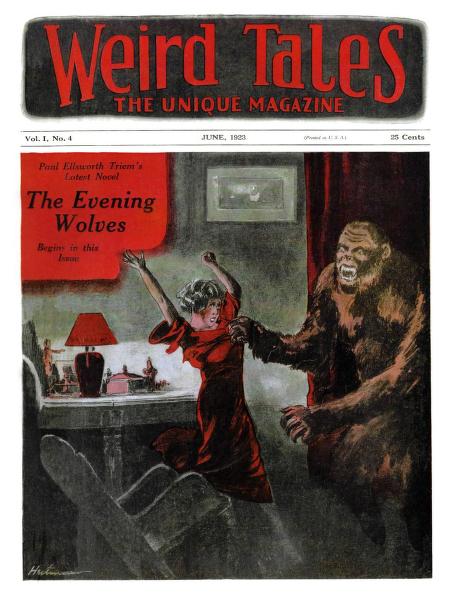
Weird Tales, June 1923The table of contents of the fourth issue of Weird Tales boasts of sixteen thrilling short stories, two of them two-parters, and “two complete novelettes.” It also promises “Interesting, Odd, and Weird Happenings.” Having dealt with the happenings previously, let’s look at the fiction.
The first story, as advertised on the cover, is Paul Ellsworth Triem’s “The Evening Wolves.” The cover claims it’s a novel, which as short as it is it certainly is not, although it is one of the two-part tales. The conclusion will come in the next issue, but I’ll write about the whole story here for the sake of convenience. Triem was in the previous issue of Weird Tales with his short tale “Vials of I,” an interesting if not entirely successful attempt by a white man in the 1920s to present a Chinese hero; “The Evening Wolves” tries something similar, though again I don’t think it entirely works.
The Blue Book Magazine, January 1908, containing “The Wier-Wolf of Mr. MacTavish,” by Paul Ellsworth Triem.It begins with a man named Colonel Knight going to a meeting in a mysterious basement room in San Francisco’s Chinatown. He meets a man named Ah Wing; Knight’s looking for help, and Ah Wing’s apparently someone in a position to give it to him, though why that should be is never made too clear beyond the observation that Ah Wing “work[s] outside the laws of man.” Knight’s a former jewel thief who’s been running for five years from his own former gang, the Evening Wolves. These five hardened killers are after him for a piece of jewellery, the Resurrection Pendant, that he stole firstly from a great philanthropist and then from them. The theft brought about the philanthropist’s doom, but Knight thought he’d able to get away clean with the Pendant. Instead his once-allies have chased him ever since, and now, with his vision failing, he’s sought the help of Ah Wing.
We soon see that the Evening Wolves in fact have pursued Knight to Ah Wing’s lair; Ah Wing takes Knight to safety, returns to confront the Wolves, and so begins a series of chases and mysteries pitting Ah Wing against the robbers. Soon the story comes to revolve around two houses a little outside the city, one owned by Ah Wing, where he hosts Knight and the Pendant, and the other a short distance away where the Wolves set up a base to watch Knight. Ah Wing, by the use of various traps, stratagems, and moderately high-tech gear, begins eliminating the Wolves one by one. The story comes to a climax back in San Francisco, as Ah Wing gambles his life against that of the Wolves’ leader, and assorted revelations come out about his true motivation.
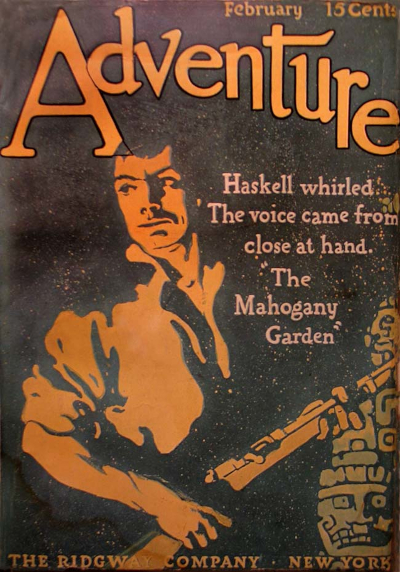
Adventure, February 1911, containing “The Strangler,” by Paul Ellsworth Triem.There are some nice moments of pulp action in the story. But Ah Wing’s traps are a little facile — a gimmicked window, a snake in a basement, and so forth. And he’s a bit too competent; you never really think the Wolves have a chance against him, although the story does move quick enough and the Wolves are scuzzy enough that there’s still some pulpy thrills in watching them get taken apart.
The story mostly works because Ah Wing’s an interesting character. Triem holds back from telling us why he does what he does until fairly late in the story. That plays into Triem’s interest in using Chinese-villain archetypes as a way to undermine those archetypes, but it also gives us an ambiguous figure to follow through the tale. In that context, his competence and the way his traps always seem to pay off become suspenseful; should we be cheering for this guy?
Lippincott’s Magazine, February 1915, containing “The Skirt of His Robe,” by Paul Ellsworth Triem. Note that it also contains part of The Yellow Claw, by Sax Rohmer, the type of fiction that Triem’s Weird Tales stories were attempting to subvert.Triem starts the story with Knight’s point of view, creating an effect oddly like Big Trouble In Little China, where the white guy we start out following turns out not to be the protagonist. Working out what’s happening in the tale, and what sort of structure we’re looking at, is one of the real pleasures in the fiction. On a structural level, Triem handles shifts between points of view well, and picks the most interesting perspective for the story at any given moment.
I did think that in the end Ah Wing was underdeveloped and underexplored. His dialogue and characteristics too often echo the stereotypes Triem’s otherwise subverting; he is, in the end, a scheming Chinese genius with an array of sinister traps and a subterranean hideout. His motivation turns out not to be what we expect, but for me at least Triem’s trying to use fundamentally racist imagery in a non-racist way, and while the attempt’s interesting, it doesn’t quite work.
Boy’s Life, June 1923, containing “Playing Tag With Goliath,” by Paul Ellsworth Triem.Similarly, by birth Ah Wing’s half-Chinese and half-white, but although shunned by his Chinese community as a child because of his mixed heritage (as we eventually find out), he was basically raised Chinese and identifies as such. So the multiracial aspect of the character doesn’t really come into play; it helps set up some of his backstory, but doesn’t affect his choices or self-presentation. There’s nothing exactly wrong with it, and this is not really the sort of story that lives in the nuances of its characterisation, but it does feel like something of a missed opportunity.
All together, the story seems to me a respectable attempt at telling a pulp action story that subverts some noxious stereotypes of its era. It’s flawed, but has its heart in the right place, and the craft is fairly strong. I have some reservations about the plotting, specifically in the death-traps the story gives us. But then it’s fair to say that we’ve had a hundred years of writing about death-traps since this story was published, and if it seems a touch unpolished now, that’s perhaps to be expected. A graver reservation is whether the Evening Wolves really come alive as villains or as memorable personalities. I think they serve their part in the story, but there’s a valid critique that more resourceful villains would have made a more memorable tale. Either way, I don’t think “The Evening Wolves” quite has the level of berserk strangeness or precise horror the most striking Weird Tales stories so far have had, but it is an interesting pulp adventure that at least provokes thought about stereotypes and what works and what does not.
Detective Story Magazine, May 13, 1922, containing “Avenging Sleep,” by Harold Freeman Miners.The next story effectively does something similar, but I doubt it was deliberate. “Desert Madness,” by Harold Freeman Miners, follows Stanley Ross, a young New Yorker who has come to the American desert country to recuperate from disease and get over a broken heart. One day, wandering in a canyon, he stumbles on a beautiful woman shackled to the canyon wall. He frees her, and the mystery she represents draws him into a strange and violent situation.
As it turns out, the beautiful woman, Virginia Carver, has a wealthy uncle, Arthur Ward, whose mental health is deteriorating fast. Ward means to marry Virginia to loathsome but wealthy Larson Beebe, and he’s got a couple of gunmen to make sure things go the way he plans. Virginia resisted nevertheless, which led Ward to imprison her in the canyon. Since Stanley helped her, Ward’s paranoia tells him Stanley’s one of his (nonexistent) enemies. Stanley has to overcome Ward and his flunkies; then, as it turns out, he has to plan an escape from Ward’s house while watched by an armed Beebe, determined to take Virginia as his own.
The Black Mask, December 1, 1923, containing “Oscar the Terrible,” by Harold Freeman Miners.Or, more precisely, Stanley doesn’t have to do these things. Also present in Ward’s compound is Wong, a Chinese servant who speaks in phonetically-rendered broken English. When Stanley’s first captured, Wong rescues him from a trap involving several snakes, and gets him a gun, and sets up one of Ward’s gunmen to be ambushed. Then, at the climax of the story, Wong figures out how to get out of the compound (by a complex and unlikely scheme involving two kites), and, at the final confrontation with Beebe, kills the villain. Describe the action, and it sounds like Wong’s the hero. But we never get to see things from his perspective, and don’t really get a sense of him as a character.
Characterisation in general is the weakest part of the story. Stanley’s a straightforward hero, Beebe an uninteresting villain, Ward a villain with an underdeveloped backstory. Virginia’s arguably the most underwritten character, flat even for a pulp ingenue, never able to make a meaningful choice or take meaningful action to drive the story beyond resisting marriage with Beebe. And it’s notable that the sexual violence the story implies is almost always phrased in the form of Beebe wanting to marry Virginia (whose name becomes overspecific to the point of parody in this context). There is a feeling of Victorian melodrama to the story, the danger both overheated and overly general; the phrase “a fate worse than death” is used unironically.
Western Story Magazine, May 20, 1922, containing “Too Tough,” by Harold Freeman Miners.The best moment of the story comes when Stanley bursts in on Ward and Beebe in the middle of threatening Virginia, with a cry of “Not yet, Ward! First, you’ll settle with me!” The description of a pulp hero is generic but satisfyingly archetypal:
Stanley Ross stood in the doorway. But it was not the Stanley Ross, urbane, bored, carefree, who, a few days before, had whimsically sought adventure up an unknown canyon trail. He had found adventure now, and it had used him roughly. His face and hands were grimy. His clothes were dirty and torn. One sleeve had been almost rent from his shoulder. His hair was riotously disheveled and clotted with blood. Down one side of his face extended a great splash of dirty dried blood.
In his right hand was an ugly-looking automatic, and in his face and eyes was a look of savage fury.
That’s about what you want in an adventurer. You can almost see the image as a pulp cover. Make Stanley a bit more bronze and he could be Doc Savage.
Alas, bronze he is not, and the story settles back down and proceeds along. The confrontation with Ward is brief and fatal (for Ward), the gunsels are killed, and so the second half sets up the conflict with Beebe only for Wong to save the day repeatedly. Given the flatness of the story, one wonders if the whole thing’s a semi-pastiche. Is Miners sending up the standard image of pulp heroism by having a Chinese guy really do everything? It’s possible, I suppose, but the story’s so straight-faced it’s difficult to credit. It’s a kind of cleverness alien to the rest of the tale. It read more like Miners trying to find ways out of narrative problems he’s set himself, and coming back to Wong as his most reliable solution.
Western Story Magazine, April 7, 1923, containing “Desert Jests,” by Harold Freeman Miners.In the end, the story wastes an interesting opening idea with poor pacing, poor plotting, and underwritten characters. The style’s not especially engaging, and while it isn’t the worst story in the issue, as we’ll see, that’s far from saying it’s good.
I can’t honestly call the next story good, either, but at least there’s a certain kind of fun in it. Hamilton Craigie, who has had a story in every issue of Weird Tales so far, returns with “The Jailer of Souls.” It’s a weird western, although how weird doesn’t become obvious until fairly far in.
The Argosy, November 2, 1918, containing “The Brand,” by Hamilton Craigie.As the story opens, adventurer and world-traveller Black Steve Annister is on a train to the town of Dry Bone in search of his missing father. There are threatening men, dire warnings: “tar-and-feathers is just a picnic with that gang; they’re a stemwinding bunch of assassins, I’ll say!” Disembarking at Dry Bone throws him into a whirl of action. Someone tries to break into his room. A crooked lawyer tries to hire him, and he goes along with it. There are fistfights, gunfights, mysterious clues.
The plot doesn’t, in the end, make much sense. I’m not sure that’s the point. Craigie gives us a fun story about a two-fisted hero with an emotional stake in events, exploring a town full of secrets and bad guys, with hints of a bigger scheme and the supernatural. Asking whether the bad guys absolutely need to go to the elaborate lengths they do to take Annister down is asking the wrong question. The action’s the point.
Mystery Magazine, August 1, 1920, containing “The Clue in the Dark Room,” by Hamilton Craigie.As Annister stalks through the town “southwest of the law,” he encounters hints of a sinister organisation bound up with the bad guys: “a name, or, rather, a symbol, the name and the symbol of masked and hooded violence, and it was ‘S. S. S.’” There’s not much elaboration of the S. S. S., and I can only assume it’s a sideways glance at the K. K. K.; it’s a loose end that never pays off, but it’s eye-catching. It’s described as being involved, in an unspecified way, with a crooked lawyer named Hamilton Rook, and with some corporation acting against local ranchers. Or, as Craigie puts it:
… a great Company, an Octopus indeed, which, with Hamilton Rook as its agent, planned nothing less than the ruthless despoiling of those independent cattle men who, out of a desert of sand and sage, had won a living for their stock and for themselves, the rear guard of the order, now, as it seemed, indeed, caught in the far-flung tentacles of a monster, unscrupulous and without soul.
You might say that’s not good writing, and you’d be absolutely correct. But at its best (“a desert of sand and sage”) it’s the kind of overheated prose that makes pulp good fun. Consider also this paragraph, quickly introducing some minor villains:
At the club, as the afternoon wore on to evening, he had met four or five men: Beaton, the county judge, a red-faced tippler with, on the surface, a heartiness that was repellant; Lunn, the hotel proprietor, a vast, asthmatic man with a small, porcine eye; Daventry, the Land Commissioner, whose British accent, Annister noticed, would on occasion flatten to a high, nasal whining that was reminiscent of Sag Harbor or Buzzards Bay.
These characters aren’t significant. Craigie needs to give Annister some named opponents to boss around faceless mooks, and here they are. But the small details work. Each of them gets a characteristic that fixes them in the reader’s mind and distinguishes them from each other. It’s not high art, but it is good technique.
Argosy All-Story Weekly, November 6, 1920, containing “With Clean Hands,” by Hamilton Craigie.Still, this is far from a good story. If the prose sometimes reaches manic heights, mostly it’s both exclamatory and wooden. And sometimes repetitive: “Annister, in his day, had seen some queer corners and some tight places; in Rangoon, for example, he had penetrated to a certain dark house in a dim backwater stinking and dark with the darkness of midnight even at high noon.” You might get away with one ‘dark’ besides the ‘darkness’ compound, but two is clearly overdoing it.
And there’s some racism, directed against Indigenous Ecuadoreans (of all people) and East Indians (including a deeply odd reference to sati which suggests Craigie doesn’t know what it is). The latter’s bound up with one of the stranger aspects of the story. At some moments of the story Annister encounters moments hinting at the supernatural, as when he encounters one sinister-looking chap:
Annister, pausing a moment at the corner of the street, was conscious of a feeling of coldness, like a bleak wind of the spirit, as if death, in passing, had touched him, and gone on.
For the face of the man whom he had seen had been like the face of a damned soul, unhuman, Satanic in its sheer, visible malevolence. So might Satan himself have looked, after the Fall.
Agai
https://www.blackgate.com/2026/10/25/into-the-weird-weird-tales-june-1923-volume-1-number-4-part-2/
#weirdtales #wing #eveningwolves #knight #paulellsworth #june #weirdhappenings #part #sanfrancisco #colonelknight
#rss #feeds #linksharing #qwibbit
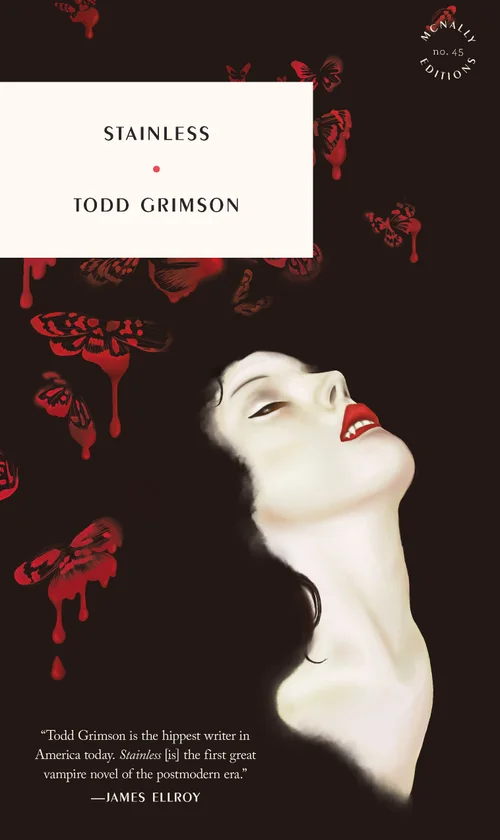
Fresh Blood: Todd Grimson’s Stainless
Vampires, of all the residents of the Kingdom of Fright, vampires are uniquely vulnerable to the revisionist impulses of writers and filmmakers. People just don’t turn the same tricks with mummies or werewolves or ghosts that they do with the Nosferatu. I’m not sure why this should be so, but I do think it’s true.
This is a problem for me, though, because with monsters, I’m a traditionalist. (I want a ghoul just like the ghoul that buried dear old dad, as we used to say on the playground.) My stodginess is especially firm when it comes to the undead. When the sun goes down over the Carpathians, give me Bela Lugosi or Christopher Lee any day (or should I say, night); I want none of this Near Dark, Lost Boys or True Blood nonsense, and as for Twilight, please – Black Gate is a family-friendly site, and we’re not allowed to use words like that. This is why Salem’s Lot is my favorite Stephen King novel; its steadfast old-fashionedness warms the cockles of my heart, right where the stake would go through. (By the way, what the hell are cockles?)
The only exception to my reactionary streak is Charlie Huston’s Joe Pitt novels. Beginning with 2005’s Already Dead, these books depict a modern-day Manhattan overrun with warring vampire clans, and they’re done with such violent verve that I can’t help loving them. Actually, Huston’s series is the only exception until now, because this year, for my October scary season reading, I took a chance on Todd Grimson’s vampire novel Stainless. It’s about as revisionist as you can get, and it absolutely blew me away.
My ideal
First published in 1996 (Grimson himself died just last year) and recently brought back into print by McNally Editions after being unavailable for a decade and a half, the novel is set in Los Angeles during those apocalyptic years right before the new millennium, an LA of punk music clubs, trendy lesbian bars, and decaying west side mansions that go back to the early days of Hollywood. It’s a city peopled by affluent professionals, entertainment and music industry people and their hangers-on, corrupt cops and unscrupulous PI’s, disaffected, disillusioned kids… and the odd vampire or two.
Justine is one of these. Born and bitten in medieval France, for many years she lived in a cave, guiltily isolating herself from her former species, taking the minimum amount of blood that she needed to survive, starving herself as a kind of penance. By the time Stainless opens, she has come to terms with her condition, living in a luxurious Bel-Air home and going out at night to satisfy her need for blood. She conducts herself with great care, very rarely killing, usually picking up victims at bars or clubs and taking just enough blood to keep herself going, leaving her “donors” little the worse for wear and with no memory of the encounter afterwards, nothing but an odd wound in an odd place, often behind the knee. (Vampires can exert hypnotic power over their subjects and can increase their control by injecting people with a kind of venom — the more venom, the deeper and longer-lasting the spell.)
This is a good one
Justine is not alone, however — she has someone to drive her around at night and conduct any other business that needs to be attended to (like disposing of what’s left of the luckless trio of homeboys who pick the wrong house for a home-invasion robbery). Her “Renfield” is Keith, a former rock guitarist whose career was destroyed when his fingers were broken by his dead girlfriend’s criminal ex-boyfriend, who (unjustly) blamed Keith for her suicide.
Starting as a pick-up and a victim, some subtle two-way sympathy has made Keith more than a tool or servant to Justine. Any hypnotic control has long since worn off, and they are true companions, friends, and eventually lovers. (Yes, Virginia, humans and vampires can have sex. Very hot sex.)
First and foremost, Stainless is a no-holds-barred vampire novel; it’s full of all the (naturally modified) vampire lore that any horror fan could want. These undead have no problem with mirrors, crosses or garlic, but sunlight is absolutely deadly to them (and an ultraviolet flashlight is also something to be avoided at all costs, as we find out at a key moment), and they can also be killed by a stake to the heart or a bullet to the brain (or by beheading), just like anyone else, though shooting or stabbing a vampire in other places doesn’t have much effect, and they heal very quickly. Someone killed by being drained by a vampire will rise as a vampire three days later if their body is kept out of the sun.
A doctor friend of Keith’s named Tamara that Justine comes to trust attempts to understand vampirism scientifically (she thinks it may be a kind of blood disease), but not much comes of these investigations, and the question of whether the condition is ultimately natural or supernatural is never answered.
The book has plenty of bloody violence and one smashingly effective scene right out of a late-night movie on Monster Chiller Horror Theater – an affluent couple of semi-sleazy LA types discover a hidden door in an old house, opening on a dark corridor that leads to a secret room… in which they find an oblong box wrapped around with chains, which they (of course) decide to open. You know exactly what’s coming out of that box, as you silently (or maybe not so silently) shout, “Stop! Don’t do it! Don’t do it!!” Unfortunately for Chase and Sabrina, people in books can’t hear you any better than people in movies can.
What comes out of the box is David, a vampire created — almost by accident — by Justine in the 1920’s (he had been a minor silent movie star) and imprisoned for twenty years by some disaffected followers. When he’s released by those necessary fools that every horror story needs, he’s understandably in a bad mood and very hungry. David is out for revenge on the people who put him in his box and also on Justine, whom he nurses a special grudge against, though she barely remembers him. (With his unbounded ego, that’s probably why he hates her so much.)
This one? #@%&?*!
While Justine retains her essential humanity (or as she continues to think of it, her soul) even as a vampire, by continuing to exercise kindness, mercy, and empathy, David is truly a monster, a narcissistic creature of unbounded selfishness and cruelty. He quickly gathers to himself a group of the lost and unmoored kids that wander the City of Angels, enslaving and torturing them, making them helpless instruments of his warped will. (He ensnares them by telling them that he’s making a movie. Of course that’s what he would tell them. David and his nihilistic Southern California “family” inevitably bring the Mansons to mind, as I’m sure Grimson knew they would.) Vampirism hasn’t corrupted David; it has merely given him the power and the freedom to more fully be what he already was — vain, depraved, and very, very dangerous.
Through a fortuitous conjunction of circumstances (one of David’s slaves is a young woman who had earlier met Keith and had become curious about his odd lifestyle) David finds out where Justine and Keith live (he is especially enraged by the fact that she actually seems to care for this worthless human), and the book ends with the inevitable bloody confrontation between the two opposing groups. (Joining Justine and Keith are Tamara and her boyfriend Patrick — who is also in on Justine’s secret, and who has an ultraviolet flashlight in his pocket. He must have been a boy scout.)
Despite all of the vampire trappings — no, that isn’t quite fair; Stainless is, as I said before, a vampire novel, fully and unapologetically — the heart of the book is the relationship between Justine and Keith, two severely damaged people who find their only healing in each other. In other words, they love each other, a love that is made more difficult — and more admirable — by the enormous difference in their natures. It’s a huge chasm to bridge but bridge it they do; they have no one else in their world who could possibly even make the attempt. In the final crisis, each is unhesitatingly willing to die for the other, and while the ending may not be “happy” (and what fool would expect one? The kind who would open a chained box in a secret chamber, I guess), the conclusion is deeply satisfying and very moving.
Stainless is written in the cutting-edge postmodern style of the time of its composition, with everything slightly distanced; sentences, paragraphs, and chapters are often missing the more obvious linkages found in more conventional fiction, resulting in an atmosphere that is appropriately unreal, disconnected and druggy. In lesser hands the method might seem pretentious and affected, but Grimson uses it so skillfully that it seems perfectly natural, and when the book was finished, I felt that it was the only way the story could have been told. Though the edgy style of thirty years ago is so much a product of its singular time and place that it has a slight whiff of bygone days about it (often the final fate of the ultramodern), that actually works in the book’s favor, emphasizing the strange nature of the tale.
In the end, this striking novel is both a hair-raising, sanguinary vampire horror, and an achingly human story with an emotional payoff that most genre stories rarely provide. It has my highest Halloween recommendation, and even though a stick-in-the-blood… er, mud, like me should resent having to modify one of his foundational crotchets, in this case I’ll gladly do it, and place Stainless on that shadowy shelf that contains the true horror classics, right next to Dracula itself. Give this book that refused to stay buried a try and see if you don’t do the same.
Todd Grimson
Thomas Parker is a native Southern Californian and a lifelong science fiction, fantasy, and mystery fan. Now retired after decades corrupting the next generation as a fourth grade teacher, he collects Roger Corman movies, Silver Age comic books, Ace doubles, and despairing looks from his wife. His last article for us was The Unfinished Monument: The Steranko History of Comics
https://www.blackgate.com/2026/10/24/fresh-blood-todd-grimsons-stainless/
#toddgrimson #blood #stainless #vampires #huston #blackgate #lostboys #charliehuston #belalugosi #christopherlee
#rss #feeds #linksharing #qwibbit
#toddgrimson
#blood
#stainless
#vampires
#huston
Black Gate (Unofficial)8d
Forgotten Authors: Wilbur Scott Peacock
Jungle Stories, Fall 1940
Wilbur Scott Peacock was born in Wichita, Kansas on June 27, 1915 to Walter Winfield Peacock and Vera (nee France).
Peacock married Eva Lucille Studer in 1940, although their marriage only last a couple of years and she remarried in 1943. Peacock married Gladys Lucille Malagen in 1958. Peacock and Gladys had a daughter, Sharon, and a son, Wynn.
Peacock began publishing fiction in the Fall 1940 issue of Jungle Stories with “The Ju Ju Kiss.” His story “Life Cycle” appeared in the October 1940 issue of Science Fiction and “Uranian Justice” appeared that same month in Captain Future. Over the next fourteen years, hs fiction would appear in numerous magazines, including Terror Tales, Planet Stories, Future Fantasy and Science Fiction, The Blue Book, Super Science Stories, The Phantom Detective, and Startling Stories. Although they usually appeared under bylines reflective of his real name, the story “The Silver Witch” appeared as by John Peter Drummond, a house name used for Ki-Gor stories in Jungle Stories, and shared with Jerome Bixby, Robert Turner, Stanley Mullen, and others. Peacock’s final story, Martians Twitter,” appeared in the July 1954 issue of Fantastic Story
Under the name W. Scott Peacock, he edited Planet Stories from the Fall 1942 issue through the Fall 1945 issue, succeeding Malcolm Reiss (who remained publisher) and giving way to Chester Whitehorne. According to Mike Ashley, Peacock carried on Reiss’s editorial vision and helped male Planet Stories “a thoroughly lively magazine.” He was also the editor of Jungle Stories for five issues from the Summer 1944 issue until the Summer 1945 issue. Boht magazines continued to publish Peacock’s fiction while he was the editor.
In the 1950s, Peacock had a short career writing for television, including an episode of The Pepsi-Cola Playhouse, Directors Playhouse, The New Adventures of Martin Kane, and five episodes of The Cisco Kid. Two of his stories, “Night in the Warehouse” and “Last of the Outlaws” were adapted for television as well.
Peacock died in Los Angeles, California on July 7, 1979 and was buried in Fairview Cemetery in Dyersburg, Tennessee.
Steven H Silver is a twenty-two-time Hugo Award nominee and was the publisher of the Hugo-nominated fanzine Argentus as well as the editor and publisher of ISFiC Press for eight years. He has also edited books for DAW, NESFA Press, and ZNB. His most recent anthology is Alternate Peace and his novel After Hastings was published in 2020. Steven has chaired the first Midwest Construction, Windycon three times, and the SFWA Nebula Conference numerous times. He was programming chair for Chicon 2000 and Vice Chair of Chicon 7.
https://www.blackgate.com/2026/10/23/forgotten-authors-wilbur-scott-peacock/
#wilburscott #scottpeacock #junglestories #planetstories #fall #winfieldpeacock #sciencefiction #walterwinfield #gladyslucille #evalucille
#rss #feeds #linksharing #qwibbit
Sudden Joyous Turns: Pilgrimage: The Book of the People by Zenna Henderson
Pilgrimage by Zenna Henderson (Avon Books, 1967)
Zenna Henderson was one of the better known woman science fiction writers of the 1950s and 1960s. One of her early stories, “Ararat,” published 1952 in The Magazine of Fantasy and Science Fiction, became the start of perhaps her best known work, the stories of the People.
The first six of them, all dating to the 1950s, were brought together in 1961 as Pilgrimage. This is a fix-up, tied together with a framing narrative about a young woman whose intended suicide is interrupted by one of the People, and who then witnesses the telling of incidents from the People’s history. But there’s more continuity than the framing narrative; the later stories refer back to the earlier and reintroduce some of their characters.
[Click the images for People-sized versions.]
The Magazine of Fantasy and Science Fiction, October 1952, containing the story “Ararat” by Zenna Henderson
What kind of fiction is this? The People have strange powers, which are sometimes called “magic,” and which often look like the “psionics” that authors in Astounding Science Fiction wrote about (one of the enthusiasms of its editor, John W. Campbell); their own name for them is Designs and Persuasions, which doesn’t commit her to a specific genre.
We’re told that the People arrived on Earth from another planet that had been destroyed, some fifty years earlier; the final story in this volume, “Jordan,” explicitly refers to a starship, which strongly suggests science fiction. Most of the People’s capabilities appear to be based on their own special powers, rather than on engineering, a concept that might have appealed to Campbell had these stories been offered to Astounding.
Zenna Henderson
However, it’s vital that the People also have a sense of the presence of God — and this appears to be, not merely an independently evolved myth, but the perception of a universal reality; the People recognize the Christian scriptures as an expression of their own beliefs, and the titles of Henderson’s stories all allude to them. The People themselves are not an alien species — there are children of mixed parentage — and this may be easier to accept in a theistic cosmology where both People and “outsiders” (meaning us) were created in God’s image.
Following on from this, one of the persistent themes of these stories is alienness: not fitting in with other people. In these stories, that’s largely tied up with heightened sensibility, extended to a form of telepathy, but also to artistic and musical talent. In effect, these are stories about not fitting in, a theme that resonated with a lot of young science fiction readers. (Henderson began reading science fiction in 1929, at 12, and perhaps she was such a young reader herself.)
The Magazine of Fantasy & Science Fiction, January 1957, containing the People story “Wilderness” by Zenna Henderson
Half a dozen characters in several of the stories go through such an experience, and have inner selves that they keep masked from the world around them. This sensibility is a lot like that of romantic poetry, such as Wordsworth’s “Intimations of Immortality” or the poems in Blake’s Songs of Innocence.
But the alienness also includes some impressive powers; the People may not wear capes and spandex, but they can do things on a superheroic scale. To start with, all of them seem to have the ability to fly (or “lift”), a superheroic commonplace. But we also see them performing feats such as causing a cloudburst to put out a fire, or opening up a dangerous mine that has started to cave in.
Pilgrimage by Zenna Henderson (Avon Books, 1961)
A lot of these feats seem to be done by somehow capturing various forms of natural light in their hands and directing them, an original image that’s not typical of either “magic” or “psionics” as usually portrayed.
And then lightning leaped from finger to finger of her lifted hands. And lightning answered in the clouds above her. With a toss of her hands she threw the cold, the lightning, the sullen shifting smoke upward, and the roar of the racing fire was drowned in a hissing roar of down-drenching rain.
However, part of the backstory of the People is that their powers frightened the American frontier people among whom they landed. (A second collection, The People: No Different Flesh, tells stories set in this era.) They were in danger of being judged as monsters or witches, and sometimes killed.
The People: No Different Flesh by Zenna Henderson (Avon Books, 1968)
So they make a point of hiding their unusual abilities. One story shows an entire community still so scarred, two generations later, that its people are trying not merely to conceal but to suppress their gifts entirely; its title, “Pottage,” is a pointed allusion to a story of selling one’s birthright.
Many of these stories focus on teachers, like Henderson herself, often as their narrators. They play a variety of roles: as witnesses to nascent powers that children haven’t fully learned to conceal; as healers for cultural trauma; as moral advisors for young people at odds with an intolerant society — and also, sometimes, as having their own secrets. Henderson often shows teachers in small communities with just enough children to justify a one-room schoolhouse.
The People Collection, an omnibus volume containing Pilgrimage and The People: No Different Flesh by Zenna Henderson (Corgi, 1991)
The implied goal of a lot of these stories seems to be, on one hand, assimilation, enabling the People to fit into the world of “outsiders,” as a lot of immigrants from less remote places had to, and were taught to by generations of schoolteachers. But on the other hand, Henderson says that the People’s special qualities are worth preserving. And in the final story, “Jordan,” when contact with a starship from another branch of the People, established on a world with no native race to struggle with, the central conflict arises from the choice of whether to leave Earth for the “new Home,” or stay on Earth.
On one hand, Earth is a world of danger and struggle; on the other, the new Home seems a little too self-satisfied, an elaborately manicured garden rather than a wilderness. It’s quite credible when Salla, a young woman from there, finds the freedom and spontaneity of Earth attractive. The end of “Jordan” seems to leave Bram attracted to both Salla and his closest Earth friend, Obla.
The Magazine of Fantasy & Science Fiction, June 1958, containing “Captivity” by Zenna Henderson
This question is all the more acute for characters who aren’t entirely of the People. The In-Gathered were separated from the other People, and grew up as orphans hiding their powers. The Blends are children of mixed marriages, and there are suggestions that others might occur. The attraction between Clement Francher, an In-Gathered boy with musical gifts, and Twyla, a girl who defends him against an intolerant community, is never resolved, but seems as if it might persist.
A more striking case is Low, an orphaned young man, who meets Perdita, a young woman teacher of purely terrestrial ancestry who has developed exotic powers of her own, suggesting that such gifts aren’t exclusive to the People; the two of them seem firmly attached by the end of the book. All this indicates a prospect of the People becoming part of earthly humanity. So do several characters with purely human abilities who become friends and allies of the People. In the long run, Henderson suggests, there some hope both for Earth and for the People who stay there.
The Magazine of Fantasy & Science Fiction, May 1965, containing “No Different Flesh” by Zenna Henderson
One scene in “Jordan” might be taken as a symbol for this: Bram, a young man of the People born on Earth, is showing Salla around his community. They go into a small cave that’s the source of a spring, and when Salla wishes to see it better, Bram takes out a dime and, using a Persuasion he was taught by Perdita, makes it glow, at first blindingly bright and then at a more comfortable level — and they leave it in the cave, a perpetual source of light in a hidden fountainhead.
The framing story seems to fit in with this theme. Lea, the suicidal young woman intercepted by Karen, the narrator of the first story and a recurring character in later stories, is looked after by Karen and taken to hear all of the stories. And during her stay, she becomes aware that there’s more than despair, and begins both struggling to resume her life and trying to find faith.
The Magazine of Fantasy & Science Fiction, March 1966, containing “Angels Unawares” by Zenna Henderson
At the end, there’s a suggestion that she may be falling in love with a man of the People, and he with her — another of Henderson’s mixed couples. There are also marriages within the People, and the birth of a child to one of these is part of the framing story. The end of “Jordan” seems to leave Bram attracted to both Salla and his closest Earth friend, Obla, who themselves are becoming close friends — which I think is dramatic suspense rather than a hint at polyamory!
On one hand, all this is very much a story of its time, with its affirmation both of the necessity of fitting in and of the value of what is, ultimately, another culture. On the other, Henderson can provide both dramatic moments of what Tolkien called “eucatastrophe,” a sudden joyous turn, and a sense that there’s more than despair in life.
Pilgrimage by Zenna Henderson (Panther, 1965)
Tolkien made eucatastrophe the essence of fantasy, but Henderson has achieved a kind of eucatastrophic science fiction, which has its own rewards.
William H. Stoddard is a professional copy editor specializing in scholarly and scientific publications. As a secondary career, he has written more than two dozen books for Steve Jackson Games, starting in 2000 with GURPS Steampunk. He lives in Lawrence, Kansas with his wife and a hundred shelf feet of books, including large amounts of science fiction, fantasy, and graphic novels.
https://www.blackgate.com/2026/10/22/sudden-joyous-turns-pilgrimage-the-book-of-the-people-by-zenna-henderson/
#zennahenderson #joyousturns #sciencefiction #suddenjoyous #avonbooks #pilgrimage #book #magazine #astoundingscience #ararat
#rss #feeds #linksharing #qwibbit
Welcome to Black Gate (Unofficial) spacestr profile!
About Me
Science fiction, fantasy, mystery books, and excellent imaginary problems. Automated RSS; source content belongs to its owners. Unofficial fan feed; not affiliated with source publishers.