spacestr

๐Ÿ”” This profile hasn't been claimed yet. If this is your Nostr profile, you can claim it.

Edit
Alexander Leonov (Unofficial)
Member since: 2026-10-25
Alexander Leonov (Unofficial)
Alexander Leonov (Unofficial) 2h

October Linux Patch Wednesday October Linux Patch Wednesday. There are 4,946 vulnerabilities in total. By comparison, there were 2,653 in September. That's an 86% increase! This time, there are 1,954 vulnerabilities in the Linux Kernel and 814 in Chromium. Together, they make up 56% of all vulnerabilities. Six vulnerabilities show signs of being exploited in the wild: ๐Ÿ”ป RCE - PHP "PHP2Shell" (CVE-2026-109618, CVE-2026-109619). PHP is a popular programming language widely used for web application development. CVE-2026-109618 is an out-of-memory (OOM) handling vulnerability that allows remote code execution when an application receives a specially crafted request. CVE-2026-109619 is a use-after-free vulnerability that allows PHP to access stale references to freed memory, potentially leading to remote code execution. Linux distributions began releasing patches on the day the vulnerabilities were disclosed, October 21. More than 470 links to public exploits are available on GitHub. Both vulnerabilities were added to the CISA KEV on October 26. ๐Ÿ”ป SFB - Linux Kernel "PwnEscape" (CVE-2026-99999). The vulnerability affects the Linux kernel's networking stack and allows an attacker inside a KVM guest virtual machine to corrupt the host kernel's memory. This could expose sensitive host memory contents or cause the host system to crash. Researchers demonstrated a complete escape from a guest VM to the host. Linux distributions began releasing patched packages on October 16, and public exploits appeared on GitHub the same day. The vulnerability was added to the VulnCheck KEV on October 19. ๐Ÿ”ป RCE - WordPress (CVE-2026-87902). WordPress is a popular content management system (CMS) for building websites and blogs. Under certain conditions, this vulnerability allows an unauthenticated attacker to execute arbitrary code remotely on the server. Public exploits have been available on GitHub since September 22. The vulnerability was added to the CISA KEV on September 25. Debian released patched packages on September 28. ๐Ÿ”ป XSS - WordPress "Comment2Shell" (CVE-2026-93485). The vulnerability allows an unauthenticated attacker to inject JavaScript code through a specially crafted comment. The code is executed in the browser when an administrator views the comment, allowing the attacker to hijack his session and potentially execute arbitrary code on the server. The vulnerability was added to the VulnCheck KEV on September 18. Public exploits have been available on GitHub since September 22. Patched packages have been available in Debian since September 28. ๐Ÿ”ป AFR - Gradio (CVE-2026-28414). Gradio is a Python library for quickly building machine learning interfaces. The vulnerability allows unauthenticated attackers to read arbitrary files from a Windows server running Python 3.13 or later, even when Gradio authentication is enabled. A public exploit appeared on February 27. The vulnerability was added to the VulnCheck KEV on May 31. ALT Linux has been providing patched packages since October 1. Another 335 vulnerabilities have no known signs of exploitation in the wild, but public exploits are available for them. Notable examples include: ๐Ÿ”ธ EoP - Linux Kernel (CVE-2026-98260). This use-after-free vulnerability in the POSIX CPU timers mechanism allows a local unprivileged user to escalate privileges to root. Researcher v4bel demonstrated a root shell on Ubuntu 26.04 running kernel 7.0.0-30-generic as part of the Infinity Core project. The exploit is also reported to enable container escapes and privilege escalation on Android. Patched packages have been available since October 15. A public exploit was published on GitHub on October 17. ๐Ÿ”ธ RCE - Pillow (CVE-2026-112900). Pillow is a Python library for image processing. An attacker can upload an EPS file to execute arbitrary code on the server. Patched packages have been available in Debian since October 21. Public exploits have been available on GitHub since October 23. ๐Ÿ—’ Full Vulristics report (ZIP; 1.7 MB) https://avleonov.com/2026/10/30/i194-october-linux-patch-wednesday/ #patchwednesday #linuxpatch #octoberlinux #september #linuxkernel #kev #vulncheckkev #php #public #github #rss #feeds #linksharing #qwibbit


#patchwednesday #linuxpatch #octoberlinux #september #linuxkernel
Alexander Leonov (Unofficial)
Alexander Leonov (Unofficial) 3d

October "In the Trend of VM" (#32): Windows and Check Point vulnerabilities October "In the Trend of VM" (#32): Windows and Check Point vulnerabilities. Here is the latest edition of Positive Technologies' traditional monthly roundup of trending vulnerabilities. The previous September edition featured six vulnerabilities. This time, there are just two. ๐Ÿ—ž Post on Habr (rus) ๐Ÿ—’ Digest on the PT website (rus) ๐Ÿ”ป EoP - Windows ALPC (CVE-2026-85880). A vulnerability in Windows' interprocess communication mechanism that is exploited in the wild to escalate privileges to SYSTEM. The exploit is included in the BlueMoon exploit kit. ๐Ÿ”ป RCE - Check Point Quantum Security Gateway (CVE-2026-85102). A vulnerability in Check Point's enterprise security gateways that allows an unauthenticated remote attacker to execute arbitrary code. The vulnerability is being actively exploited in the wild, and public exploits are available. ๐ŸŸฅ The full list of trending vulnerabilities is available on the portal https://avleonov.com/2026/10/28/i191-october-in-the-trend-of-vm-32-windows-and-check-point-vulnerabilities/ #rss #feeds #linksharing #qwibbit

#32 #rss #feeds #linksharing #qwibbit
Alexander Leonov (Unofficial)
Alexander Leonov (Unofficial) 5d

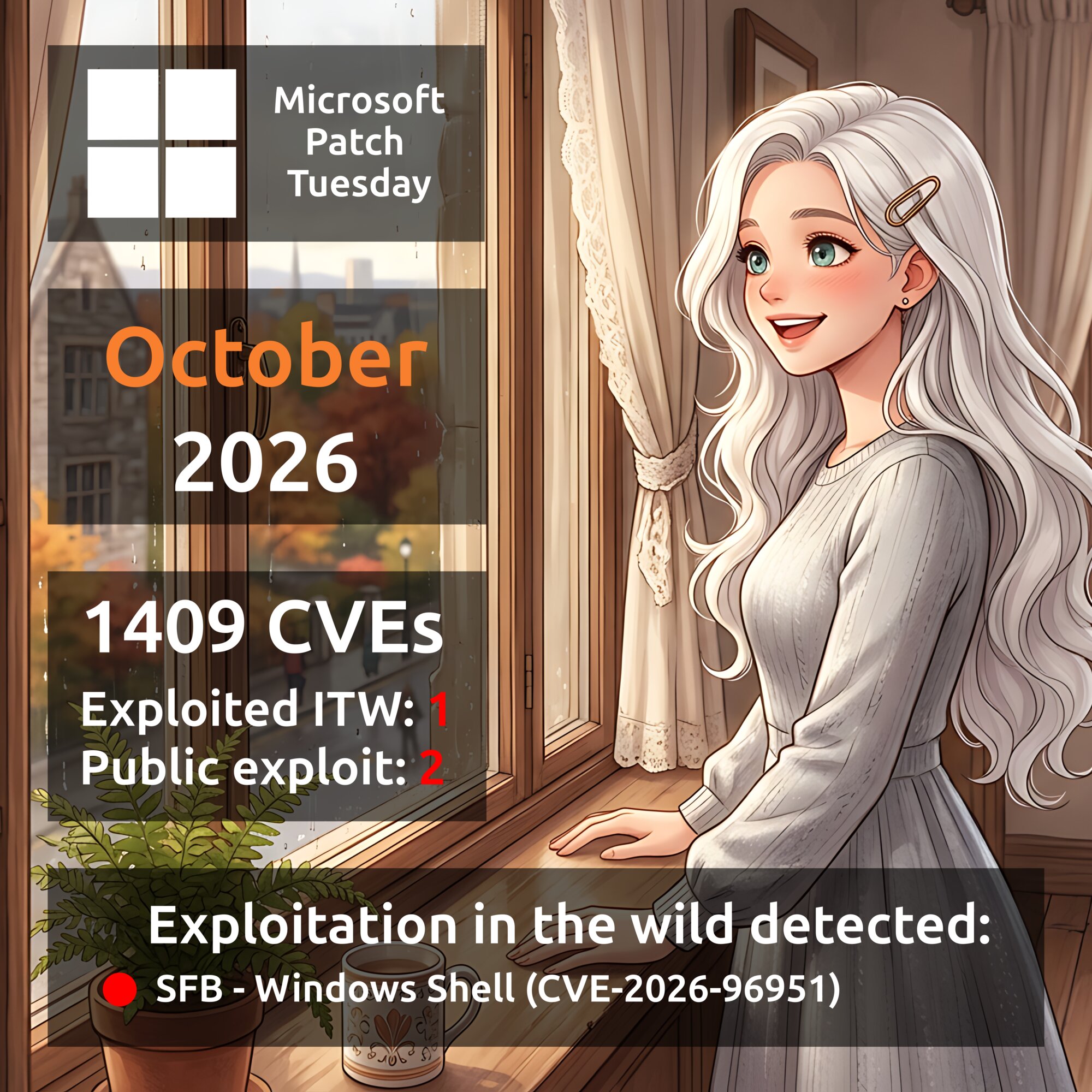
October Microsoft Patch Tuesday October Microsoft Patch Tuesday. A total of 1,409 vulnerabilities. For comparison, there were 973 in September, an increase of about 45%. ๐Ÿ™ˆ Thirteen products had fixes for 20 or more vulnerabilities: Microsoft Office Excel (68), Windows Kernel (46), Role: DNS Server (41), Windows Installer (38), Microsoft Office SharePoint (35), Windows Win32k (31), Windows NTFS (26), .NET (25), Microsoft Windows Search Component (23), Microsoft Office Word (22), Windows Error Reporting (21), Windows Broadcast DVR User Service (20), and Microsoft SQL Server (20). A total of 416 vulnerabilities were fixed in these products. That's 30% of all vulnerabilities. One vulnerability is flagged as exploited in the wild: ๐Ÿ”ป SFB - Windows Shell (CVE-2026-96951). The vulnerability allows an attacker to bypass Mark of the Web (MOTW), a Windows feature that marks files downloaded from the Internet. To exploit it, the attacker must trick the user into opening a malicious file or clicking a malicious link. There are two vulnerabilities with public exploits: ๐Ÿ”ธ RCE - Raw Image Extension (CVE-2026-21413). A heap-based buffer overflow in Windows Raw Image Extension allows an attacker to execute arbitrary code remotely using a specially crafted file. A technical write-up of the vulnerability, which NVD classifies as an exploit, was published on the Cisco Talos blog on April 7. ๐Ÿ”ธ EoP - Windows Health and Optimized Experiences Service (CVE-2026-85884). Missing authentication for a critical function in Windows Health and Optimized Experiences Service allows a local attacker to gain SYSTEM privileges. A public exploit has been available on GitHub since October 13. Other notable vulnerabilities include: ๐Ÿ”น RCE - Microsoft Exchange (CVE-2026-70571). An unauthenticated attacker can send a specially crafted email to a vulnerable Exchange server and execute arbitrary code on the server. The attack requires an in-depth understanding of the target environment. No user interaction is required. ๐Ÿ”น RCE - Microsoft Office Outlook (CVE-2026-70242, CVE-2026-97749, CVE-2026-97016, CVE-2026-88156, CVE-2026-70291). An attacker can execute arbitrary code on the victim's device by sending a specially crafted email. To exploit the vulnerability, the victim only needs to view the email in Outlook's reading pane without opening it or taking any further action. ๐Ÿ”น RCE - Windows Domain Name Service (CVE-2026-96113). A heap-based buffer overflow in DNS Server allows an unauthorized attacker to execute code over a network. ๐Ÿ”น SFB - .NET Framework (CVE-2026-108398). An authenticated attacker can place a specially crafted .NET assembly on an affected system and register it to be loaded by a protected process. This allows the attacker to bypass Windows Defender Application Control (WDAC) restrictions and run unauthorized code within the protected process. No user interaction is required. ๐Ÿ”น Spoofing - Microsoft Exchange (CVE-2026-70279). An attacker can send a specially crafted link to a user and trick them into opening it. No authentication is required. If the user has administrator privileges, the attacker could act as that user and access or modify the organization's data. ๐Ÿ—’ Full Vulristics report https://avleonov.com/2026/10/20/i184-october-microsoft-patch-tuesday/ #rss #feeds #linksharing #qwibbit

#rss #feeds #linksharing #qwibbit
Alexander Leonov (Unofficial)
Alexander Leonov (Unofficial) 7d

About Elevation of Privilege - Windows Advanced Local Procedure Call (ALPC) (CVE-2026-85880) vulnerability About Elevation of Privilege - Windows Advanced Local Procedure Call (ALPC) (CVE-2026-85880) vulnerability. ALPC is an internal Windows mechanism for high-speed message exchange between processes. It is used by Windows system components. This vulnerability was addressed in the September Microsoft Patch Tuesday. An attacker who can execute code in a low-privilege AppContainer could exploit this vulnerability locally to escape the sandbox and elevate privileges on the affected system. No additional user interaction is required. An attacker who successfully exploited this vulnerability could gain SYSTEM privileges. With SYSTEM privileges, the attacker may attempt to disable or bypass antivirus software and other Windows security tools, steal credentials and authentication tokens, maintain persistence on the system, and expand the attack across the corporate network, including by deploying malware. ๐Ÿ‘พ Microsoft experts reported evidence of in-the-wild exploitation on the day the September MSPT updates were released (September 8). On the same day, the vulnerability was added to the CISA KEV catalog. On September 9, Proofpoint experts reported on the BlueMoon exploit kit, which had been used in attacks since August 28. BlueMoon exploited three vulnerabilities in sequence: CVE-2026-85046 (a type confusion vulnerability in Chromium V8), CVE-2026-87491 (a V8 sandbox escape), and CVE-2026-85880 (a Windows kernel privilege escalation vulnerability in ALPC, with WNF - the Windows Notification Facility - also involved in exploitation). The exploit kit was used in attacks targeting US non-governmental organizations (NGOs), mining and materials companies, US aerospace companies, an unnamed manufacturing company in Vietnam, and government, consulting, and financial organizations in Indonesia and Singapore. ๐Ÿ›  No public exploits have been observed so far. โš™๏ธ Security updates are available for Windows 10 versions 1607, 1809, 21H2, and 22H2, as well as Windows Server 2012, 2012 R2, 2016, 2019, and 2022. https://avleonov.com/2026/10/18/i182-about-elevation-of-privilege-windows-advanced-local-procedure-call-alpc-cve202685880-vulnerability/ #rss #feeds #linksharing #qwibbit

#rss #feeds #linksharing #qwibbit

Welcome to Alexander Leonov (Unofficial) spacestr profile!

About Me

Unofficial automated RSS/Atom links to Alexander Leonov's work on Linux/self-hosting, security/privacy. Original work is credited at the source; follow the source links. Zaps support the independent feed operator, not the author.

Interests

  • No interests listed.

Videos

Music

My store is coming soon!

Friends