Oliver: I Went Close to Death and Did Not Die
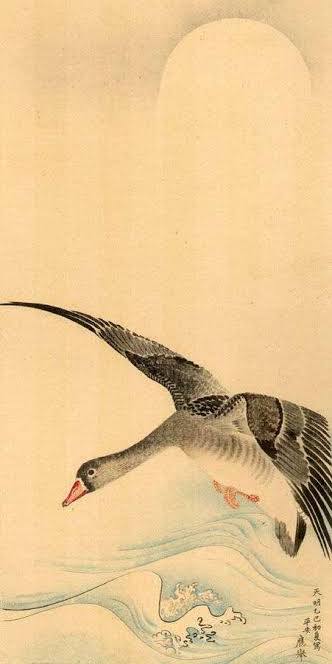
Maruyama Ōkyo, Wild Good on Waves
Sunday – All Souls’ Day
Today is a national holiday for Slovenians, a time to gather the family and visit and tend to the graves of members who have passed. It’s a powerful way of balancing grief with the reassurance that life continues.
I borrow the image of balancing from Mary Oliver’s poem “Heavy.” “It’s not the weight you carry,” she reports a friend telling her, “but how you carry it.” Whether one is carrying books, bricks, or grief, it’s
all in the way
you embrace it, balance it, carry it
when you cannot, and would not,
put it down.
Carrying takes practice so Oliver practices. She learns to laugh again, and she lingers
to admire, admire, admire
the things of this world
that are kind, and maybe
also troubled—
This is what Jesus means by heaven on earth. Oliver is lifted up by images of fragility balanced with powerful natural forces, the last pairing being love and death:
roses in the wind,
the sea geese on the steep waves,
a love
to which there is no reply?
Notice the question mark at the end, where she leaves it open whether love in fact belongs with the other two. This is the only stanza with five lines, which means that the poem ends not with her love but with the silence of the departed. She is unnerved by the fact that she cannot yet speak with complete assurance.
Before I share the poem, here’s one last thought. In a lecture on Beowulf to Slovenian students this past week, I noted how Beowulf (as I read his confrontation with Grendel’s Mother) walks up to her lake of grief and plunges in. Not all characters in the poem can do this, and we are told that a deer pursued by hounds would rather be torn apart on the shore than enter those waters. King Hrethel, to cite a human instance, retreats to his bed when he loses his eldest son and never gets up again. Like Oliver, he thinks that he “could not/ go any closer to grief/ without dying.”
It takes courage to face up to the heart’s anguish, the kind (here we get Oliver’s own image of being torn apart) that Daniel exhibits in the lions’ den. During her own grieving she learns, as Beowulf does, that she will not be ravaged upon close contact.
“Surely God/ had his hand in this,” she thinks before adding, “as well as friends.” She has Daniel, and Beowulf, when battling dragon depression, has Wiglaf. Overcoming the dragon leads to a shining moment:
[Wiglaf] saw too a standard, entirely of gold,
hanging high over the hoard,
a masterpiece of filigree; it glowed with light…
As is characteristic with Oliver, her own luminescent vision involves images from nature: a rose and wild geese.
And underlying it all, she hopes and prays, is love.
Heavy
By Mary Oliver
That time
I thought I could not
go any closer to grief
without dying
I went closer,
and I did not die.
Surely God
had his hand in this,
as well as friends.
Still, I was bent,
and my laughter,
as the poet said,
was nowhere to be found.
Then said my friend Daniel
(brave even among lions),
“It is not the weight you carry
but how you carry it—
books, bricks, grief—
it’s all in the way
you embrace it, balance it, carry it
when you cannot, and would not,
put it down.”
So I went practicing.
Have you noticed?
Have you heard
the laughter
that comes, now and again,
out of my startled mouth?
How I linger
to admire, admire, admire
the things of this world
that are kind, and maybe
also troubled—
roses in the wind,
the sea geese on the steep waves,
a love
to which there is no reply?
The post Oliver: I Went Close to Death and Did Not Die first appeared on Better Living through Beowulf.
https://betterlivingthroughbeowulf.com/oliver-i-went-close-to-death-and-did-not-die/?utm_source=rss&utm_medium=rss&utm_campaign=oliver-i-went-close-to-death-and-did-not-die
#oliver #die #went #close #daytoday #beowulf #maryoliver #wavessunday #surelygod #wildgood
#rss #feeds #linksharing #qwibbit
#oliver
#die
#went
#close
#daytoday
Robin Bates (Unofficial)2d
Poe Penetrated My Rational Exterior as a Teen
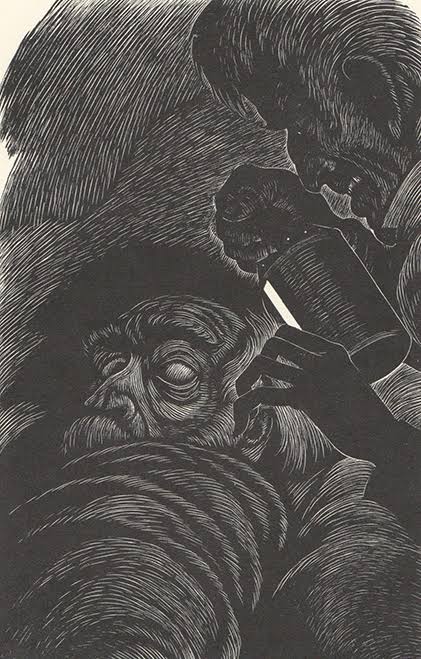
Fritz Eichenberg, “The Tell-Tale Heart”
Friday Memories of Books That Shook My World
As tomorrow is Halloween, I share one of my most frightening encounters with a horror story. Although I was a teenager when I first read Edgar Allan Poe’s “Tell-Tale Heart,” to this day I vividly remember vibrating with terror. It didn’t help that I read it after midnight in my attic room.
Never before had I had such a visceral encounter with story. I was especially haunted by the narrator’s fascination with the old man’s eye.
I think it was his eye! yes, it was this! One of his eyes resembled that of a vulture — a pale blue eye, with a film over it. Whenever it fell upon me, my blood ran cold; and so by degrees — very gradually — I made up my mind to take the life of the old man, and thus rid myself of the eye forever.
On the night of the murder, sensing that someone is in the room, the victim has his eye open so that the narrator’s lantern falls directly upon it:
When I had waited a long time, very patiently, without hearing him lie down, I resolved to open a little — a very, very little crevice in the lantern. So I opened it — you cannot imagine how stealthily, stealthily — until, at length a single dim ray, like the thread of the spider, shot from out the crevice and fell upon the vulture eye.
It was open — wide, wide open — and I grew furious as I gazed upon it. I saw it with perfect distinctness — all a dull blue, with a hideous veil over it that chilled the very marrow in my bones; but I could see nothing else of the old man’s face or person: for I had directed the ray as if by instinct, precisely upon the damned spot.
I also remember being struck by the narrator’s claim to be rational throughout the story:
True! — nervous — very, very dreadfully nervous I had been and am; but why will you say that I am mad? The disease had sharpened my senses — not destroyed — not dulled them. Above all was the sense of hearing acute. I heard all things in the heaven and in the earth. I heard many things in hell. How, then, am I mad? Hearken! and observe how healthily — how calmly I can tell you the whole story.
He continues to insist this until the end, when his façade finally breaks and he reveals to the police his rising hysteria, along with the murder.
Why did this particular horror story stand out, surpassing “The Cask of Amontillado.” (A teacher had entertained us with a very effective performance of “Amontillado” but it was nothing like this.) Reading it in bed after midnight accounted for some of the horror, but I think there was more to my response.
Being raised in a professor’s family meant that rationality was our m.o. We were products of the Enlightenment, and as Michel Foucault points out (in Madness and Civilization: A History of Insanity in the Age of Reason), Enlightenment thinkers had a particular problem with madness. Philosophy was to have no truck with it, and, unlike officials in earlier ages, authorities separated madness out from society and locked it up. “You’re not being rational” was a reproof that had some weight with me.
The obsession with the eye, the most rational of the senses, therefore makes sense. The narrator feels that the old man’s eye can penetrate his calm exterior, for all his daytime smiling and “calling him by name in a hearty tone.” He senses that the old man can perceive an inner madness that he himself doesn’t want to admit is there. He must shut that eye for ever.
Poe is famous for planting his feet on both sides of the rationality/madness divide. On the one hand, with Dupin he invented the soft-boiled detective, forerunner of Holmes and Poirot, whose powers of “ratiocination” astound the police. On the other hand, there are the incursions into insanity that Poe is famous for, with “The Black Cat” and “Amontillado” joining “Tell-Tale.” In “Murders of the Rue Morgue” the two sides come together, with Dupin pitted against the animality of an orangutang.
Part of my fascination, then, may have been with the irrational part of myself that I was denying. I remember a few years later being struck, while reading Nietzsche’s Birth of Tragedy for a college ethics class, by philosopher Schopenhauer’s image of a sailor trusting in his “frail barque.” Meanwhile, he sits “in the midst of a stormy sea, unbounded in every direction, rising and falling with howling mountainous waves.” As an Apollonian he thinks he can sit there calmly, but Dionysus threatens to overwhelm him utterly. I thought I should be Apollo, even though I sensed Dionysian forces at work.
The ending of “Tell-Tale Heart” functioned as a wake-up call. The police were the quiet world around me, which I mistook for reality, but inside I could sense another dynamic:
[T]he noise arose over all and continually increased. It grew louder — louder — louder! And still the men chatted pleasantly, and smiled.
Perhaps the ending of the story worked as an acknowledgement that I was not as much in rational control of my life as I thought I was supposed to be:
Was it possible they heard not? Almighty God! — no, no! They heard! — they suspected! — they knew! — they were making a mockery of my horror! — this I thought, and this I think. But anything was better than this agony! Anything was more tolerable than this derision! I could bear those hypocritical smiles no longer! I felt that I must scream or die! — and now — again! — hark! louder! louder! louder! louder! —
“Villains!” I shrieked, “dissemble no more! I admit the deed! — tear up the planks! — here, here! — it is the beating of his hideous heart!”
I’ve detected the same dynamic in my response to wolf man stories, with the Lon Chaney, Jr. Wolf Man being my first horror film and Stanley Kubrick’s The Shining being the scariest film I have ever seen. While I was pretty sure that I would never grab an axe and go after my kids, there were times in my parenting life when I was close to losing it.
Who knows what darkness lies beneath a rational exterior? (Answer: Poe knows.)
The post Poe Penetrated My Rational Exterior as a Teen first appeared on Better Living through Beowulf.
https://betterlivingthroughbeowulf.com/poe-penetrated-my-rational-exterior-as-a-teen/?utm_source=rss&utm_medium=rss&utm_campaign=poe-penetrated-my-rational-exterior-as-a-teen
#rationalexterior #poepenetrated #teen #allanpoe #fridaymemories #heart #edgarallan #amontillado #fritzeichenberg #enlightenment
#rss #feeds #linksharing #qwibbit
Cankar, Yeats, and Lawrence on Remorse
Slovenian author Ivan Cankar
Thursday
It shouldn’t have taken so long but, after hearing about Ivan Cankar’s short story “A Cup of Coffee” for years, I’ve finally read it. Cankar is Slovenia’s most famous author, and visiting Cankar’s childhood home provided extra incentive.
“Cup of Coffee” is a story of remorse, and reading it sent me off on a systematic search for a Yeats poem on a similar theme. I read it 53 years ago and only now, thanks to Google AI, have I been able to track it down. This poem in turn reminded me of another poem that I loved at that time, D. H. Lawrence’s “The Snake.” Today’s essay is about what all of these poems teach me about painful thoughts.
Often when I am reading or writing, I’ll recall an embarrassing moment from long ago and groan aloud. Julia will ask me about it and always I will refuse to tell her. Perhaps it is too painful, perhaps it is embarrassingly trivial, but in any case I choose to keep it private.
Cankar describes such pain in “Cup of Coffee,” a story that every Slovenian school child has read. Confessing a sin he committed when returning home from his university, the author writes,
Sometimes the sin is forgotten, eroded from your life, drowned in the eventfulness of the days; but suddenly, perhaps in the middle of a beautiful enjoyable day, perhaps at night, it comes back upon you, to weigh down your soul, to pain and burn your conscience as though you have just committed it. Almost every other sin or bitter memory may be washed away with atonement and good thought, except this sin of injustice against someone whom you love. It becomes a black spot in your heart and there it remains.
So what is this “sin”? Cankar, as we saw from his house, grew up in extreme poverty, and he writes about asking his mother for a cup of coffee when she could ill afford it. He was in the midst of writing a story at the time:
One day I craved black coffee. I don’t know how it came to my mind; I simply wanted some black coffee. Perhaps because I knew that there was not even a slice of bread in the house and that much less coffee. Sometimes a person is merciless, cruel.
Mother looked at me with her meek, surprised eyes but would not speak. After I informed her that I wanted some black coffee, I returned to the attic to continue my love story, to write how Milan and Breda loved each other, how noble, divine, happy and joyful they were.—”Hand in hand, both young and fully alive, bathed in morning dew-drops, swaying—”
The sin was committed when she showed up with the cup:
Then I heard light steps on the stairs. It was mother, ascending carefully, carrying a cup of steaming coffee. Now I recall how beautiful she was at that moment. A single ray of sun shone directly into her eyes through a crack in the wall. A divine light of heaven, love and goodness were there in her face. Her lips held a smile as those of a child bringing one a gift. But—
“Leave me alone!” I said harshly. “Don’t bother me now! I don’t want any coffee!”
As he saw the light in her eyes die and the smile on her face disappear, he realized what he has done and tried to rectify the situation:
“Give it to me, mother.”
But it was too late.
Compounding the sin, he never apologized:
As I drank the coffee, I said to myself:
“Tonight I shall speak tenderly to her and make up for what I have done.”
In the evening I could not speak to her kindly, nor the next day.
Time passed and then he had one of those moments I’m describing:
Three or four months later a strange woman brought a cup of coffee to my room. Suddenly I felt a sting in my heart. I wanted to cry out from pain. I shivered, my whole being trembling in stark agony.—For a man’s heart is a just judge; a man’s heart does not concern itself with paragraphs in statute books or trifles.
The writing of the story worked as a confession:
A man may perhaps try to lie to his soul.—”It wasn’t so bad as that. Your restlessness has created a black night out of mere shadows. It was but a trifle, an every-day occurrence.”—Such words are lies, and the man knows it.
And further:
Pardonable is a sin which can be described by word of mouth and atoned for. But heavy, tremendously heavy, is a sin which remains with you—in your heart—indescribable, formless. You confess it to yourself when you tremble in fear before death, or at night when the covers of your bed seem like mountains piled upon you.
There are layers upon layers in the story that I will not go into here. A headmistress friend of mine who has written her dissertation on “Bad Mothers in Victorian Literature” tells me that Slovenians’ relationships with their mothers are particularly charged, and who’s to say what emotional power games get played between the mother and her adult son in this interchange. I want to return now, however, to the issue of painful memories that explode suddenly in the mind, knocking us back on our heels.
The Yeats poem in which I recognized myself is “Vacillation,” which contains the following stanza:
Things said or done long years ago,
Or things I did not do or say
But thought that I might say or do,
Weigh me down, and not a day
But something is recalled,
My conscience or my vanity appalled.
I like the way that Yeats mentions “conscience” and “vanity” in the same line since sometimes it’s not clear which is involved. In Cankar’s case, it appears to be conscience, but perhaps he is also chagrined that he is not the noble person he thought he was. In my own moments of sudden shame, often it is vanity. I think of myself as a rational and controlled person and yet recall moments when I fell short.
The discrepancy between elevated self image and an action that contradicts it marks D. H. Lawrence’s “Snake,” one of my favorite of his poems. Encountering a poisonous snake at an Italian water trough, he has mixed feelings. While inner voices tell him he should kill it, he feels honored by its magnificent presence:
And truly I was afraid, I was most afraid,
But even so, honored still more
That he should seek my hospitality
From out the dark door of the secret earth.
He drank enough
And lifted his head, dreamily, as one who has drunken,
And flickered his tongue like a forked night on the air, so black,
Seeming to lick his lips,
And looked around like a god, unseeing, into the air,
And slowly turned his head,
And slowly, very slowly, as if thrice adream,
Proceeded to draw his slow length curving round
And climb again the broken bank of my wall-face.
So far, so good. When the snake begins to withdraw into its hole, however, Lawrence experiences a sudden feeling of revulsion and acts without thinking:
And as he put his head into that dreadful hole,
And as he slowly drew up, snake-easing his shoulders,
and entered farther,
A sort of horror, a sort of protest against his withdrawing into
that horrid black hole,
Deliberately going into the blackness, and slowly drawing
himself after,
Overcame me now his back was turned.
I looked round, I put down my pitcher,
I picked up a clumsy log
And threw it at the water-trough with a clatter.
A holy moment has been spoiled, and Lawrence is disgusted with himself, just as Cankar is disgusted with himself. From one who prides himself on appreciating nature’s magnificence, Lawrence now sees himself is paltry, vulgar, and mean. He even invokes Coleridge’s Ancient Mariner killing the albatross:
And immediately I regretted it.
I thought how paltry, how vulgar, what a mean act!
I despised myself and the voices of my accursed human education.
And I thought of the albatross,
And I wished he would come back, my snake.
For he seemed to me again like a king,
Like a king in exile, uncrowned in the underworld,
Now due to be crowned again.
With this ending we realize that Lawrence is writing his poem for the same reason that Cankar writes his story: as an act of expiation. Cankar never apologized to his mother and Lawrence can’t apologize to the snake but, by expressing their guilt publicly, perhaps they can they achieve the relief promised by the confessional.
Which leads me to wonder whether, when I groan aloud and Julia asks me about it, I would be better off sharing the moment. Maybe that would loosen the incident’s hold on me.
The post Cankar, Yeats, and Lawrence on Remorse first appeared on Better Living through Beowulf.
https://betterlivingthroughbeowulf.com/cankar-yeats-and-lawrence-on-remorse/?utm_source=rss&utm_medium=rss&utm_campaign=cankar-yeats-and-lawrence-on-remorse
#cankar #ivancankar #coffee #lawrence #cup #yeats #remorse #cankarthursday #perhaps #sometimes
#rss #feeds #linksharing #qwibbit
#cankar
#ivancankar
#coffee
#lawrence
#cup
Robin Bates (Unofficial)4d
Shakespeare’s Deep Dive into Explosive Sexual Desire
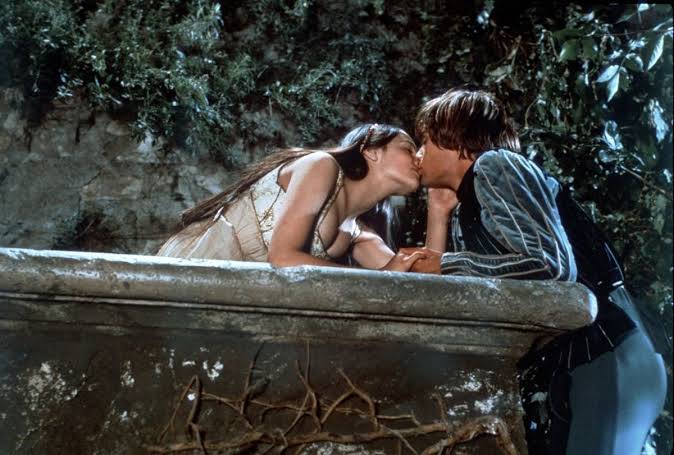
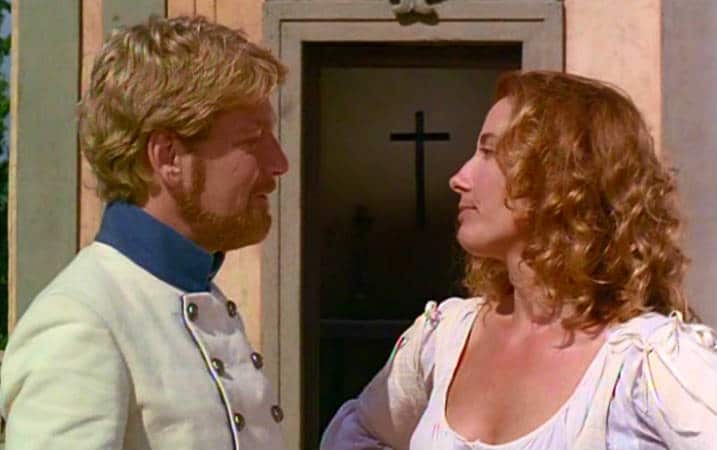
Hussey and Whiting in Zephirelli’s Romeo and Juliet
Wednesday
A question that has nagged at me for years suddenly came into focus yesterday as I was teaching Midsummer Night’s Dream and Romeo and Juliet. I had paired the two, figuring that a comedy and a tragedy addressing the same topic (explosive sexual desire) provided a good way of understanding how the two genres work. Pairing them did that and more.
My question was which of the two plays, both written between 1594-96, came first. The play-within-a-play that we encounter in Midsummer is a botched rendering of Ovid’s story Pyramus and Thisbe, the evident model for Romeo and Juliet. If Shakespeare wrote Romeo and Juliet first, was he spoofing his tragic love story in Midsummer? Or (to venture upon a more elaborate theory), was he making Theseus’s point that the inept play in Midsummer is to R&J what Shakespeare’s R&J on stage was to the R&J in Shakespeare’s mind?
This requires some explanation so here goes. In Midsummer, Queen Hippolyta says of the disastrous performance, “This is the silliest stuff that ever I heard,” to which Theseus replies,
The best in this kind are but shadows; and the worst are no worse, if imagination amend them.
When Hippolyta reasonably says, “It must be your imagination then, and not theirs,” Theseus counters, “If we imagine no worse of them than they of themselves, they may pass for excellent men.”
I love the interchange because I imagine that Shakespeare is talking about his own plays. If even the best plays “are but shadows”—and in my opinion Shakespeare wrote the best plays the world has ever seen—then perhaps he’s expressing his disappointment that R&J didn’t live up to his internal vision of it. Thus the spoof.
Or maybe (to float a third theory under option #1), he was following in the tradition of the Ancient Greek tragedians, who would follow a trilogy of tragedies with a lighthearted satire. It was a way of letting their audiences down gently after running them through an emotional wringer.
After teaching yesterday’s class, however, I have come to the opposite conclusion. I now think that, in exploring the explosive workings of human desire, Shakespeare was unsatisfied with just laughing at humans. Puck may say, “What fools these mortals be,” but Shakespeare wanted to explore further. “Long shot for comedy, close-up for tragedy,” Charlie Chaplin once said, and Shakespeare went for close-up. In the process, he produced one of the world’s greatest love stories.
If you imagine that the Oscar-winning film Shakespeare in Love actually happened, he proved to Queen Elizabeth that England was indeed capable of besting the Italians in the love story business.
I came down on the side of option #2—that R&J was written second—in part because of insights gained from pairing Taming of the Shrew and Much Ado about Nothing the week before. As I wrote last Wednesday and Thursday, I sensed potential in a Katharina-Petruchio pairing—what if they are actually collaborating at the end?—and then saw Shakespeare embodying that potential in the Beatrice-Benedick relationship. Isn’t a marriage where sparks fly endlessly more satisfying to both partners than one in which one ,submits utterly. I think of the lines by the 17th century libertine John Wilmot, “But did you love your pleasure less,/ You were no match for me.”
If Shakespeare could see potential for a more expansive relationship after writing Taming, perhaps he saw the same after writing Midsummer.
With Shakespeare, I admire above all the way he acknowledges our full humanity. As Harold Bloom contends, Shakespeare invented personality, changing our ideas “as to what makes the self authentically human.” While comedy gets us part of the way there, tragedy is where we see humanity at its most complex. (As I told the class, comedy focuses more on the social, tragedy on the individual.)
All of which is to say, I imagine Shakespeare thinking that he’d like to become better acquainted with Pyramus and Thisbe and creating Romeo and Juliet as a result. It has been said of the Bard that he was incapable of creating a two-dimensional character—this is true also of Tolstoy—and in R&J he created three-dimensional characters in spades, everyone from the leads to Mercutio to the nurse to Friar Laurence to the Montague and Capulet parents and on and on.
Shakespeare does justice to our full selves, capturing like no one before or since our virtues, our vices, and our situations. To apply to him a line delivered by perhaps his most deeply realized character (Hamlet), he held his “mirror up to nature: to show virtue her own feature, scorn her own image, and the very age and body of the time his form and pressure.”
All that being said, I’m open to other arguments. The virtue of the debate is that it plunges us more deeply into the plays.
The post Shakespeare’s Deep Dive into Explosive Sexual Desire first appeared on Better Living through Beowulf.
https://betterlivingthroughbeowulf.com/shakespeares-deep-dive-into-explosive-sexual-desire/?utm_source=rss&utm_medium=rss&utm_campaign=shakespeares-deep-dive-into-explosive-sexual-desire
#rss #feeds #linksharing #qwibbit
#1
#2
#rss
#feeds
#linksharing
Robin Bates (Unofficial)5d
Sexual Dominance and the Iran Invasion
Tuesday
Thinking about Trump’s invasion of Iran in light of readings from my Post-Colonial Literature class has me wondering how much macho sexuality entered into the decision. Hang on while I explain.
I start off with Edward Said’s observation (in Orientalism) that western colonialists were fascinated by the exotic or oriental Other. This fascination is so powerful for Marlow in Heart of Darkness that he is determined to get to Africa “by hook or by crook.” Here he is describing his fascination:
But there was in it one river especially, a mighty big river, that you could see on the map, resembling an immense snake uncoiled, with its head in the sea, its body at rest curving afar over a vast country, and its tail lost in the depths of the land. And as I looked at the map of it in a shop-window, it fascinated me as a snake would a bird—a silly little bird. Then I remembered there was a big concern, a Company for trade on that river. Dash it all! I thought to myself, they can’t trade without using some kind of craft on that lot of fresh water—steamboats! Why shouldn’t I try to get charge of one? I went on along Fleet Street, but could not shake off the idea. The snake had charmed me.
At the heart of this “place of darkness” is “a wild and gorgeous apparition of a woman”:
She walked with measured steps, draped in striped and fringed cloths, treading the earth proudly, with a slight jingle and flash of barbarous ornaments. She carried her head high; her hair was done in the shape of a helmet; she had brass leggings to the knee, brass wire gauntlets to the elbow, a crimson spot on her tawny cheek, innumerable necklaces of glass beads on her neck; bizarre things, charms, gifts of witch-men, that hung about her, glittered and trembled at every step. She must have had the value of several elephant tusks upon her. She was savage and superb, wild-eyed and magnificent; there was something ominous and stately in her deliberate progress.
In Marlow’s eyes, Africa and the woman are one in the same. He writes that “the immense wilderness, the colossal body of the fecund and mysterious life seemed to look at her, pensive, as though it had been looking at the image of its own tenebrous and passionate soul.”
A woman is also at the heart of Africa in H. Rider Haggard’s 1887 potboiler She. One of the explorers describes her:
She lifted her white and rounded arms—never had I seen such arms before—and slowly, very slowly, withdrew some fastening beneath her hair. Then all of a sudden the long, corpse-like wrappings fell from her to the ground, and my eyes travelled up her form, now only robed in a garb of clinging white that did but serve to show its perfect and imperial shape, instinct with a life that was more than life, and with a certain serpent-like grace that was more than human. On her little feet were sandals, fastened with studs of gold. Then came ankles more perfect than ever sculptor dreamed of. About the waist her white kirtle was fastened by a double-headed snake of solid gold, above which her gracious form swelled up in lines as pure as they were lovely, till the kirtle ended on the snowy argent of her breast, whereon her arms were folded. I gazed above them at her face, and—I do not exaggerate—shrank back blinded and amazed. I have heard of the beauty of celestial beings, now I saw it; only this beauty, with all its awful loveliness and purity, was evil—at least, at the time, it struck me as evil. How am I to describe it? I cannot—simply I cannot! The man does not live whose pen could convey a sense of what I saw. I might talk of the great changing eyes of deepest, softest black, of the tinted face, of the broad and noble brow, on which the hair grew low, and delicate, straight features. But, beautiful, surpassingly beautiful as they all were, her loveliness did not lie in them. It lay rather, if it can be said to have had any fixed abiding place, in a visible majesty, in an imperial grace, in a godlike stamp of softened power, which shone upon that radiant countenance like a living halo. Never before had I guessed what beauty made sublime could be—and yet, the sublimity was a dark one—the glory was not all of heaven—though nonetheless was it glorious. Though the face before me was that of a young woman of certainly not more than thirty years, in perfect health, and the first flush of ripened beauty, yet it had stamped upon it a look of unutterable experience, and of deep acquaintance with grief and passion. Not even the lovely smile that crept about the dimples of her mouth could hide this shadow of sin and sorrow. It shone even in the light of the glorious eyes, it was present in the air of majesty, and it seemed to say: “Behold me, lovely as no woman was or is, undying and half-divine; memory haunts me from age to age, and passion leads me by the hand—evil have I done, and from age to age evil I shall do, and sorrow shall I know till my redemption comes.”
Okay then.
Visualizing unexplored territory as female didn’t begin in the 19th century, incidentally. John Donne famously addresses his mistress—this while she disrobes in front of him—as
O my America! my new-found-land,
My kingdom, safeliest when with one man mann’d,
My Mine of precious stones, My Empirie,
How blest am I in this discovering thee!
To enter in these bonds, is to be free;
Then where my hand is set, my seal shall be.
Many reasons have been offered as to why Trump would embark on a “stupid foreign war” (his 2024 phrase), with Israeli pressure and Saudi money entering the explanation. But what if he thought he could be the man that none of his predecessors were? He had set his seal on Venezuela so why not Iran. He was not a man to be emasculated as his predecessors had been, especially (in his eyes) Jimmy Carter, Barack Obama, and Joe Biden.
[I note as an aside that there may have been another psychodrama, this one Oedipal, to George W. Bush’s decision to invade Iraq. After all, he finished off a dictator that his father failed to oust.]
Invasion as sexual conquest is also the dream of Trump’s testosterone-obsessed Defense Secretary, who models himself on General Jack Ripper in Stanley Kubrick’s Doctor Strangelove. Blowing up fishing boats, Venezuelan infrastructure, and finally Iranian military installations are experienced as orgasmic ejaculations by those controlling unimaginable fire power. If Trump can bring down Iran, he figures, then he will prove that he belongs in the company of those other two presidents to whom he keeps comparing himself: Washington, who won the American Revolution, and Lincoln, who won the Civil War.
While not so impervious to public sentiment as to risk escalating his war before the midterm elections, Trump promises more bombing after November 4. In Kubrick’s brilliant film, Armageddon and sexual release are inextricably intertwined. I’m terrified that this sociopath will use his access to the nuclear codes to assert dominance over the Persian Orient.
If he chooses to go that route, I pray that there are courageous souls in the U.S. military who will disobey what would be an illegal order.
Further thought: Psychologist Carl Jung uses Haggard’s She as an illustration of the devouring female principle (the anima) responding to hypermasculinity. Only when the male psyche accepts that it has a female side does the anima cease to be threatening. Victorian England, testing its manhood against the African subcontinent, could not help but see it as female. Trump and Pete Hegseth, meanwhile, are obsessed with, and fearful of, strong Black women.
The post Sexual Dominance and the Iran Invasion first appeared on Better Living through Beowulf.
https://betterlivingthroughbeowulf.com/sexual-dominance-a-factor-in-the-iran-invasion/?utm_source=rss&utm_medium=rss&utm_campaign=sexual-dominance-a-factor-in-the-iran-invasion
#iraninvasion #sexualdominance #africa #marlow #tuesdaythinking #darkness #fleetstreet #trump
#rss #feeds #linksharing #qwibbit
Iran: Heart of Darkness Redux?
Monday
As I reread Heart of Darkness for a Post-Colonial Literature class I’m currently teaching, I am reminded why Francis Ford Coppola used it as the basis for Apocalypse Now. The novella captures what happens when a superpower claiming lofty ideals loses its way.
Will some future filmmaker use it to make a film about DJT’s assaults on Iran and Venezuela?
I’m using the Conrad masterpiece as background for the course. To establish the colonialist mindset, I’ve also assigned:
–an excerpt from Edward Said’s Orientalism, which contends that racist depictions of “the Orient” helped pave the way for Western colonialism. “To say simply that Orientalism was a rationalization of colonial rule,” Said writes, “is to ignore the extent to which colonial rule was justified in advance by Orientalism, rather than after the fact.” If one looks at the works of various “novelists, poets, translators, and gifted travelers,” one sees that “the Oriental” is often described as “irrational, depraved (fallen), childlike, ‘different’; thus the European is rational, virtuous, mature, ‘normal.’” Said’s framing applies also to the other areas colonized by the European powers.
–an excerpt from Rider Haggard’s She (1887), about a mysterious woman living in the heart of Africa, immortal and stunningly beautiful, who draws men to their doom. Such a woman can also be found in Heart of Darkness.
–Rudyard Kipling’s poem “The White Man’s Burden,” in which the colonized people are described at various junctures as “fluttered folk and wild,” “new-caught sullen peoples,” “half devil and half child,” slothful and foolish, and ungrateful. The white men, by contrast, are (or should be) mature, patient, self-sacrificing, and tireless in their efforts to improve others.
The poem opens with this heroic vision:
Take up the White Man’s burden—
Send forth the best ye breed—
Go bind your sons to exile
To serve your captives’ need;
To wait in heavy harness
On fluttered folk and wild—
Your new-caught sullen peoples,
Half devil and half child.
One line particularly struck me since it is a version of what DJT has been promising us with the Iran invasion. Indeed, it has been presented to Americans as justifications for all its imperial wars:
Take up the White Man’s burden—
The savage wars of peace—
Fill full the mouth of famine
And bid the sickness cease…
In other words, less developed nations, we are using force to give you peace. It’s for your own good since such wars will bring an end to famine and sickness.
Kipling follows up this promise with anger that the colonized don’t appreciate these gifts:
And when your goal is nearest
The end for others sought,
Watch Sloth and heathen Folly
Bring all your hopes to nought.
Kipling is not always this patronizing, and recent scholarship has determined that he was one of the more enlightened Brits when it came to colonial matters. Whatever his blind spots, he at least believes in sacrificing oneself for the good of others: he tells his fellow colonialists to choose the “toil of serf and sweeper” rather than the “tawdry rule of kings.”
DJT, by contrast, wants to be a king, and his view of the world is one described by Conrad’s Marlow when he imagines the ancient Romans conquering Britain:
But these chaps were not much account, really. They were no colonists; their administration was merely a squeeze, and nothing more, I suspect. They were conquerors, and for that you want only brute force—nothing to boast of, when you have it, since your strength is just an accident arising from the weakness of others. They grabbed what they could get for the sake of what was to be got. It was just robbery with violence, aggravated murder on a great scale, and men going at it blind—as is very proper for those who tackle a darkness. The conquest of the earth, which mostly means the taking it away from those who have a different complexion or slightly flatter noses than ourselves, is not a pretty thing when you look into it too much.
Or as DJT put it when defending his invasion of Venezuela to the United Nations put it, “To the victor go the spoils.”
When Trump’s supporters praise him for his honesty, even though every word that comes out of his mouth is a lie, it’s because his base motivations and his base hatreds are so clear. He feels no more need to be diplomatic than an entitled toddler. Whereas Kipling sorrowfully defends “savage wars of peace,” Trump relishes smash and grab fighting. He is the perfect embodiment of the ivory-obsessed “pilgrims” in Conrad’s novel, and his Iran invasion echoes Marlow’s account of a French ship lobbing shells into the African continent:
For a time I would feel I belonged still to a world of straightforward facts; but the feeling would not last long. Something would turn up to scare it away. Once, I remember, we came upon a man-of-war anchored off the coast. There wasn’t even a shed there, and she was shelling the bush. It appears the French had one of their wars going on thereabouts. Her ensign dropped limp like a rag; the muzzles of the long six-inch guns stuck out all over the low hull; the greasy, slimy swell swung her up lazily and let her down, swaying her thin masts. In the empty immensity of earth, sky, and water, there she was, incomprehensible, firing into a continent. Pop, would go one of the six-inch guns; a small flame would dart and vanish, a little white smoke would disappear, a tiny projectile would give a feeble screech—and nothing happened. Nothing could happen. There was a touch of insanity in the proceeding, a sense of lugubrious drollery in the sight; and it was not dissipated by somebody on board assuring me earnestly there was a camp of natives—he called them enemies!—hidden out of sight somewhere.
Unlike Trump but like Kipling, Marlow believes that a noble ideal drive the colonial enterprise. “What redeems it,” he says speaking of invasion,
is the idea only. An idea at the back of it; not a sentimental pretense but an idea; and an unselfish belief in the idea—something you can set up, and bow down before, and offer a sacrifice to….
The “idea at the back” of the European colonizers is that they will lift up benighted souls with western Christian civilization. Marlow hears a version of this from the aunt who helps him obtain his captain’s post. Although he expresses skepticism, part of him (as we learn in the final pages) clings to the vision:
She talked about ‘weaning those ignorant millions from their horrid ways,’ till, upon my word, she made me quite uncomfortable. I ventured to hint that the Company was run for profit.
‘You forget, dear Charlie, that the laborer is worthy of his hire,’ she said, brightly. It’s queer how out of touch with truth women are. They live in a world of their own, and there has never been anything like it, and never can be. It is too beautiful altogether, and if they were to set it up it would go to pieces before the first sunset. Some confounded fact we men have been living contentedly with ever since the day of creation would start up and knock the whole thing over.
The crisis is that Kurtz, who represents the best of civilization—at various times we learn that he’s a gifted writer, a great musician, a superb painter, a natural leader of men, a compelling orator, and a “universal genius” and that all Europe has contributed to his making–casts off all restraint and descends into barbarism. We see the reversal in an essay Kurtz has written for the International Society for the Suppression of Savage Customs, one in which lofty sentiments are overthrown by a later addition:
It was a beautiful piece of writing. The opening paragraph, however, in the light of later information, strikes me now as ominous. He began with the argument that we whites, from the point of development we had arrived at, ‘must necessarily appear to them [savages] in the nature of supernatural beings—we approach them with the might of a deity,’ and so on, and so on. ‘By the simple exercise of our will we can exert a power for good practically unbounded,’ etc., etc. From that point he soared and took me with him. The peroration was magnificent, though difficult to remember, you know. It gave me the notion of an exotic Immensity ruled by an august Benevolence. It made me tingle with enthusiasm. This was the unbounded power of eloquence—of words—of burning noble words. There were no practical hints to interrupt the magic current of phrases, unless a kind of note at the foot of the last page, scrawled evidently much later, in an unsteady hand, may be regarded as the exposition of a method. It was very simple, and at the end of that moving appeal to every altruistic sentiment it blazed at you, luminous and terrifying, like a flash of lightning in a serene sky: ‘Exterminate all the brutes!’
We are never told exactly what Kurtz does that’s so bad although we see heads on poles and an African mistress. Meanwhile Marlow mentions “certain midnight dances ending with unspeakable rites,” “abominable satisfactions,” and “the colossal scale of his vile desires.” The rest is left up to our nightmarish imaginations.
Marlow, however, is won over to Kurtz in the end by his honest summing up of his life. Kurtz sees, in his dying moment, both the heights to which humans can soar and the depths to which they can descend. If Coppola turned to the novella in his film, it’s because he saw both the promise of America’s democratic vision and its descent into an abyss.
Given our own “superpower suicide” (historian Timothy Snyder’s phrase), I suppose a sequel might work. America at the moment is teetering between its better angels and its worse angels. But it could not be a film about Trump, who is more of a “papier-mache Mephistopheles” (as Marlow describes another character) than a Kurtz. “It seemed to me that if I tried I could poke my forefinger through him, and would find nothing inside but a little loose dirt, maybe,” he writes.
For Trump, the world will end, not with a bang but a whimper (to cite a T.S. Eliot poem that kicks off with an allusion to Heart of Darkness).
In other words, not a Hollywood ending.
The post Iran: Heart of Darkness Redux? first appeared on Better Living through Beowulf.
https://betterlivingthroughbeowulf.com/apocalypse-now-the-sequel/?utm_source=rss&utm_medium=rss&utm_campaign=apocalypse-now-the-sequel
#heart #whiteman #iran #fordcoppola #francisford #orientalism #half #burden #kipling #djt
#rss #feeds #linksharing #qwibbit
#heart
#whiteman
#iran
#fordcoppola
#francisford
Robin Bates (Unofficial)7d
Jesus’s Radical Empathy – Nothing Toxic about It
George Frederic Watts, The Good Samaritan
Sunday
As I reported last week, people calling themselves Christians have been writing books attacking empathy. These include a Minnesota Catholic bishop and podcaster (Robert Barron), a rightwing commentator and Christian nationalist (Allie Beth Stuckey, author of Toxic Empathy: How Progressives Exploit Christian Compassion), and a rightwing theologian (Joe Rigney, The Sin of Empathy). While I suppose there’s a case to be made about those who listen only with the heart and not with the head, the willingness of these authors to rationalize inhuman deportations and draconian benefit cuts leads one to wonder whether they really listen to Jesus.
The Gospel reading today has Jesus addressing people who are so bound up in intricate arguments that they have lost sight of the two great commandments:
When the Pharisees heard that Jesus had silenced the Sadducees, they gathered together, and one of them, a lawyer, asked him a question to test him. “Teacher, which commandment in the law is the greatest?” He said to him, “’You shall love the Lord your God with all your heart, and with all your soul, and with all your mind.’ This is the greatest and first commandment. And a second is like it: ‘You shall love your neighbor as yourself.’ On these two commandments hang all the law and the prophets.”
And then, of course, there’s Matthew 25:42-45:
‘For I was hungry and you gave me nothing to eat, I was thirsty and you gave me nothing to drink, I was a stranger and you did not invite me in, I needed clothes and you did not clothe me, I was sick and in prison and you did not look after me.’
“They also will answer, ‘Lord, when did we see you hungry or thirsty or a stranger or needing clothes or sick or in prison, and did not help you?’
“He will reply, ‘Truly I tell you, whatever you did not do for one of the least of these, you did not do for me.’
When it comes to empathy, I also think of “Jesus wept,” described by poet Malcolm Guite as “the shortest, sharpest, and most moving sentence in Scripture.”
I bring this up in a literature blog because of how fiction and poetry encourage empathy. I recently quoted Barack Obama on the subject:
When I think about how I understand my role as citizen…the most important set of understandings that I bring to that position of citizen, the most important stuff I’ve learned I think I’ve learned from novels. It has to do with empathy.
There are novels, to be sure, that do not foster empahty—in my book I cite Jean Raspail’s Camp of Saints and Ayn Rand’s two novels as examples—but the greatest works are those that capture us in our full humanity. Amongst these, following the lead of Percy Shelley, I include Jesus’s parables.
Constructing a pantheon of the greatest authors in his Defence of Poetry, Shelley puts Jesus up there with Shakespeare, Sophocles, Dante, and Homer. The “poetry in the doctrines of Jesus Christ,” he writes, was so powerful that it “outlived” the darkness of the intervening years and the distortions of establishment religion.
Shelley doesn’t entirely do justice to what used to be called “the Dark Ages” and that we now refer to as the Medieval period. We now know that “the extinction of the poetical principle” was not as thorough as he feared. Nevertheless, we can agree with him that poetry is indispensable if we are to resist “lust, fear, avarice, cruelty, and fraud.” Here’s Shelley:
Whatever of evil their agencies may have contained sprang from the extinction of the poetical principle, connected with the progress of despotism and superstition. Men, from causes too intricate to be here discussed, had become insensible and selfish: their own will had become feeble, and yet they were its slaves, and thence the slaves of the will of others: lust, fear, avarice, cruelty, and fraud, characterized a race amongst whom no one was to be found capable of CREATING in form, language, or institution.
In another essay (“Essay on the Literature, the Arts, and the Manners of the Athenians”), Shelley observes that Jesus alleged “the absolute and unconditional equality of all human beings,” and one sees this especially in “The Parable of the Good Samaritan.” Jesus is once again citing the second great commandment in response to a test question:
On one occasion an expert in the law stood up to test Jesus. “Teacher,” he asked, “what must I do to inherit eternal life?”
“What is written in the Law?” he replied. “How do you read it?”
He answered, “‘Love the Lord your God with all your heart and with all your soul and with all your strength and with all your mind’; and, ‘Love your neighbor as yourself.’”“You have answered correctly,” Jesus replied. “Do this and you will live.”But he wanted to justify himself, so he asked Jesus, “And who is my neighbor?”
Realizing that an abstract theological answer will not work at this point, Jesus responds with a story that elicits an empathetic response. Would Stuckey call it “toxic” and Rigney “a sin” if it were not told by Jesus? Our own version of the Samaritan could be as one of those populations demonized by the president (Haitians, Somalians, Muslims, undocumented immigrants):
In reply Jesus said: “A man was going down from Jerusalem to Jericho, when he was attacked by robbers. They stripped him of his clothes, beat him and went away, leaving him half dead. A priest happened to be going down the same road, and when he saw the man, he passed by on the other side. So too, a Levite, when he came to the place and saw him, passed by on the other side. But a Samaritan, as he traveled, came where the man was; and when he saw him, he took pity on him. He went to him and bandaged his wounds, pouring on oil and wine. Then he put the man on his own donkey, brought him to an inn and took care of him. The next day he took out two denarii and gave them to the innkeeper. ‘Look after him,’ he said, ‘and when I return, I will reimburse you for any extra expense you may have.
Luke, a great storyteller himself, follows up the story with an interchange that is all the more powerful because of its brevity:
“Which of these three do you think was a neighbor to the man who fell into the hands of robbers?”
The expert in the law replied, “The one who had mercy on him.”
Jesus told him, “Go and do likewise.”
Religious Studies professor Robin Collins tells me that one of Judaism’s great contributions to the world is its focus on the downtrodden and oppressed. Jesus comes out of this tradition, and throughout the centuries many marginalized communities have seen themselves in his message. His parables push against tribalism, invoking a God of universal love.
It’s a call for us to be more empathetic.
The post Jesus’s Radical Empathy – Nothing Toxic about It first appeared on Better Living through Beowulf.
https://betterlivingthroughbeowulf.com/jesuss-radical-empathy-nothing-toxic-about-it/?utm_source=rss&utm_medium=rss&utm_campaign=jesuss-radical-empathy-nothing-toxic-about-it
#radicalempathy #nothingtoxic #jesus #christiancompassion #exploitchristian #fredericwatts #goodsamaritan #samaritansunday #joerigney #robertbarron
#rss #feeds #linksharing #qwibbit
Why I Hated Catcher in the Rye (But Not Anymore)
Friday Memories of Books That Shook My World
The classics that we hate can teach us as much about ourselves as the classics we love. I know this from my high school reaction to Catcher in the Rye.
Bill Goldfinch, my sophomore English teacher, assigned the book, and while my negative reactions were intense, I can recall certain scenes as vividly as if I had read the novel yesterday. These include:
–Holden horsing around with his roommate and being irritated by Ackley, a student down the hall. Like me, Ackley had “a lot of pimples. Not just on his forehead or his chin, like most guys, but all over his whole face.” (My dermatologist at the time informed me that I had the worst case of acne he had ever seen.) I was particularly struck by Holden’s self-consciousness and his incessant mood swings. (Example: “All of a sudden–for no good reason, really, except that I was sort of in the mood for horsing around–I felt like jumping off the washbowl and getting old Stradlater in a half nelson.”)
–Holden smoking, a practice I found disgusting. (We hounded my mother about it until she finally gave it up.)
–Holden employing a prostitute, his awkwardness around her (they don’t end up having sex), and then his arguing with her pimps. The entire encounter felt to me unspeakably dirty and dangerous.
–His former teacher stroking his hair while he’s asleep. The scene creeped me out and only now do I connect my extreme discomfort with a man rubbing my leg two years earlier in a Paris movie theater when I was watching a Gary Cooper movie with my brothers. (I changed seats and he didn’t do anything further.)
The only scene I remember favorably is Holden at the playground with his sister Phoebe, which is when he reveals the meaning of the title:
“You know that song ‘If a body catch a body comin’ through the rye’? I’d like—”
“It’s ‘If a body meet a body coming through the rye’!” old Phoebe said. “It’s a poem. By Robert Burns.”
“I know it’s a poem by Robert Burns.”
She was right, though. It is “If a body meet a body coming through the rye.” I didn’t know it then, though.
“I thought it was ‘If a body catch a body,’” I said. “Anyway, I keep picturing all these little kids playing some game in this big field of rye and all. Thousands of little kids, and nobody’s around—nobody big, I mean—except me. And I’m standing on the edge of some crazy cliff. What I have to do, I have to catch everybody if they start to go over the cliff–I mean if they’re running and they don’t look where they’re going I have to come out from somewhere and catch them. That’s all I’d do all day. I’d just be the catcher in the rye and all. I know it’s crazy, but that’s the only thing I’d really like to be. I know it’s crazy.”
Back in the 1980s, when I asked my students to list their ten favorite novels, Catcher in the Rye showed up on more lists than any other. Since I had been avoiding the novel ever since my disagreeable encounter with it in high school, I figured it was time to reread. Why had I disliked it so much?
I discovered that, although I didn’t swear, cuss, or fail classes, I had identified with Holden, seeing in his situation resemblances to my own. We were both in prep schools (although I wasn’t a boarder), the fellow students were like those I saw around me, I shared his awkwardness around girls, and I recognized myself in his sensitivity and extreme self-consciousness. Oh, and we also shared a love of literature:
I read a lot of classical books, like The Return of the Native and all, and I like them, and I read a lot of war books and mysteries and all, but they don’t knock me out too much. What really knocks me out is a book that, when you’re all done reading it, you wish the author that wrote it was a terrific friend of yours and you could call him up on the phone whenever you felt like it.
Rather than making me love Catcher, however, all these similarities caused me to loathe it. I wanted literature that would take me away from my world, not plunge me into it. I wanted Tolkien or Greek mythology (see last week’s post) or at least existential allegory that allowed me to feel elevated and sophisticated. While I desired to remain cushioned in a world of books, Catcher felt to me less like a book and more like raw, unfiltered reality.
This reality included Holden growing up and encountering the world of sex and the city. If the scene with the prostitute and her pimps traumatized me, it was because this was the world I feared was out there, one in which I would be utterly out of my depth. Perhaps the episode in the Paris movie theater had sensitized me a little more to the scene—Paris until that moment had seemed more a large playground than a city where bad things could happen—but whatever the reason, I wanted to pretend I had never read it.
Only years later did I realize that, in desiring to become a catcher in the rye, Holden longs for someone to catch him. He wants to hang on to the innocence that he sees in his little sister, returning to a time when his beloved brother was still alive and when the world seemed simpler.
Such a longing went so deep in me that I freaked out at someone else freaking out when reality sets in.
I’ve read the book since, including today for this post, and now find it brilliant, both funny and sad. I understand now why my students felt seen by Salinger. It’s just that, when I was their age, I wanted to hang out in denial.
Previous posts on memorable book encounters
The Iliad Saved My Freshman Year (Oct. 16, 2026)
At 12 I Fell in Love with Taming of the Shrew (Oct. 9, 2026)
Alice Captured My Childhood Anxieties (Oct. 2, 2026)
How Tintin Gave Shape to My Sense of Wonder (Sept. 25, 2026)
E. Nesbit’s Formative Moral Influence on My Life (Sept. 18, 2026)
Lord of the Rings: Trudging up Mount Doom with Frodo (Aug. 28, 2026)
The Silver Chair and a Childhood Love (Aug. 21, 2026)
My Childhood Encounter with Wind in the Willows April 14, 2026)
The post Why I Hated Catcher in the Rye (But Not Anymore) first appeared on Better Living through Beowulf.
https://betterlivingthroughbeowulf.com/why-i-hated-catcher-in-the-rye-but-not-anymore/?utm_source=rss&utm_medium=rss&utm_campaign=why-i-hated-catcher-in-the-rye-but-not-anymore
#catcher #rye #holden #robertburns #like #ackley
#rss #feeds #linksharing #qwibbit
#catcher
#rye
#holden
#robertburns
#like
Robin Bates (Unofficial)10d
Much Ado about Male I
Branagh and Thompson in Much Ado about Nothing
Thursday
While I’ve watched the Kenneth Branagh Much Ado about Nothing many times, before this past Tuesday I’ve never taught it. By pairing it with Taming of the Shrew, I recognized its obsession with cuckoldry for the first time.
I should have seen it earlier after reading Benedick’s opening diatribe against marriage. “Recheat” in the following passage is a set of notes blown on a hunting bugle to call back hounds. The image frames Benedick as a hunted stag wearing cuckold horns, with the prospective hunters being the mocking male community:
That a woman conceived me, I thank her; that she brought me up, I likewise give her most humble thanks: but that I will have a recheat winded in my forehead, or hang my bugle in an invisible baldrick, all women shall pardon me. Because I will not do
them the wrong to mistrust any, I will do myself the right to trust none; and the fine is, for the which I may go the finer, I will live a bachelor.
The follow-up conversation contains more of the same:
DON PEDRO Well, as time shall try: “In time the savage bull doth bear the yoke.”
BENEDICK The savage bull may; but if ever the sensible Benedick bear it, pluck off the bull’s horns and set them in my forehead: and let me be vilely painted, and in such great letters as they write “Here is good horse to hire,” let them signify under my sign “Here you may see Benedick the married man.”
CLAUDIO If this should ever happen, thou wouldst be horn-mad.
The cuckolding fears become more than a joke when the villainous Don John gets Claudio to think his fiancé Hero has been untrue. The result is one of the most painful scenes in all of Shakespeare as Claudio rejects sweet Hero at the altar:
Out on thee! Seeming! I will write against it:
You seem to me as Dian in her orb,
As chaste as is the bud ere it be blown;
But you are more intemperate in your blood
Than Venus, or those pamper’d animals
That rage in savage sensuality.
After Hero swoons, her father follows up with equally harsh words:
Do not live, Hero; do not ope thine eyes:
For, did I think thou wouldst not quickly die,
Thought I thy spirits were stronger than thy shames,
Myself would, on the rearward of reproaches,
Strike at thy life.
…why, she, O, she is fallen
Into a pit of ink, that the wide sea
Hath drops too few to wash her clean again
And salt too little which may season give
To her foul-tainted flesh!
When I watched Branagh’s film years ago, the play seemed the product of a different age. I didn’t know then that, a few decades later, America would enter its own “horn-mad” stage. Who could have imagined that the rightwing would begin calling moderate Republicans “cuckservatives”; that the GOP would embrace rape culture and the Tate brothers; that the Secretary of Defense would start testing our troops for testosterone deficiency; and that he and the president would get a thrill from bombing boats and invading countries? Male i has always been with us, of course, but Shakespeare shows how it can destroy an entire society when it is pushed to extremes.
Don John becomes his instrument for exposing the fragility of such societies. As I noted yesterday, I worried that Shakespeare bought into this mindset, which turns men and women into one-dimensional automatons manipulated by gender ideology. In doing so, I worried that Shakespeare was just angling for cheap laughs.
I have come to believe, however, that he uses these plays to provide us with a healthier vision of male-female partnerships. While I grant that such a vision is murkier in Taming, there is something glorious about the Benedick-Beatrice relationship, with each giving as good as he/she gets. They share a sharp sense of humor that bodes well for the future, as seen in the following exchange:
BENEDICK Do not you love me?
BEATRICE Why, no; no more than reason.
BENEDICK Why, then your uncle and the prince and Claudio
Have been deceived; they swore you did.
BEATRICE Do not you love me?
BENEDICK Troth, no; no more than reason.
BEATRICE Why, then my cousin Margaret and Ursula
Are much deceived; for they did swear you did.
BENEDICK They swore that you were almost sick for me.
BEATRICE They swore that you were well-nigh dead for me.
BENEDICK ‘Tis no such matter. Then you do not love me?
BEATRICE No, truly, but in friendly recompense.
LEONATO Come, cousin, I am sure you love the gentleman.
CLAUDIO And I’ll be sworn upon’t that he loves her;
For here’s a paper written in his hand,
A halting sonnet of his own pure brain,
Fashion’d to Beatrice.
HERO And here’s another
Writ in my cousin’s hand, stolen from her pocket,
Containing her affection unto Benedick.
BENEDICK A miracle! here’s our own hands against our hearts.
Come, I will have thee; but, by this light, I take thee for pity.
BEATRICE
I would not deny you; but, by this good day, I yield upon great persuasion; and partly to save your life, for I was told you were in a consumption.
BENEDICK Peace! I will stop your mouth.
Kissing her
By the end, Benedick is confessing himself a marriage advocate, even though he knows the “wit-crackers” will mock him for his reversal:
I’ll tell thee what, prince; a college of wit-crackers cannot flout me out of my humor. Dost thou think I care for a satire or an epigram? No: if a man will be beaten with brains, a’ shall wear nothing handsome about him [live a tame life]. In brief, since I do purpose to marry, I will think nothing to any purpose that the world can say against it; and therefore never flout at me for what I have said against it; for man is a giddy thing, and this is my conclusion.
It’s true that Don John is not the play’s only manipulator. Benedick and Beatrice’s friends have tricked them in ways that allow them to overcome their defenses. No one ever said that relationships are easy. Once in love, however, the two can’t imagine wanting anything different. Male comradeship is fine but this is something special. A final horn joke, complete with a phallic staff, seems to take the worry off the table as Benedick invites the remaining bachelor to join them:
BENEDICK Prince, thou art sad; get thee a wife, get thee a wife: there is no staff more reverend than one tipped with horn.
To be sure, the shadow of Don John looms, the specter of destructive male anxieties. He may rise again.
But that’s an issue for another day. As Benedick says in the closing lines after learning that the man has been imprisoned,
Think not on him till to-morrow: I’ll devise thee brave punishments for him. Strike up, pipers.
The post Much Ado about Male I first appeared on Better Living through Beowulf.
https://betterlivingthroughbeowulf.com/much-ado-about-male-i/?utm_source=rss&utm_medium=rss&utm_campaign=much-ado-about-male-i
#ado #benedick #male #nothingthursday #hero #kennethbranagh #claudio
#rss #feeds #linksharing #qwibbit
#ado
#benedick
#male
#nothingthursday
#hero
Robin Bates (Unofficial)11d
Is Taming of the Shrew about Male Fragility?
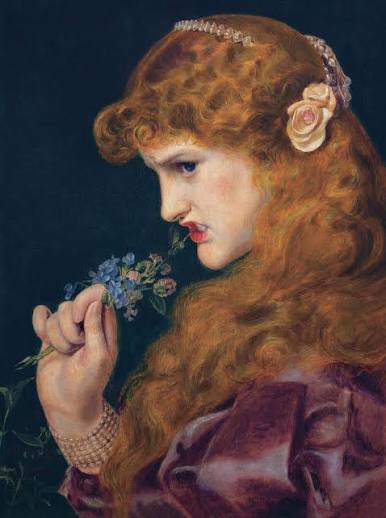
Frederick Sandys, Love’s Shadow
Wednesday
I’m currently in Slovenia for six weeks to teach courses on Shakespeare and Post-Colonial Literature at the University of Ljubljana. I’ll also be visiting various classes. I will report on my classes from time to time, something I used to do regularly when I was a full-time teacher. Yesterday I lectured on The Taming of the Shrew and Much Ado about Nothing.
Pairing the two works gave me new insight into both. I headlined the class “Sexual Attraction as Comic Combat,” explaining that sometime potential lovers fight because they fear the vulnerability that opening themselves to the other requires. In other words, they desire each other but fear getting hurt.
Battling lovers is at the heart of the romantic comedy genre, especially those films where the couple literally battle. I think of the screwball comedies of the 1930s (especially His Girl Friday) and, even more, films like War of the Roses, Roses, True Lies, and (my favorite) Mr. and Mrs. Smith.
Before we examined the two Shakespeare comedies, I provided the class with a theoretical understanding of why we laugh. I set forth three theories, starting with Thomas Hobbes’s grim notions. The author of The Leviathan, writing in an era that had seen civil war and the execution of a king, contended that we laugh because we seek to triumph over others. Laughter is aggressive, predatory and hostile—or as he put it,
a sudden glory arising from some sudden conception of some eminency in ourselves, by comparison with the infirmity of others, or with our own formerly.
Such laughter involves hitting down, targeting a scapegoat or mocking someone with a deformity. Although Hobbes doesn’t mention it, such laughter can often mask i.
The Earl of Shaftesbury in 1711 countered Hobbes with a far more benign theory. We laugh with rather than at, laughter functioning as social glue rather than combat. In Characteristicks of Men, Manners, Opinions, Times, Shaftesbury writes, “We polish one another, and rub off our Corners and rough Sides by this amicable Collision.”
Finally I mentioned Sigmund Freud’s theory in Jokes and Their Relation to the Unconscious (1905): We laugh to relieve anxiety, especially the tensions and anxieties built up by sexual repression (although relationships produce anxiety even without repression).
As I mentioned in a recent post, Shakespeare borrowed the shrew-taming trope from ballads and folk tales. The reality could be dark, with society sometimes fitting shrews with bridles, dunking them, or parading them around in carts to be mocked. For an instance of Hobbesian humor, there was a 1580 English ballad entitled “A Merry Jest of a Shrewd and Curst Wife Lapped in Morel’s Skin for Her Good Behavior.” In it, a man beats his wife with sharp rods until she bleeds and then wraps her in the salted skin of a dead horse to intensify the pain of her wounds. By the end she is tamed.
Although one character mentions that Katharina should be carted rather than courted, she is not subjected to these particular measures. However, Pretruchio does employ techniques used by torturers, including sleep and food deprivation, public humiliation, and gaslighting. I shared the following instance of the latter with the class:
PETRUCHIO Come on, i’ God’s name; once more toward our father’s.
Good Lord, how bright and goodly shines the moon!
KATHARINA The moon! the sun: it is not moonlight now.
PETRUCHIO I say it is the moon that shines so bright.
KATHARINA I know it is the sun that shines so bright.
PETRUCHIO Now, by my mother’s son, and that’s myself,
It shall be moon, or star, or what I list,
Or ere I journey to your father’s house.
Go on, and fetch our horses back again.
Evermore cross’d and cross’d; nothing but cross’d!
HORTENSIO Say as he says, or we shall never go.
KATHARINA Forward, I pray, since we have come so far,
And be it moon, or sun, or what you please:
An if you please to call it a rush-candle,
Henceforth I vow it shall be so for me.
PETRUCHIO I say it is the moon.
KATHARINA I know it is the moon.
PETRUCHIO Nay, then you lie: it is the blessed sun.
KATHARINA Then, God be bless’d, it is the blessed sun:
But sun it is not, when you say it is not;
And the moon changes even as your mind.
What you will have it named, even that it is;
And so it shall be so for Katharina.
Over the past decade Americans have come to understand what it means to be gaslighted by a person in charge. How many have succumbed to DJT’s contention that he won the 2020 election?
The challenge for modern audiences is how to respond to Petruchio’s taming. Should we, like all the men in the play, applaud Katharina’s final admonition to her fellow wives:
Then vail your stomachs [lower your pride], for it is no boot [use],
And place your hands below your husband’s foot:
In token of which duty, if he please,
My hand is ready; may it do him ease.
How does Shakespeare feel? If he too enjoys the surrender, does that make him just a guy like all the rest? Is he playing to the mob? Fellow playwright Ben Jonson famously wrote that Shakespeare “was not of an age but of all time,” but this would make him just of an age.
My contention that Shakespeare surpasses all authors in capturing our full humanity comes into question with Taming. Did he only later become Shakespeare?
Modern renditions of the play, however, suggest that Katharina doesn’t entirely surrender, and I myself am willing to give Shakespeare the benefit of the doubt. She certainly soars above the small and petty men around her. She commands the stage the way another problematic creation, Shylock, commands the stage. Some modern productions have her and Petruchio giving each other a knowing wink, as if they are jointly playing the others. (If so, it’s a profitable collaboration as they emerge from the affair 22,200 crowns richer.)
More than demonizing forceful women, Shakespeare exposes male fragility. It’s a point made recently about rightwing men by Chris Hayes and Adam Serwer on Why Is This Happening? For all their macho posturing, the Pete Hegseths and Andrew Tates of the world whine incessantly.
The focus on male fragility was further brought home to me when I compared Taming with Much Ado. That play, as I’ll discuss tomorrow, revolves around men’s obsessive fear of being cuckolded. In the end, however, Shakespeare reveals these fears to be, well, much ado about nothing. Beatrice and Benedick realize they can have much more fun if they stop worrying about being stereotypical women and men and just enjoy each other. If Katharina and Petruchio are in on the joke together, then maybe they are discovering this as well.
The post Is Taming of the Shrew about Male Fragility? first appeared on Better Living through Beowulf.
https://betterlivingthroughbeowulf.com/is-taming-of-the-shrew-about-male-fragility/?utm_source=rss&utm_medium=rss&utm_campaign=is-taming-of-the-shrew-about-male-fragility
#malefragility #taming #shadowwednesday #shakespeare #hobbes #roses #fredericksandys #thomashobbes #shaftesbury #truelies
#rss #feeds #linksharing #qwibbit
Welcome to Robin Bates (Unofficial) spacestr profile!
About Me
Unofficial automated RSS/Atom links to Robin Bates's work on Original literature/culture commentary connects Beowulf with contemporary figures and includes poetry. Original work is credited at the source; follow the source links. Zaps support the independent feed operator, not the author.