Bodleian: Hebban olla vogala
"Hebban olla vogala" is not the name of a manuscript in the Bodleian Library of Oxford. It is part of a single line scribbled in the margin of a larger manuscript. In 1933, Kenneth Sisam, professor of Anglo-Saxon linguistics at Oxford, looked at a probatio pennae that had been jotted down on a manuscript page sometime before 1100. The manuscript was from St. Andrew's Church in Rochester, Kent. (Some trivia: one of Sisam's students was J.R.R.Tolkien.)
A probatio pennae is done to test a pen (see more here). This one was just a scribble. Although faded, this particular "test" is considered to be:
Hebban olla uogala nestas hagunnan hinase hic enda thu uuat unbidan uue nu
Directly above it is written a Latin translation:
(H)abent omnes uolucres nidos inceptos nisi ego et tu quid expectamus nu(nc)
which (to us) means:
All birds have begun nests, except me and you – what are we waiting for now?
Sisam recognized that 1) This was a line from a love song, and 2) it was not Old English, or (as originally assumed) Flemish, but instead was the earliest line in Old Dutch so far discovered. The line is not "pure" Old Dutch. The spelling suggests that the unknown monk working on the manuscript was likely from Flanders, working in Kent, and influenced by the Latin and Old English texts he was constantly copying.
The Dutch language was well-developed, but we have nothing of note earlier than this example.
The manuscript on which this "scribble" is found is a a collection of Old English sermons by Ælfric of Eynsham, who has been mentioned before, but not in great detail. Since it's sitting in the Bodleian, I think it's fair game to talk about these homilies and Ælfric next time. See you tomorrow.
https://dailymedieval.blogspot.com/2026/10/bodleian-hebban-olla-vogala.html
#hebbanolla #ollavogala #oldenglish #bodleian #olddutch #sisam #oxford #kennethsisam #kent #latin
#rss #feeds #linksharing #qwibbit
Bodleian: The Book of Glendalough
Two things may be said about the Book of Glendalough. One is that it resides in the Bodleian Library in Oxford. The second thing? That we don't know for certain where or what the Book of Glendalough is. Let me explain.
First let's look at the facts about the catalog entry known as MS Rawlinson B 502. It is a 166-page vellum manuscript that was composed between 1100 and 1130 CE in Glendalough in the County Wicklow. It is written in Middle Irish and latin, and has later notes added by owners and scholars. There are two parts to it: separate works that were bound together in the 1600s. Three different scribal hands can be detected. One of the scribes seems to have been the one designated "H," the same who wrote notes into the Book of the Dun Cow.
The subject matter of the first manuscript is the Annals of Tigernach, a history of early Ireland. The second manuscript includes religious poems, a revised edition of a history called "The Six Ages of the World," and a poem called a "Song for Columcille" (Columba), and more.
The reason for the uncertain identity? The Book of Glendalough was referenced by other manuscripts, with referrals to some of the texts that we find contained in MS Rawlinson B 502. But MS Rawlinson B 502's provenance and history are not carved in stone. Determining that this manuscript was the same Book of Glendalough that other manuscripts quoted has left room for debate.
Adding to the confusion is that the title "Book of Glendalough" (I am using the English translation of the Gaelic) was used to refer to what is now universally known as the Book of Leinster.
Taken at face value, the manuscript has been called "most important and most beautiful ... undoubtedly the most magnificent" of medieval Irish manuscripts by the 20th-century scholar Brian Ó Cuív. For more on the debate, you can read here (requires special access).
From the same century as the Book of Glendalough, tomorrow let us look at a true one-of-a-kind manuscript, the only known example in existence of the language Old Dutch, the Hebban olla vogala.
https://dailymedieval.blogspot.com/2026/10/bodleian-book-of-glendalough.html
#book #glendalough #bodleian #rawlinson #let #irish #countywicklow #middleirish #duncow #sixages
#rss #feeds #linksharing #qwibbit
#book
#glendalough
#bodleian
#rawlinson
#let
MedievalNotes2d
Bodleian: Cædmon's Hymn
Our first foray into the special medieval holdings of the Bodleian Library is Cædmon's Hymn.
Bede wrote that Cædmon was an illiterate man in the late 7th century who cared for the cows at what is now Whitby Abbey. One night, in a dream, he was approached by "someone" who asked him to sing about the beginning of the world. In the dream he first refused, then did create a poem.
When he woke up the next morning, he wrote down the remembered poem. Taking it to Abbess Hilda of Whitby (658–80), it was declared a gift from God. They gave him a test to make a new poem, which he did so well that they had him join the abbey and take monastic vows. They taught him history and citrine, after which he would compose beautiful poems. (This was all in Anglo-Saxon.)
Cædmon's Hymn is considered the oldest surviving English poem, and one of the oldest surviving samples of Germanic alliterative verse. It is also the second most numerous of surviving manuscripts; there are 22.
The Bodleian Library has four manuscripts. One is from the first half of the 10th century, two from the mid-11th century, and one from the first quarter of the 12th century. (The illustration is Hatton 43, from the mid-11th.) Below is one translation (made in 2011 by American poet Harvey Shapiro):
Guardian of heaven whom we come to praise
who mapped creation in His thought's sinews
Glory-Father who worked out each wonder
began with broad earth a gift for His children
first roofed it with heaven the Holy Shaper
established it forever as in the beginning
called it middle kingdom fenced it with angels
created a habitation for man to praise His splendor
Tomorrow we will look at the Book of Glendalough, from pre-Norman Ireland.
https://dailymedieval.blogspot.com/2026/10/bodleian-cdmons-hymn.html
#bodleianlibrary #hymn #whitby #abbesshilda #abbey #harveyshapiro #holyshaper
#rss #feeds #linksharing #qwibbit
The Bodleian Library
The Bodleian Library in Oxford is actually not from the Middle Ages. It was founded in 1602 by Sir Thomas Bodley (1545 - 1613), an English diplomat and scholar. What he accomplished, however, was the salvation of what had existed in the Middle Ages.
The first library at Oxford was a collection of books left by Bishop Thomas Cobham of Worcester (died 1327). Those books were chained to tables for research, not for lending.
Between 1435 and 1437, the brother of King Henry V, Humphrey, Duke of Gloucester, donated 281 manuscripts. The space where Cobham's books were stored was too small to accommodate the influx of material. A room above the Divinity School was built (finished in 1488) to store them all. That space is still known as Duke Humfrey's [sic] Library.
The Reformation (1550) saw the ruin of the library (not the building) in order to destroy any vestige of Roman Catholicism. Some books were removed by sympathetic people and hidden to keep them safe. The furniture was removed in 1556. Only three books from the original collection are there now. One was re-acquired only in the last few years.
Thomas Bodley began the restoring of Duke Humfrey's in 1598. Over the next decades, two wings were added, the east wing (Arts End) and west wing (Selden End), creating an "H" shape. It contains collections of art, maps, music, theology, and Western manuscripts.
Now there are five buildings that comprise the Bodleian, with off-site storage near Swindon. Its catalog includes over 13,000,000 items, the second largest collection in England after the British Library. It is one of a handful of "legal deposit" libraries (the British Library is another) to which a copy of all published works must be given.
Although he had access to wealth through his wife and father, Bodley recognized that donations would be needed to maintain the library, and he created the idea of a Benefactors' Book that would record every donation and be kept on display. In it we can see that Sir Walter Raleigh donated £50 in 1603, and Francis bacon donated a copy of his book The Advancement of Learning in 1605.
Tomorrow I'll tell you about some of the medieval works that exist inside the Bodleian.
https://dailymedieval.blogspot.com/2026/10/the-bodleian-library.html
#bodleianlibrary #middleages #britishlibrary #thomasbodley #dukehumfrey #thomascobham #bishopthomas #oxford #sirthomas #kinghenry
#rss #feeds #linksharing #qwibbit
Isaac of Nineveh
Isaac of Nineveh was a 7th-century Syriac Christian, born c.613 in eastern Arabia (Qatar), an area that spoke Arabic and Syrian. He was ordained Bishop of Nineveh in 676, but one record says he left that position not long after starting it. He is often referred to as Isaac the Syrian.
The reason may simply have been the desire to live the life of an ascetic. We are told he retired to a mountain in a province of Iran, and then joined a monastery called Rabban Shapur where he concentrated his energy on writing on Christian mysticism. It is said that his devotion to study was so great that at the time of his death he was nearly blind. (Of course, eyes naturally age as we grow older, and the invention of eyeglasses was centuries away.)
He wrote extensively on theology and asceticism. A later Syriac writer claimed that Isaac wrote seven volumes. They are discussed as three "Parts." The First Part was translated first into Greek and then into other languages. It is the best known of the Parts, and was translated into English in 1923. It is a collection of homilies whose number and order vary depending on which manuscript one reads.
The Second Part was unknown until 1983, when a British Syriac scholar was reading a manuscript in the Bodleian Library that had been donated by an Assyrian priest who had lived and preached in Flint, Michigan. It contain 41 chapters, but one of the chapters, entitled "Headings on Spiritual Knowledge," has 400 chapters of its own. It was identified by matching it with quotations in other early manuscripts that were known to be by Isaac. Since then, other manuscripts have been identified as version of the Second Part.
The Third part is only known by a 1903 copy of a 14th-century manuscript that has since been lost.
If other Parts still exist, they have not been identified.
Isaac's writings suggest the idea of universal salvation, that all human beings can and will be restored to a proper relationship with God. In his writings we find sentences that claim "God will not abandon anyone." and "There was a time when sin did not exist, and there will be a time when it will not exist." He offers an analogy:
As a handful of sand thrown into the ocean, so are the sins of all flesh as compared with the mind of God; as a fountain that flows abundantly is not dammed by a handful of earth, so the compassion of the Creator is not overcome by the wickedness of the creatures... If He is compassionate here, we believe that there will be no change in Him; far be it from us that we should wickedly think that God could not possibly be compassionate; God's properties are not liable to variations as those of mortals.
Isaac died c.700 in Umayyad Iran. He is considered a saint in the Church of the East.
The Bodleian Library (as no doubt many other major research libraries in the world) contains donations that have not all been examined closely. Treasures lie within. Let's take a look next time at the Bodleian, and especially at its precursors in Oxford.
https://dailymedieval.blogspot.com/2026/10/isaac-of-nineveh.html
#nineveh #isaac #secondpart #god #bodleianlibrary #syriac #syriacchristian #rabbanshapur #britishsyriac #iran
#rss #feeds #linksharing #qwibbit
#nineveh
#isaac
#secondpart
#god
#bodleianlibrary
MedievalNotes5d
Syriac
The Syriac alphabet is a set of 22 consonants; there are no vowels. It was created in the 1st century CE as an offshoot of cursive Aramaic.
Written from right to left, (and occasionally vertically), the vowel sounds were implied by context. In the 8th century, diacritical marks were introduced to represent vowel sounds.
There were three variations of the script, one of which, the oldest and classical version called "Estrangela" is shown here. As the oldest version, Estrangela does not usually adopt the diacritical marks, and is therefore "pure" classical Syriac.
Looking at the table here, one might notice the first letter, ālep̄, and say "Isn't that the vowel "a"? It is actually a glottal stop, so not the same. Just below it on the table, Waw is the consonant "w" but can create the sounds of "o" and "u" when spoken. Yöt on the second row is the letter 'y' but can also create a vowel sound for "I" and "e."
Across the Middle East, Syriac was a major vernacular, literary, and religious language. It ha also been called Edessan, the Mesopotamian, and Aramaic. It was the main language of the early Christian era. As Syriac Christianity spread, the language became known as far as India and China. By the end of the Middle Ages, it became less a daily language and more reserved for liturgical use.
Syriac is still around. In fact, you can order a book designed to teach it to children.
While it flourished, however, it was used by several major authors of the early era. Jacob of Serugh (c.451 - 521) composed hundreds of homilies in verse. The poet Narsai (c.399 - 502) was nicknamed the "Tongue of the East" for his writings that influenced East Syrian liturgical theology. Jacob of Edessa (c.640 - 708) created the first formal Syriac grammar and translated Greek philosophical works into Syriac.
Then there was Isaac of Nineveh, also known as Isaac the Syrian, whose Syriac writings on mysticism were so popular that they were translated from Syriac into Arabic, Ethiopic, and Greek. We'll talk about him more tomorrow.
https://dailymedieval.blogspot.com/2026/10/syriac.html
#syriac #east #syriacchristianity #estrangela #aramaic #middleeast #eastsyrian #greek #isaac
#rss #feeds #linksharing #qwibbit
The Elimination of Grief
After Muhammad's death, the Muslim world expanded its reach quickly. Within a century, its reach extended from modern-day Afghanistan and India in the east to the southern border of France (and all around the Mediterranean).
One result of this influence was the adoption of Arabic by Christian writers. Christian authors wrote explanations of their faith in Arabic to reach a wider audience.
The 11th-century Nestorian Archbishop Elijah of Nisibis was one of these, choosing to write several works in Arabic as well as other languages. His best-known is a history called Opus Chronologicum in Latin ("Work of chronology") and Kitāb al-Azmina in Arabic. He modeled it on the Ecclesiastical History of the 4th-century Eusebius of Caesarea. It includes information taken from works written in earlier centuries that are now lost. He also includes tables for calculating Persian and Syriac new years as well as Zoroastrian calendars.
A lesser-known work by Elijah that has survived is the Kitāb dafʿ al-hamm ("The Book of Elimination of Grief"). It blends Christian theology and Islamic ethical philosophy to offer practical and spiritual strategies for overcoming sorrow and anxiety.
Though Christian, Elijah shows a deep understanding of traditional Islamic thought. The work includes several quotations from the Hadith (the collection of Muhammad's sayings), and refers to the writings of early Islamic Sufi mystics.
The second chapter emphasizes the cultivation of gratitude to combat grief and anxiety. He advises the reader to actively appreciate divine blessings to counter the tendency of humans to lean toward despair.
The work, which survives today (though I cannot locate an English-language edition), is part of a tradition that started earlier with writers like the 9th-century al-Kindi.
Another work of Elijah's was a dictionary and grammar for learning the Syriac language, which was his primary language. Tomorrow, let's take a dive into something really different: Syriac.
https://dailymedieval.blogspot.com/2026/10/the-elimination-of-grief.html
#rss #feeds #linksharing #qwibbit
#rss
#feeds
#linksharing
#qwibbit
MedievalNotes6d
Elijah of Nisibis
Thank heavens for people in the past who took the time to write down what they knew—although, to be fair, we have very few means to independently verify the truth of what they wrote. The best we can hope for is to compare what they wrote to the records of others, examine as best we can at this remove what political or religious or personal motives they might have had, and then make a case for their truthfulness.
Elijah of Nisibis was a member of the Church of the East, which is also known as the Assyrian Church, or the Nestorian Church, or even the Babylonian Church. It was different from the Chalcedonian Church, from which modern Roman Catholicism (and therefore Protestantism) and Eastern Orthodoxy descend.
He was originally known as Elijah Bar Shinajah, meaning "Elijah, son of Šena." Šena was not his father, but a reference to a town near what is present-day Al-Zab, Iraq. Born in 975, he was ordained a priest in 994, made a bishop in 1002, and became archbishop of Nisibis in 1008.
A fulfilling life for him, certainly, but he is important to us because of his desire to write and explain, and his desire to have intellectual discussion with non-Christians.
His reputation extended not only among Christian scholars and theologians of his era but also Muslim mutakallimūn and intellectuals. This recognition stemmed not only from his profound knowledge spanning medicine, mathematics, philosophy, Arabic and Syriac philology, ethics, Christian theology, and Islamic Kalām, but also from his adeptness at enculturating his philosophical and theological doctrines within the Islamic world through the adoption of Islamic language and terminology. [source]
(The illustration is part of one of his works written in Arabic script.) While at Nisibis, he met with the Muslim vizier Abū al-Qāsim al-Maġribī for discussions on various topics of mutual interest, and to enable both to learn about the other's faith. The two remained in contact, and a few letters between the two from the following year exist.
The visits, from 15 to 29 July 1026, are called the "Seven Sessions." They were initiated by the vizier himself after he experienced a miraculous cure at the hands of a Christian monk. They were written up by Elijah and covered the following topics:
God's unity (because of the Trinity, Christianity was considered polytheistic and therefore "false")
Jesus's incarnation of two natures (divine and human)
Quranic support for considering some forms of Christianity as monotheistic
Logical and miraculous justifications for various Christian doctrines
Elijah's own profession of monotheism
Language, and considerations of its importance in theology
Christian perspectives on astrology, Islam, and the soul
Tomorrow I'd like to start exploring some of Elijah's writings. See you then.
https://dailymedieval.blogspot.com/2026/10/elijah-of-nisibis.html
#elijah #nisibis #church #christian #assyrianchurch #chalcedonianchurch #islamic #romancatholicism #easternorthodoxy #barshinajah
#rss #feeds #linksharing #qwibbit
The House Nicolas Flamel Built for the Living and the Dead in 1407
Built in Paris in 1407, the surviving house of the Parisian Bourgeois, Nicolas Flamel, offers an unusual glimpse into medieval housing, charitable foundations and the religious obligations of working people.
At 51 rue de Montmorency in Paris stands one of the city’s oldest surviving houses. Built in 1407, it is known as the House of Nicolas Flamel, the celebrated Parisian escripvain whose considerable fortune and charitable foundations eventually inspired the legend that he had discovered the secret of making gold.
Yet the house was not his private residence. Rather, it was one of several properties acquired and developed by Flamel following his marriage to Pernelle in 1368. Known as Le Grand Pignon, or the Great Gable, it was constructed to accommodate working people, combining housing with the religious obligation to remember the dead. What makes the building particularly interesting is that its medieval inscription survives, as do substantial parts of its fabric. Furthermore, eighteenth-century research into Flamel’s property transactions preserves details concerning the foundation and subsequent management of the house. This is not just any old house, but a building with a distinct history telling us about life in 15th century Paris.
A new building in the expanding city
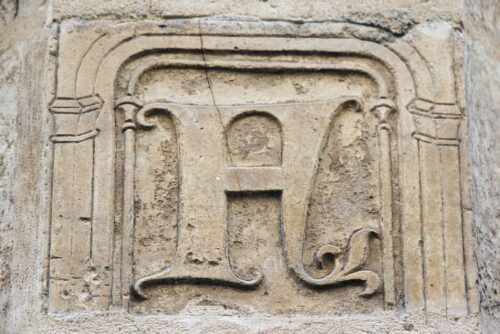
Monogramme af Nicolas Flamel. from the façade of the house at Rue de Montmorency. Sorce: wikipedia
In the early fifteenth century, the rue de Montmorency lay in an area of Paris that had developed beyond the older wall of Philippe Augustus and had subsequently been enclosed within the expanded city. The district was associated with the powerful priory of Saint-Martin-des-Champs, which retained important seigneurial rights over its properties.
Here, in 1406, Nicolas Flamel acquired property and negotiated with the monks concerning his proposed building. An agreement dated 17 November 1406 identifies him as “Nicolas Flamel, escripvain”. His plans involved the construction of charitable housing on land within the priory’s jurisdiction. The monks permitted the development, although the agreement restricted the establishment of an independent church or chapel. Flamel also undertook financial obligations towards the priory, including an annual rent. Already, at this point there is perhaps an indication that Flamel intended the building to serve as a hospital where the income in the form of rent from the ground-floor shops were redirected to pay for the infirm and poor people housed higher up. However, the backyard held a well, and some sources suggest this was also a local laundry.
The transaction is significant. Flamel was not simply distributing alms to the poor. He was actively acquiring, consolidating and developing urban property, negotiating with ecclesiastical landlords and incorporating his foundation into the legal, economic and pious structures of medieval Paris while at the same time trying to shore up his legacy.
A house for working men and women
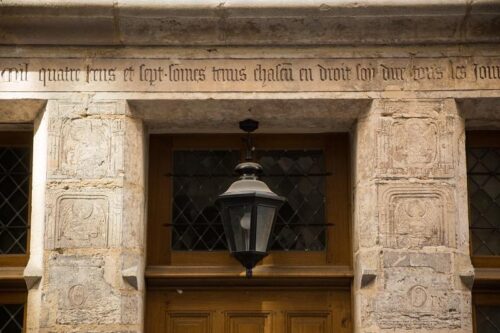
The building was completed in 1407, a date recorded in the inscription that still runs across its façade. The most remarkable feature of the house is this long inscription, carved in Gothic letters across the ground-floor façade, and which speaks in the collective voice of the occupants:
“Nous homes et femes laboureurs demourans ou porche de ceste maison qui fut faite en l’an de grâce mil quatre cens et sept, somes tenus chascun en droit soy dire tous les jours une paternostre et un ave maria en priant Dieu que sa grâce face pardon aus povres pescheurs trespasses, Amen.”
“We, working men and women dwelling beneath the porch of this house, which was built in the year of grace 1407, are each obliged, individually, to say every day an Our Father and a Hail Mary, praying that God, through His grace, may grant pardon to poor departed sinners. Amen.”
The wording deserves attention. First, the occupants are described as laboureurs. This need not mean agricultural labourers. In medieval urban usage, the term could encompass people who supported themselves by manual work. Accordingly, the inscription suggests a foundation intended for working people, rather than exclusively for the destitute, sick or elderly. Second, the obligation is explicitly religious. The inhabitants were expected to perform a daily act of intercession for the dead. In this respect, the building belonged to the wider economy of prayers, charitable gifts and commemorative services that characterised late medieval religious life. We may speculate – although there is no evidence – that the foundation was intended as a kind of beguinage such as the one nearby, called Sainte-Avoie. However, the inscription does not explicitly state that the inhabitants lived rent-free. This distinction becomes important when we turn to the later documentation.
Charity, rents and the business of housing
Inscription on Façade of house in Rude de Montmorency
In his Histoire critique de Nicolas Flamel et de Pernelle sa femme, published in 1761, Étienne-François Villain reproduced records concerning Flamel’s properties and foundations. Among them are accounts of the subsequent letting of rooms in the house at rue de Montmorency, including a series of rentals from 1446 to 1455.These records indicate that at least some occupants paid rent. One particularly revealing entry explains that a room ceased to be let at Midsummer in 1450 because it was too high up and too difficult to reach. This is a splendid little detail of everyday medieval life. Behind the solemn inscription and charitable intentions were tenants, stairs, practical inconveniences and the ordinary difficulties of managing a multi-storey urban building.
This evidence also invites a reconsideration of its charitable function. The building may have begun as a foundation intended to accommodate people on favourable terms, with prayers forming part of their obligations. However, by the middle of the fifteenth century, at least some accommodation was being administered through a system of rents. Whether this represented a change in the original arrangements, or whether charitable housing and rental income had coexisted from the beginning, remains uncertain. Indeed, the distinction between charity and investment may itself be misleading. Medieval foundations frequently combined the provision of accommodation, the generation of income and the financing of charity with obligations to perform religious services. The dilemmas involved in this balancing of charity and financing surface directly in a provision in the testament of Nicolas Flamel where he grants his tenants twenty sous parisis each, either as alms or as a reduction in their rent.
Inside the medieval house
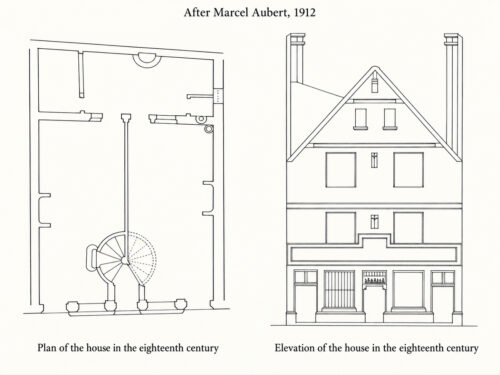
Plan from the 18th century of House of Flamel. Source Aubert 1912
Although at present a near-empty shell, the surviving structure also provides evidence of domestic architecture in late medieval Paris having been repeatedly studied by arthistorians and archaeologists.
Already in 1912, the architectural historian Marcel Aubert examined the building and described its interior organisation in considerable detail. He tells us how the ground floor contained two large rooms separated by a longitudinal partition. Heavy transverse timber beams supported the ceilings, resting on stone corbels and a substantial square support. Similar structural arrangements continued on the upper floors. At the rear was a narrow courtyard, where traces of a former well could still be recognised. Beneath the house were two barrel-vaulted cellars, reached by a staircase from the rear courtyard. Also, it appears that there were three doors into the house from the street. On either side of the middle door, the doors and windows opened up to workshops, while the door in the middle gave access to a spiral staircase leading up to the upper floors.
Also, Aubert describes how its original appearance differed from that of the present structure. The great gable that gave Le Grand Pignon its name thus disappeared during the eighteenth century, when alterations changed the profile of the roof and upper storey. Nevertheless, the surviving stonework, together with Aubert’s observations, preserves important evidence of its original construction. The façade was classified as a French monument historique on 23 September 1911. Importantly, the legal protection applies specifically to the façade rather than automatically to every part of the building.
Medallions with angels playing musical instruments. From Aubert 1912
A façade covered with prayers and images
House before restauration.Postcard, late 19th century.
The inscription above was only one element of an elaborate decorative scheme. The stone uprights of the ground-floor openings bear carved figures, religious symbols and Gothic lettering. Among the sculptures are angels playing musical instruments, while other carvings appear to contain devotional messages. Aubert identified the letters of the phrase Deo gratias, as well as other fragments of religious inscriptions. He also drew attention to a small hand associated with the principal inscription, which he interpreted as a possible personal sign of Flamel. One figure, wearing a distinctive headdress, has occasionally been interpreted as a portrait of the founder. However, this identification remains conjectural.
What matters more is the overall conception of the façade. The building addressed the street through a programme of religious images and written obligations. Its decoration made the charitable foundation visible to passers-by, while reminding the inhabitants of their duty to pray. In this, the decoration aligns well with what we know of Flamels own private home in the Vie Ecrivain.
It appears, the prayers were intended to last forever. The tenants, meanwhile, still had to climb the stairs and pay their rent.
SOURCES AND NOTES
Étienne-François Villain, Histoire critique de Nicolas Flamel et de Pernelle sa femme (Paris, 1761), particularly pp. 143–157, with further rental documentation elsewhere in the volume.
Marcel Aubert, “La maison dite de Nicolas Flamel, rue Montmorency, à Paris”, Bulletin monumental 76 (1912), pp. 305–318.
READ ALSO
Lucien Lambeau, “La maison de Nicolas Flamel, située rue Montmorency, 51”, La Cité 17 (1918), pp. 126–143.
Catherine Brut and Valentine Weiss, “La maison de Nicolas Flamel, la plus ancienne demeure conservée de Paris”, Les Dossiers d’archéologie 371 (2015), pp. 50–54.
The post The House Nicolas Flamel Built for the Living and the Dead in 1407 appeared first on Medieval Histories.
https://www.medieval.eu/the-house-nicolas-flamel-built-for-the-living-and-the-dead-in-1407/
#nicolasflamel #housenicolas #dead #paris #parisianbourgeois #montmorency #rue #grandpignon #greatgable
#rss #feeds #linksharing #qwibbit
Medieval cities, manuscripts, strange histories, and scholarly rabbit holes. Fan-run automated RSS; source rights retained. Not affiliated; tips support this feed.